




After years of debate, the Alberta government’s decision to table legislation to get rid of the twice-a-year time change and permanently adopt daylight time is being welcomed by many Albertans.

“I think it just is a bit easier, you know, changing the clocks. I feel like also that first day where you’re kind of thrown off from the time change, it’d be nice to get rid of that,” said Calgarian Camisha Rahmatian as she made her way to work during the Tuesday morning rush hour.
“Honestly, the time change has always been really hard for me. I struggle with seasonal depression. So it’s like the long hours, it’s just it’s not a good time. I really don’t enjoy the time change. I don’t think it gives us any more daylight and I think it just screws up everybody’s schedule,” added Calgarian Abbey Rodgers.
On Monday, the Alberta government confirmed it will be tabling an omnibus bill in the legislature later this week to get rid of the controversial time changes.
The decision is being made despite Albertans voting to keep the time changes in a provincial plebiscite five years ago, by a very narrow margin — 50.2 per cent to 49.8 per cent.
However, the government of British Columbia’s decision to get rid of the time changes this spring, along with Saskatchewan staying on central standard time year-round, prompted Alberta to reconsider the idea.
“We’re squished in between two provinces who no longer change their clocks,” said Service Alberta Minister Dale McNally. “So the facts on the ground have changed, and so we have to make a decision accordingly.”
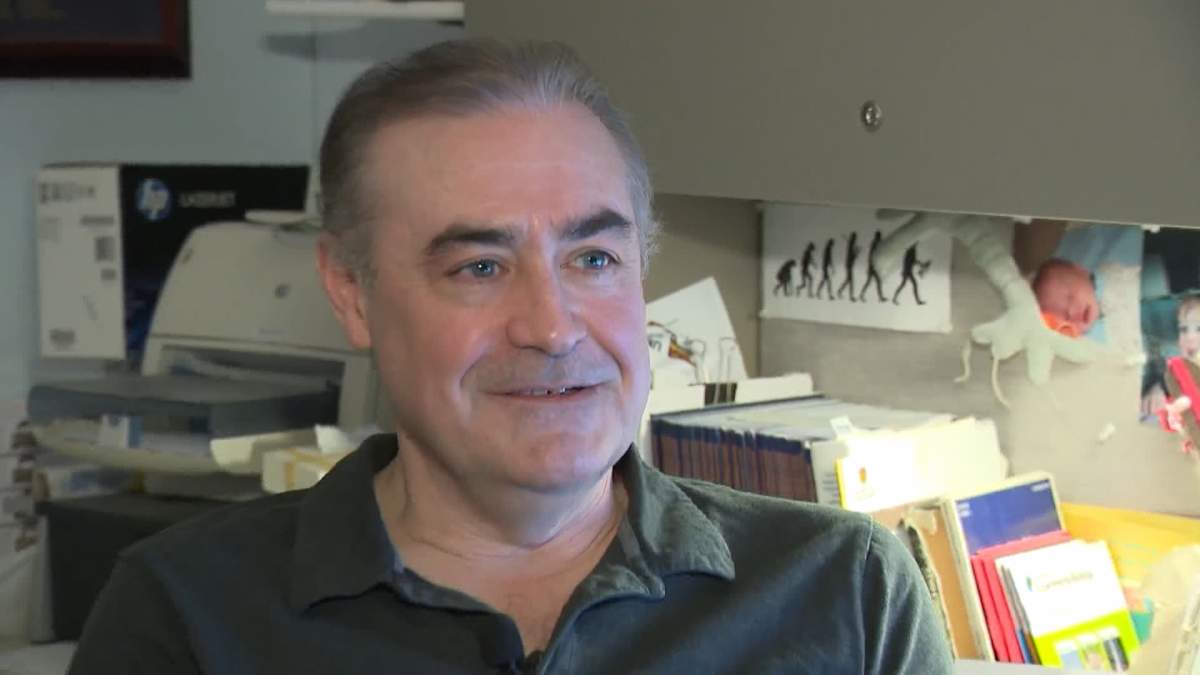
Michael Antle, head of the Department of Psychology at the University of Calgary, has been studying the circadian rhythm — the human body’s 24-hour internal clock and how it reacts to changes in sleep, light and other changes in the environment — for 30 years.
“There is acute harm in the spring when we change our clocks,” he says. “We all now have to get up an hour earlier and your body doesn’t want to do that. Your circadian clock has been following the sun and now you’re getting up before sunrise for a few weeks and that’s hard.”

Get weekly health news
“We know that there’s increased rates of car accidents, on-the-job accidents, but generally people feel tired and grumpy and they don’t like that time change,” added Antle.
He says getting rid of the time change will mean both sunset and dawn will happen later in the day.
While he says that won’t be a problem in the summer, it will make a difference during the winter.
“Because we live so far north, we have these really short winter days and the sun rises late and it sets early in the winters. So the more natural standard time is what people have really stuck with throughout history because we need that morning light. The body does not like getting up before dawn on those short days, and unfortunately, moving to daylight time year-round is going to push our dawn an hour later,” said Antle.

“So in places like Calgary, the sun won’t rise until 9:30 in December, and in other places in the northern or western part of the province (like) Edmonton and Grand Prairie, it’ll be closer to 10 or 10:30 in the morning in December before they see the sun.”
Antle says it means many people living in the northern parts of Alberta will be going to work in the dark for about five months a year.
“It’s going to be really hard. A few places have tried it. Russia tried this in 2012, and they have about the same latitude as Canada. What they found in Russia in 2012, when they went to permanent daylight time, was an increased rate of mental illness, particularly amongst the youth. So rates of depression, seasonal depression went up. After two years of that experiment, they switched to standard time year-round and they’ve been on standard time now for the last 12 years. And those rates came back down, so the mental health improved in the population,” said Antle.
He says it will be important for the province to monitor the impacts of the change for the next few years, and have “some kind of exit strategy.”
In a similar experiment in the United States in the early 1970s, Antle says the country “bailed halfway through the experiment.” In another three-year experiment in the United Kingdom in the 1960s, they eventually went back to changing their clocks twice a year.

Antle says the human circadian clock needs to be reset on a daily basis and sunlight is the cue that does that, which is why morning sunlight is so critical for most people.
“One of the things I’m going to have a talk with here at the university is class times. The 8 a.m. courses are really hard for our students, and the 9 a.m. courses are going to be the new 8 a.m., and those 8 a.m. courses are going to feel like 7 a.m.”
“We don’t want our students finishing the first class before the sun comes up, so we may have to talk to the administration here about adjusting our timetable, our exam schedules,” Antle added.
However, a spokesperson for the government of Ontario said Tuesday that residents of the province will continue to spring forward and fall back.




What we should have is “STANDARD” time not daylight time. I don’t understand why humans always want to mess with nature, it bites us in the butt every time we do. The referendum had the choices of switching time or daylight savings time, why were we not given the obvious choice of Mountain STANDARD Time?
Stunning how human beings existed and thrived for 300,000 years without “acute harm” from not having daylight savings time… or clocks for that matter.
What a clown.
What is wrong with going back to Mountain Standard Time permanently?
Humanity managed long before time zones were a thing. I’m pretty sure we’ll be just fine.
I have to wonder if that uni head psychologist is paid to complain. Most of us get up and go to work well before dawn year round.
4 – 4 months out of the year, we fall back. I am happy to just stay on Daylight time. This last time change wrecked me for the last month. I don’t ever want to change our clocks again.
Please report more on the decision to stay on daylight savings time vs central standard time. Research does not support daylight savings time, why aren’t we choosing central standard time.
Who on this planet can wait until dawn to get up. I am up at 4am, getting ready (shower etc) and quick bite out the door at 5am, drop wife off at 5:30am then on to my work for 5:45am (I start at 6:00 but prefer to be early) i work in a windowless box so i only get daylight when i leave. Permanent daylight time is works great for me and i am sure based on the traffic it work great for many others
Saskatchewan never had a sunlight problem. Stop making problems up.
When people in Alberta and BC were polled some years ago they were NOT GIVEN the opportunity to choose to stay on Standard time, it was not an option. It is ridiculous that they refer to a vote where the options were not offered and disappointing that the media fails to point this out.
Seems Albertans are asleep.
So why won’t they just vote on other things such as the referendums they are bringing in few months.
UCP is worse then plague.
Actually at the last poll, Albertans told the UCP government that we do not want permanent Daylight savings time. – quit with the disinformation.
Smith was too afraid of the outcome if she asked if we wanted permanent Mountain Standard Time.
So they are ignoring Alberta wishes, and choosing the option that will harm us the most. – SOP
Ron and Pete. Do proper research… You are right, the experts that Global uses are university hacks. The medical experts are out there, with proof.
Yes we know ‘experts say’ millions will die from Alberta’s daylight savings time changes. I am tired of these so called experts that the media quotes.
Serious health impacts? Utter rubbish, suck it up and get on with with. Bunch of whining willies.