


B.C. is set to lead or be near the top of national job growth in 2017, if you ask the provincial government.

But that stat obscures a longer-term trend that bodes ill for the quality of employment on the West Coast, said a report from CIBC Economics this week.
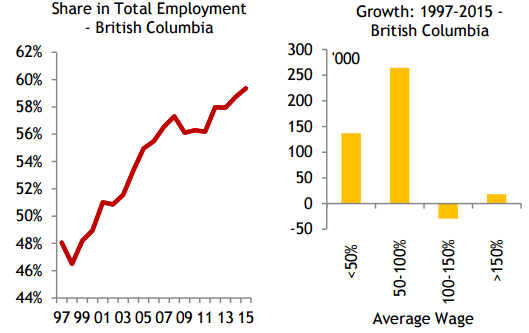
It showed that B.C. has actually led Canada in the growth of below-average wage work over the past two decades.
The report, titled “On the Quality of Employment in Canada,” was part two of a study published in November.
The conclusion? Quality jobs in B.C. and across Canada have been steadily disappearing over the past 20 years, deputy chief economist Benjamin Tal wrote.
“Is the quality of employment in Canada in decline? We think so,” he said.
When Tal talks about “quality employment,” he means higher-paying, full-time jobs.
The first part of his note said part-time work as a share of total employment has grown since the financial crisis. Low-paid full-time jobs are also growing faster in low-paying sectors than they are in high-paying industries.

Tal arrived at this conclusion by looking at indicators such as part-time vs. full-time work, self-employment vs. paid employment and the compensation of full-time jobs in over 100 industry categories.

Get weekly money news
And B.C.’s employment quality is worsening faster than anyone else’s, when you consider below-average wage work as a share of employment.
READ MORE: Canada’s best cities for full-time jobs
Tal found that the share of workers being paid below the average wage in the province grew from 48 per cent in 1997 to 60 per cent in 2015, for total growth of 12 percentage points.
The average wage in 1997 was $16.91 per hour. In 2015, it was $24.98.
B.C. doesn’t have the highest share of workers making below-average money — that’s Quebec, where 66 per cent of workers made below the average wage of $23.56 in 2015.

-
![]() Rona Ambrose says jobs are lost to Mexico because Canada is uncompetitive
-
![]() Ambrose welcomes Biden to Canada; asks Trudeau what he’s doing to help Canadians get jobs
-
![]() Trudeau says CETA will grow jobs and increase wages in Canada
-
![]() Obama discusses relationship between US, Canada; partnership in creating jobs
-
![]() Bombardier to eliminate 7,000 jobs, announces deal with Air Canada


But no province has seen faster growth in this area; Quebec’s below-average wage jobs have only grown about half as fast as B.C.’s have.


The most significant job growth in B.C. happened in the range of people making between 50 and 100 per cent of the average wage – so that’s workers making $12.49 to $24.98 per hour.
The next-strongest growth came in the cohort of workers making less than 50 per cent of that wage – less than $12.49 per hour.
READ MORE: Canada’s worst cities for full-time jobs
Of course, B.C. isn’t alone among provinces that have seen their share of below-average wage workers grow since 1997.
Below-average money as a share of employment is growing right across Canada.

Tal’s report joins a growing body of research that paints a tough picture for Canadian employment.
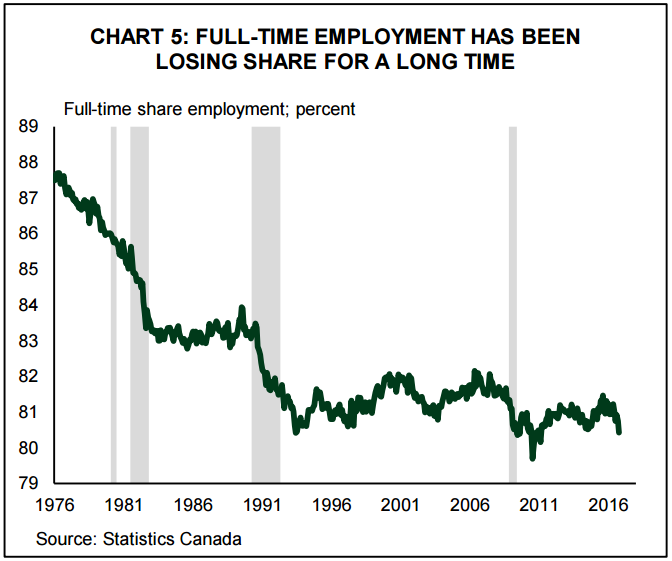
Last month, TD released a report showing that full-time work has been falling as a share of employment since the 1980s.
More recently, Desjardins released a study showing that, while Canadian employment rebounded in the last few months of 2016, much of the growth was in the service sector, and the bulk of new jobs were part-time.
Employment growth at the tail end of last year should “open the door to an ongoing uptrend in employment for the months to come,” it said.


Comments
Want to discuss? Please read our Commenting Policy first.