


At the auto dealerships in southwestern Nova Scotia, it’s not unusual for a fisherman to mark the purchase of a new truck by presenting the successful salesman with a fresh lobster.

Claude Bourgeois, sales manager at Tusket Ford, has been eating a lot of lobster lately.
READ MORE: Lobster season off Nova Scotia closes with high prices, good catches: fisherman
“It’s hard to stay slim,” jokes Bourgeois, who says sales in August were the highest they’ve been in six years — thanks to the booming lobster industry.
“We are definitely selling more trucks. It doesn’t matter if it’s us or Dodge or Chev. They all seem to be doing pretty well right now … There doesn’t seem to be as much price negotiations. The (fishermen) are buying high-end.”
And it’s not hard to see why.
The industry across the Maritimes moved into high gear last year, and has gained momentum since. Amid growing demand for the tasty crustaceans, fishermen have been hauling in record catches that are commanding the highest prices in more than a decade.
Aside from $65,000 trucks, the fishermen are also buying new boats — if they can.
“The order books are full and many yards are booked for a couple of years out,” says Tim Edwards, executive director of the Nova Scotia Boatbuilders Association. “They’re busier than they’ve been in at least 10 years, maybe 12.”
Part of the reason why boatbuilders can’t keep up is a growing demand for longer, wider, more complex boats, typically worth between $500,000 and $750,000.
READ MORE: N.B. lobster fishermen say catches are down in Northumberland Strait
The latest generation of vessels include so-called live wells designed to carry lobster in freshly circulated seawater. The tanks keep the lobsters healthy, which means they’re worth more at the dock.
These fishing boats, which can travel farther and carry more, can’t be built fast enough, Edwards says.

Get weekly money news
“It’s a nice situation for the industry right now.”
The market for lobster has been getting a boost from the weak Canadian dollar, growing demand from China and a shift in consumer tastes toward processed meat in everything from lobster rolls to lobster macaroni and cheese.
Is Beyonce responsible for lobster boom?
And then there’s the “Beyonce Bounce.”
In February, U.S.-based seafood chain Red Lobster said its sales surged 33 per cent on Super Bowl Sunday, a boost attributed to the Beyonce song “Formation,” which alludes to her taking a man to Red Lobster after sex.
READ MORE: Red Lobster enjoys sales surge after mention in Beyonce song
Lobsters are so hot they’re being stolen: A trailer loaded with frozen lobster was stolen from a processing plant in Grand Anse, N.B., in July, six months after more than 2,100 kilograms of premium-grade lobster were stolen from an ocean pen near Cape Sable Island, N.S.
In P.E.I., fishermen are currently getting about $6.75 a pound for fresh, market lobsters. That’s a long way from the $3 per pound they were getting during the global economic meltdown in 2008-09.
Earlier this spring, when supplies were running low, lobsters from P.E.I. were fetching $8.50 per pound at the wharf, says Craig Avery, president of the 1,300-member P.E.l. Fishermen’s association.
“There’s good incomes, good catches and good prices,” he says. “All of those things are driving people to go out and get new equipment. They’re spending their money. Everybody is a winner.”
Avery, a lobster fisherman for 40 years, says the weak Canadian dollar has helped boost exports to the United States – where 80 per cent of Canada’s lobsters are sent – and a determined effort to entice Asian consumers is also paying off.
“Our association has spent a lot on marketing,” says Avery, who has been to China three times on trade missions. “You’ve got over a billion people there. It’s really pushing up demand.”


China selling East Coast lobster online
Earlier this month, Prime Minister Justin Trudeau clutched an East Coast lobster for a photo op in China to promote the fact that the Alibaba Group – China’s online equivalent of Amazon.com – is now selling Canadian lobsters through its e-commerce website.
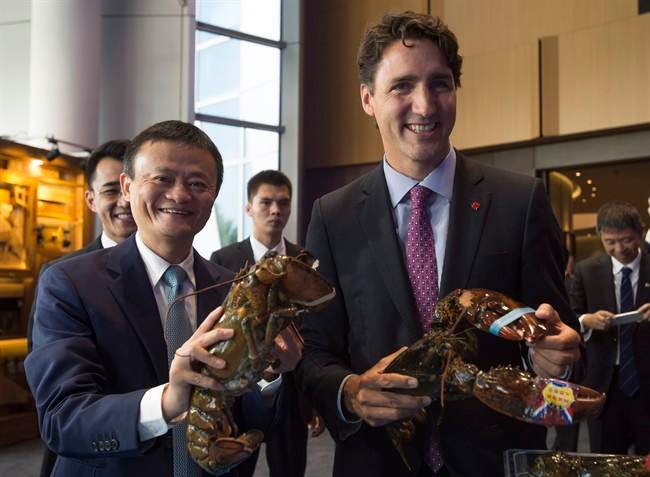
“China has been the main improvement in the market,” says Bernie Berry, president of the Coldwater Lobster Association.
However, there are stormclouds on the horizon, says Berry, whose group represents Lobster Fishing Area 34 (LFA 34) in southwestern Nova Scotia – the biggest producer of lobster in Canada.
Earlier this month, the European Union announced it would again review a proposal from Sweden to ban lobsters from the U.S. and Canada because they are considered an invasive species. Canada and United States typically export about 30 million pounds of live product to Europe every year, says Berry.
“God forbid if we lost that market,” he says. “Thirty-million pounds. You don’t just snap your fingers and relocate.”
The lobster business remains the most lucrative fishery in Canada, producing almost $1 billion in commercial landings in 2014. The 10,000 licensed enterprises in Quebec and the Atlantic provinces employ about 30,000 harvesters.
In 2015, 82,700 metric tonnes of Canadian lobster was exported, generating $2.03 billion in revenue, according to federal figures.
Berry says the 950 lobster licence holders in LFA 34 are looking forward to a banner season, which opens next month in some areas.
The more than 3,000 fishermen and deckhands in the area scooped up about 60 million pounds of lobster last year at prices averaging between $6.60 and 6.70 per pound, generating about $400 million in landed value, he says.
“Everybody’s happy,” says Ashton Spinney, a longtime lobster fisherman and co-chairman of the lobster committee for LFA 34.
“There’s a lot of new equipment and everything is busy, busy. The economy is healthy. That’s what we want. When fishermen make money, they spend it.”



Comments
Want to discuss? Please read our Commenting Policy first.