


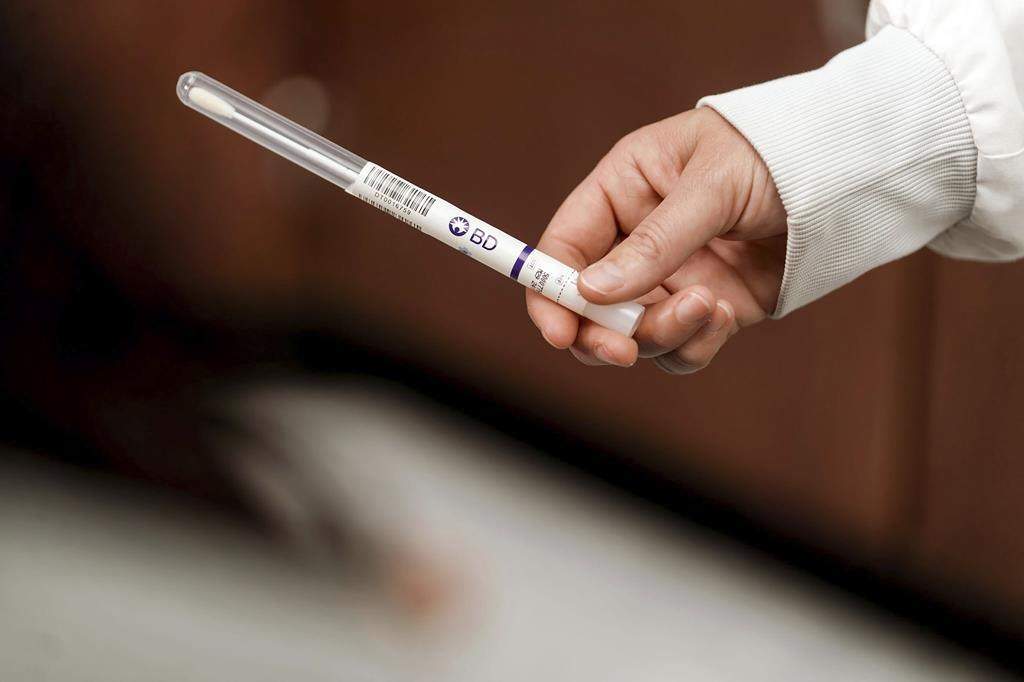
Nova Scotia’s Official Opposition is calling on the province to quickly adopt HPV testing for cervical cancer and transition away from the traditional Pap test — a move that other provinces, including New Brunswick, have already made.

In response, the Nova Scotia government says it is moving towards that goal, but work needs to be done to ensure equipment, labs and specialists are ready.
“Women deserve better care, more comfort, more convenience, less stress, better outcomes,” NDP Leader Claudia Chender told reporters Thursday.
“Switching to HPV tests to screen for cervical cancer is less invasive, less expensive and it is better at detecting the disease. This can be done at home or in a doctor’s office. And since the test is required only every five years, it frees up important medical resources and health-care workers.”

Pap and HPV tests both require a cell sample through a vaginal swab. HPV tests can be done at home and are less invasive, which means women can self-collect.
Chender said making the switch would help 300,000 Nova Scotians who require Pap tests and cervical cancer screening.
Provinces that have turned to HPV for primary screening for cervical cancer include Prince Edward Island, British Columbia, Ontario, Alberta and Quebec.

Get weekly health news
New Brunswick announces switch this week
Neighbouring New Brunswick announced Wednesday it is joining that list and is transitioning from the Pap test to the HPV test as a “primary method” for cervical cancer screening.
Health-care providers will perform the test in their office or clinic.
As well, New Brunswick is developing an at-home HPV self-sampling option for cervical cancer screening, which is expected to be implemented next year.
“The research is clear: early detection of cancer can help save lives,” said New Brunswick Health Minister John Dornan in a news release.
“By transitioning to HPV testing, we are improving our ability to identify individuals at risk of cervical cancer earlier, which is essential for prevention. This change ensures that New Brunswickers have access to the most accurate, efficient and effective screening available.”
According to the New Brunswick government, implementing HPV testing will align with the World Health Organization (WHO)’s goal of eliminating cervical cancer worldwide, as well as the federal government’s action plan to eliminate the cancer by 2040.
“Switching to HPV testing represents a vital step forward in the fight against cervical cancer,” said Dr. Eshwar Kumar, medical officer at the New Brunswick Cancer Network, in the release.
“This approach allows us to pinpoint high-risk individuals earlier and implement the preventative care needed to save lives, giving New Brunswickers the best chance for long-term health.”
‘Just a no-brainer’
Chender said Nova Scotia’s government has missed the mark by being slow to transition away from Pap tests.


“I’m really happy for women and gender diverse people in New Brunswick, but I am just dismayed at this government’s approach to ensuring that everyone can actually access basic routine health care and screening,” she said.
“Since 2020, Nova Scotia has had some of the highest rates of cervical cancer in Atlantic Canada. And considering that early detection is possible, there is simply no excuse for this.”

Nova Scotia gynecologic oncologist, Dr. Robert Grimshaw, agrees now is the time to act.
“(HPV testing is) an easier, cheaper test. It gives better results, and it allows us to do at-home testing for women in the privacy of their own homes and get every bit as good a result as provider-performed tests,” he said.
“And to me, it’s just a no-brainer that we need to be doing that.”
Nova Scotia says it’s ‘working toward’ making the change
Nova Scotia’s Department of Health and Wellness told Global News it is “working toward HPV testing as the primary method of cervical cancer screening” and that work is underway to understand what’s required to make the change.
“We acknowledge that other provinces are more advanced in this area, and we’re learning from their experiences,” the department said in an email.
“Making this change involves more than switching from one test to another. We need to ensure the right laboratory capacity, equipment, technology, specialists, and patient follow-up systems are in place so people are supported from screening through to any additional care they may need.”
— with files from Skye Bryden-Blom


Comments
Want to discuss? Please read our Commenting Policy first.