


Alberta Premier Danielle Smith is defending a proposal to redraw provincial boundaries in a way the Opposition NDP says is cheating.

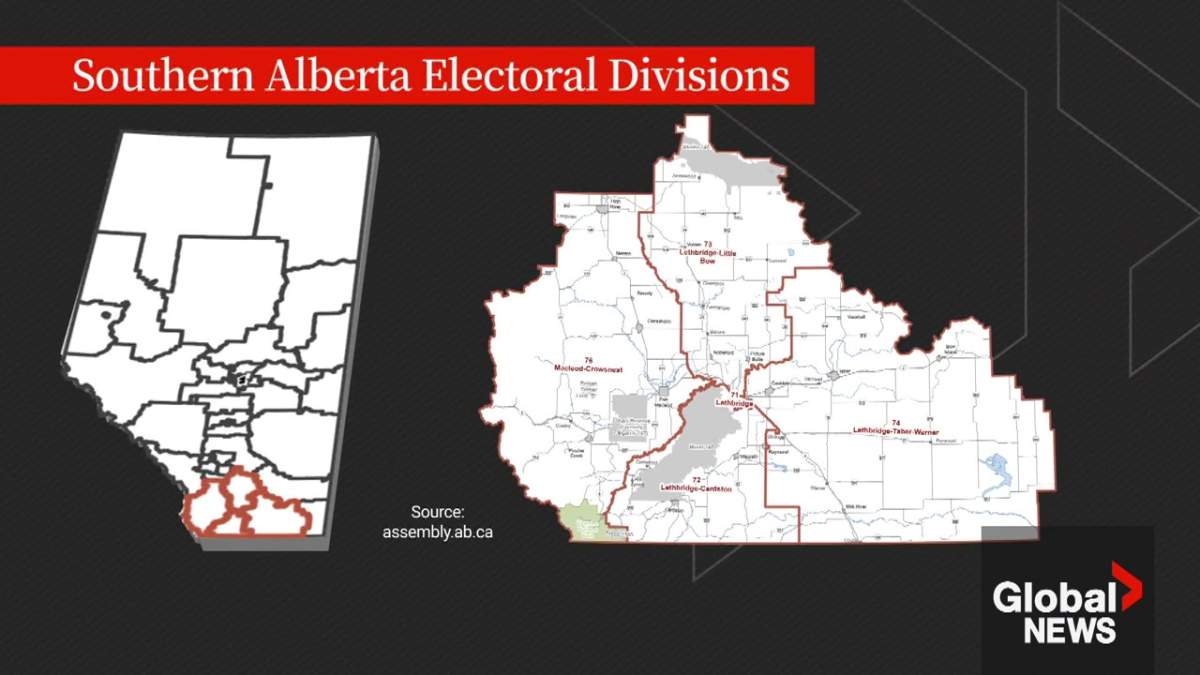
The proposal, made public in a report on Monday, would split the southern city of Lethbridge into four ridings from its current two. It would have one strictly urban riding while the other three would see some neighbourhoods linked to sprawling adjacent rural areas.
Smith told reporters at a conference of rural municipal officials in Edmonton on Tuesday that so-called hybrid ridings like those being proposed in Lethbridge are accepted practice and work elsewhere in the province.
“I think Lethbridge would be very well served by having four representatives,” Smith said.
The premier, who said she was to be briefed on the report later Tuesday, added that she currently represents a hybrid riding in Brooks-Medicine Hat.
“They might not make sense in all circumstances, but they certainly do in some.”
The Opposition NDP has said many changes suggested in the report — including additional hybrid ridings proposed for the battleground on the west side of Calgary — are designed to give Smith’s United Conservatives an unfair advantage heading into the 2027 election through a process known as gerrymandering.

Get breaking National news
Gerrymandering, a feature of politics in the United States, sees electoral districts drawn up to match voting patterns to favour one political party.
NDP Leader Naheed Nenshi has promised to take the new ridings to court if they are approved by the legislature.
Smith said Tuesday her government will assemble a legal team if necessary to defend them. She said she couldn’t comment on how legal action could complicate next year’s election.
“I hope it doesn’t come to that,” Smith said of a legal challenge.
She said she hoped the issue could be settled through debate in the legislature, which is expected to begin soon.
- De Havilland getting up to $2.5B in federal financing to ramp up water bomber production
- Health-care advocate Dr. Paul Parks aims to unseat Alberta health minister
- Second Ontario ministry facing review over ‘inconsistencies’ in funding use
- Hydro-Québec projects deficit that could force it to rely on U.S. and other provinces
-
![]() Poilievre challenges Liberals to axe taxes on fuel ahead of federal budget
-
![]() N.B. reveals new strategy to become a bigger player in Canada’s defence sector
-
![]() HRM begins development work on Sandy Lake, advocates say N.S. hasn’t planned properly
-
![]() Canada advancing ‘middle power strategy’ with new trade pacts: Anand


The boundary redrawing process has been a controversial and complicated affair since the premier rejected the main recommendations of a public boundaries commission early this year when the commission came back with a split report.
Bucking political norms, Smith’s government voted down the commission’s majority position in the legislature and restarted the redrawing process with a new advisory panel. The report and proposals from this new panel are now before the legislature.
The new panel was given direction based on some recommendations from the previous commission’s chair, including expanding the number of ridings to 91 from 87 to preserve two rural ridings that were to be dissolved.
The advisory panel — which featured two appointees from both the UCP and the NDP as well as a UCP-appointed chair — were also split along party lines, and much of the report sees the two sides criticize one another.
The panel’s majority, in the report, does propose maintaining the two rural ridings that were to be eliminated, although with adjusted boundaries. It also sees Calgary gain two seats more than it currently has while one additional seat is added in Edmonton.


So when motley changed the boundaries it was democracy in action. When smith changes the boundaries it’s gerrymandering.
Nenshi is a huge cry baby.