


Michael Harrington never thought his art was something that would be subject to tariffs at the Canada-U.S. border.

The Ottawa-based narrative painter has been working with galleries and dealers to show and sell his work full time for roughly three decades. He said the industry has felt like a rollercoaster from the 2008 recession to the COVID-19 pandemic and now unprecedented tariffs on Canadian goods.
“Art, it’s always traveled without tariffs, without tax. It’s because art is so complicated, like what is art and what’s original art,” Harrington told Global News.
U.S. President Donald Trump’s tariff regime has become his biggest worry. As part of a new round of tariffs imposed at the end of April, a 50 per cent tariff now applies to a range of visual arts, crafts and natural materials made in Canada, including paintings. Other items that became subject to tariffs include drawings, original prints, original sculptures, jewelry, textiles and items made from raw furskins, leather, bone, horn and antler.
Harrington has held exhibitions in the U.S. before, but when he was offered the opportunity to do a show at a Boston gallery in November, he was especially excited to expand his reach. That was until he found out that someone would be on the hook to pay tariffs on each piece of art that crossed the border, even before it was sold.
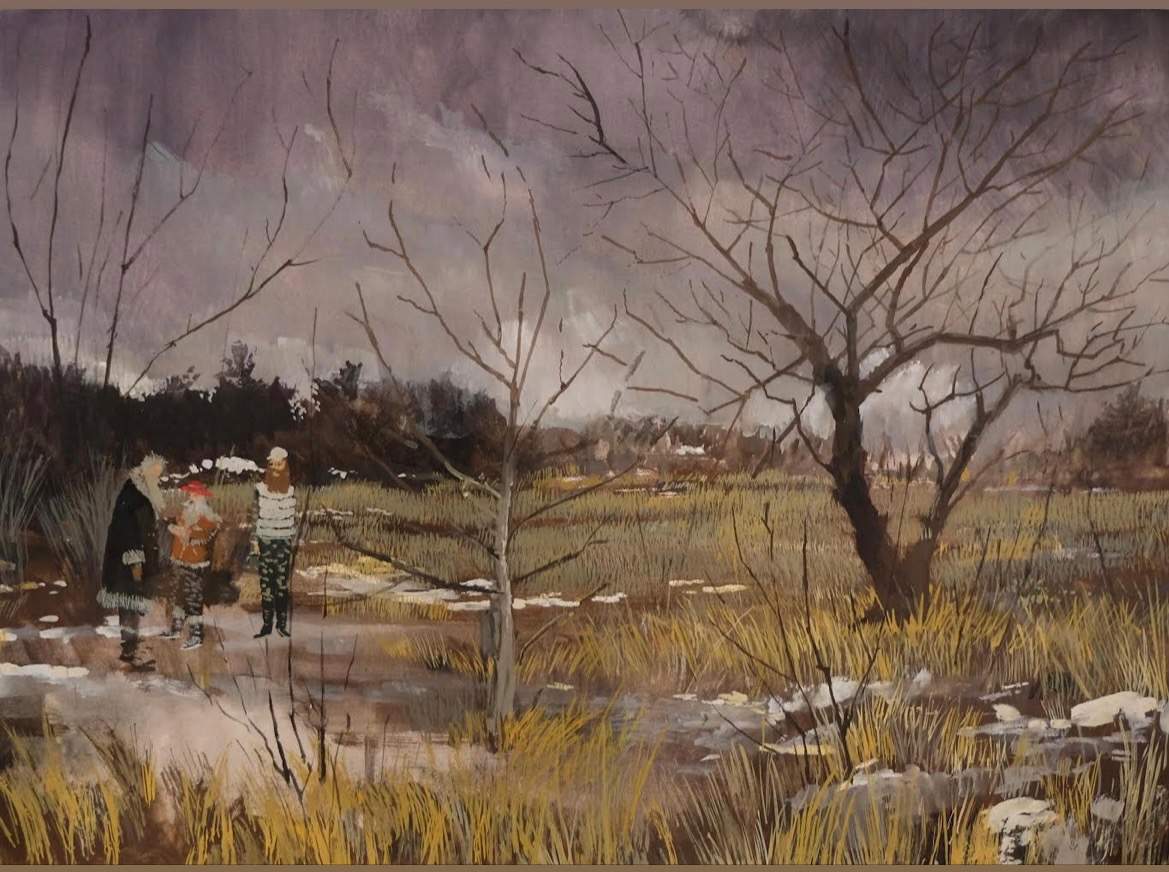
Harrington has connections with art dealers in Canada and said they sell his pieces across the country and in Europe. But losing barrier-free access to the U.S. market still hurts.
He isn’t letting that stop him from creating.
“If you just sit around and let anxiety take over, it’s debilitating and causes creative paralysis,” he said. “So you just start trying to keep motivated and keep working and believe that things are going to go back to normal.”
Are Trump's tariffs creating new opportunities for artists?
Trump initially imposed a 25 per cent blanket tariff on Canada in March 2025, with an exemption for products that comply with the Canada-U.S.-Mexico Agreement (CUSMA). Following more than a year of trade negotiations that ended without a deal, and retaliatory tariffs imposed by Canada, the U.S. president doubled down in August with 50 per cent tariffs.

For some artists, the Canada-U.S. trade war has created new opportunity.

Get breaking National news
Working from a home studio in Portugal Cove, N.L., Karyna Parsons creates pottery with a little bit of what she calls “snark.”
Her work often features characters or popular icons, with political themes.
Parsons told Global News 95 per cent of her followers are women, and since she has started using her art as political commentary on Trump’s presidency, 80 per cent of her orders have actually come from south of the border.
“I have found my target market,” she said, adding she refuses to let tariffs upend that.
Parsons said details around how the tariffs are actually charged are unclear. She said she adds a flat rate for shipping and a 10 per cent tariff surcharge when her products are purchased online, but she said she has been told by some of her customers that they have received a bill from U.S. customs after receiving their purchase.
Regardless, she said her American customers have been supportive.
“There’s really this prevalent attitude of ‘we got ourselves into this mess this is not your fault. We as Americans will pay for it,'” she said.
She’s also taken the opportunity to share a bit more Canadian culture with her American buyers. She said with every American purchase, she sends a package of Canadian-owned Hawkins Cheezies to thank them for paying the duty.
- Guilty plea in connection with Kelowna teen’s death
- Transit troubles a key issue for Winnipeg voters as civic election looms
- ‘This little bit of perfection’: Canadian astronaut Joshua Kutryk on seeing Earth from space
- ‘Catastrophic’ brake failure led to Columbia Icefield rollover that killed 3 people


“We can be pissed off and we can be defiant, but also we’re connecting,” she said while noting that the whole ordeal has been emotional. “It has to get better and let’s try to find some joy and brightness in it.”
What are artists asking the Canadian government to do?
Artists, among others, have felt an “impetus” to act as Canada has repeatedly been targeted by the U.S., Ana Serrano, president and vice-chancellor at OCAD University, told Global News in an interview.
“The need to respond to this moment of existential crisis for Canada was so strong,” she said, alluding to projects like the “Canada is not for sale” hat that was designed by an OCAD alum.
But even for work that is not necessarily political, Serrano said there is a direct link between Canadian artwork and the assertion of a Canadian culture.
“There is an absolute correlation between the work of artists and the work of how a nation defines itself,” she said.

Artists who sell their work require the government to treat it as “intellectual property” and promote it in the same way they would energy or critical minerals in foreign markets, Serrano said.
“In the same way when our Prime Minister says the world wants what Canada has. That includes our art.”
The Visual Arts Alliance is calling on the Canadian government to take measures to protect artists’ livelihoods.
“Canadian art is not simply another category of merchandise. It carries cultural knowledge, history, identity, and relationships between communities,” the alliance said in a statement.
Jenna Paye Powell, interim executive director of Canadian Artists’ Representation (CARFAC), said individual artists can work on developing contacts within the Canadian arts space and host local studio sales, but ultimately the onus is not on them.
“Artists are researching and adapting their practices to the best of their ability, to strengthen relationships with Canadian audiences, but individual entrepreneurship and resilience cannot solve broader trade barriers, increased costs, border disruptions, or the loss of access to important markets,” Paye Powell told Global News.
CARFAC and the Visual Arts Alliance are calling for targeted financial relief for artists, galleries and Indigenous-owned businesses, along with a GST exemption for buyers of Canadian-made art and the creation of clear customs policies for temporary art exports, touring exhibitions and loans.


No one to blame but Carney and delusional Liberal supporters.
Today’s TDS article. Honestly its exhausting.
Oh well… Canada is not good enough for you to sell your art? Or too poor?
There are lots of other countries besides USA.
If people like your art, they will buy it… unless they can’t afford it.
Anonymous is a village idiot….two cents on every article…everyday…all day….pathetic.
Blame Carney.
Trump and MAGA are scared of Canadian culture because they can’t compete, so they impose tariffs. The usual.
I see the MAGA traitors are here taking a break from building the Orange guy monuments to read and comment on MSN news. Aren’t you minions banned from reading real news? Back to slave labor losers. LOL!
No worries Canada, Carney will have his new USA trade deal done by July 21, 2025…oh, wait…
Art is a collectible and for those with disposable income which makes sense why you need to sell it to Americans as they have more of that . Sorry about your luck you voted for more liberal economic mismanagement and more poverty in Canada . Elbows up
You get what you vote for :D elbows up, am I right??