






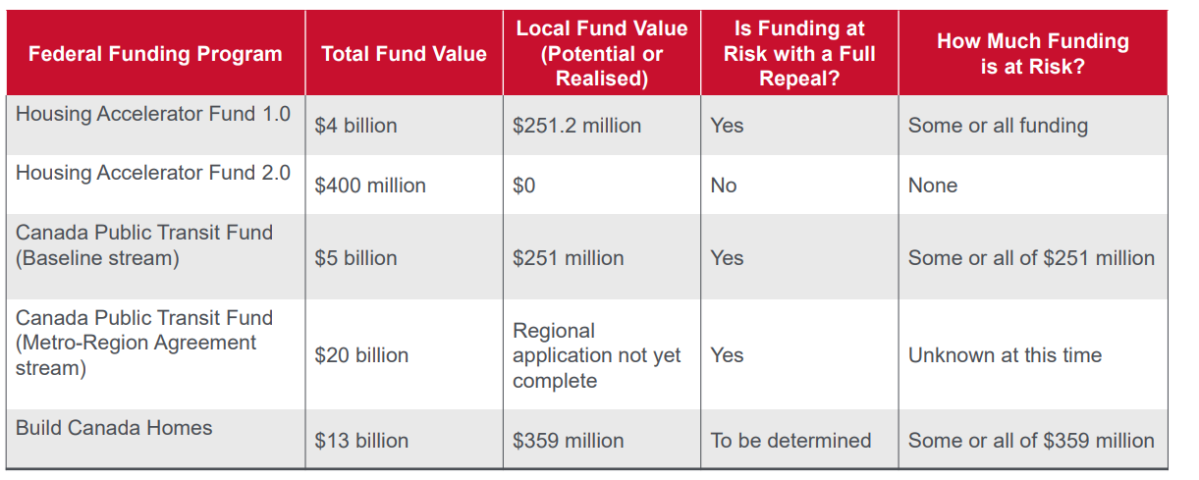
Calgary city council’s upcoming decision on repealing citywide rezoning could impact more than $861 million in federal funding moving forward, according to a new risk analysis from city administration.

According to the report, set to be presented to city councillors at next week’s Infrastructure and Planning Committee meeting, the Canada Mortgage and Housing Corporation (CMHC) “may deem” the City of Calgary to be non-compliant with the Housing Accelerator Fund (HAF) Contribution Agreement if city council fully repeals citywide rezoning.
Calgary was awarded $251.3 million, including top-ups, from the federal Housing Accelerator Fund, with $122.9 million allocated so far. The next installment of the fund is set for the end of March 2026.
City council will be holding a public hearing that same month on whether to repeal the policy.
Ward 10 Coun. Andre Chabot, who chairs the committee, said the way the report is written “almost feels like” it is trying to influence council’s decision on the matter.
“The report is very much doom and gloom. It looks at what ultimately could happen if council decided to do a full 100 per cent repeal,” said Chabot. “We’ve already heard input from others looking for amendments to address the issues identified in local area plans, as an example, I think there’s something that could be considered by council.”
The report follows an ongoing back-and-forth about whether the federal funding was tied to the previous council’s decision to approve citywide rezoning, which changed Calgary’s default residential zoning to allow for more housing types, such as duplexes and row houses on a single property, to increase the city’s housing supply.
City administration highlighted two initiatives in the agreement that CMHC could interpret as the city no longer satisfying if citywide rezoning is repealed, including “undertake city-initiated redesignations to streamline approvals to increase housing supply,” as well as “undertake land use bylaw amendments to promote missing middle land use districts.”

Get breaking National news
The report noted CMHC has already reduced or cut HAF funding for some municipalities that were found in non-compliance with their agreements, including Red Deer, Vaughan and Toronto.
The agreements signed in 2023 also include housing targets, with a goal of 41,858 new housing units by October 2026. According to the city, 44,276 new units were built in less than two years.
Although the city is exceeding those targets, the report noted several city initiatives depend on the last two advancements of HAF funding to “support the development of affordable units and its associated targets.”
“Not meeting a unit target would mean that the city would not be satisfying the ‘commitments’ as agreed to as per the terms and conditions of the HAF Agreement,” the report said.
“The city’s HAF Agreement indicates that both ‘initiatives’ and ‘targets’ are ‘commitments’ and must be completed subject to the terms and conditions of the HAF Agreement.”
The report also outlines potential risk to other federal funding streams the city has applied for through Housing, Infrastructure and Communities Canada (HICC), including $251 million from the Canada Public Transit Fund and $359 million through Build Canada Homes.
- Canada moves to help Canadians trapped in Kuwait without exit permits
- Edmonton LRT construction to close 102 Avenue to traffic starting March 16
- Land clearing starts as Whale Sanctuary Project in Nova Scotia reaches milestone
- Lawyer seeks acquittal for 2nd defendant in Montreal drive-by shooting that killed teen


According to the report, the Canada Public Transit Fund is conditional on “4 units-as-of-right within 800 metres of applicable transit stations and/or post-secondary institutions,” though an agreement has not yet been signed.
“This potential to lose what seems like up to $1 billion of funding is kind of like salt in the wound,” Ward 8 Coun. Nathaniel Schmidt told Global News. “We’re going to be putting more pressures on ourselves as a city to get Calgarians the service they’ll need.”
A full understanding of the implications of federal funding is likely not possible until after council decides on whether to repeal citywide rezoning, the report said.
However, the report notes the implications outlined by city administration cannot fetter city council’s decision on citywide rezoning, as the matter will be before a public hearing on March 23.
Schmidt said he is awaiting input from the because city council is legislated to be amenable to persuasion ahead of the public hearing on city citywide rezoning.
“Even though the financial aspect cannot be considered explicitly by us as council when we hear about rezoning, but if the public has opinions about that, I think it’s good for us to hear those opinions,” he said.
Chabot said he is also hosting town hall meetings with residents to gather input from Calgarians.
Mayor Jeromy Farkas and other city officials are in Ontario this week on a trip that includes a meeting with CMHC to seek clarity on the funding agreements.
“Ultimately, we want a built-in Calgary solution,” Chabot said. “If somebody wants a particular outcome, tell us what you want us to do, not how to do it.”
Comments
Want to discuss? Please read our Commenting Policy first.