


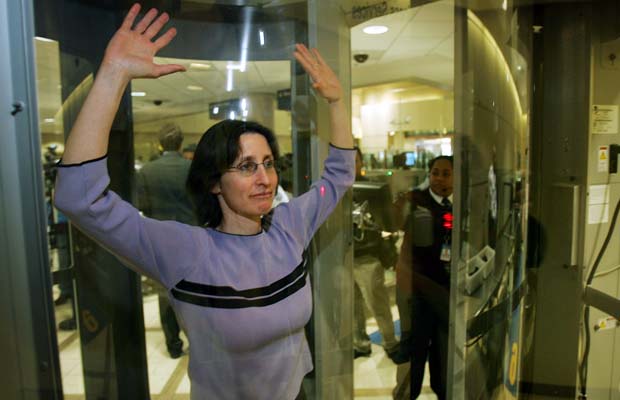
OTTAWA – The Harper government says Canadian air travellers heading to U.S. destinations will soon face virtual strip searches in major airports across the country.
Transport Minister John Baird confirmed Tuesday the government was purchasing 44 new imaging scanners that use electromagnetic waves to scan through clothing and produce images of concealed objects.
Baird suggested the machines provided the best solution to balance security and comfort for passengers.
"I think for many Canadians, the idea of going through an electronic machine, is far more comfortable and less invasive for many Canadians than an invasive physical pat down," he said at a news conference.
Transport Canada also announced plans to seek bids on a contract for a new passenger behaviour screening program to help security staff identify threats and suspicious behaviour.
The government said it believed the scanners, which cost about $250,000 each, could prevent threats such as a recent incident involving a passenger on a U.S. bound flight who allegedly tried to detonate an explosive on-board the aircraft on Dec. 25. Though critics have said this type of equipment would not have been effective in that case.
In a CBC Television interview broadcast Tuesday night Prime Minister Stephen Harper said: "Obviously the incident around Christmas brought in a whole new series of dimensions that governments are going to have to adjust to."
He said Canada faces common threats.
"We don’t have to take identical measures, but we certainly have to undertake measures that would prevent any similar kind of threat in Canada . . .I know these cause tremendous inconveniences for everybody, but the first priority ultimately has to be the safety and security of the Canadian air traveller and of our airport facilities, and we know that unfortunately these things are at risk in this day and age."
About a dozen of the new scanners are expected to arrive within the next week and the rest by the spring. Patrick Charette, a Transport Canada spokesman, said the scanners will be used in Halifax, Montreal, Ottawa, Toronto, Winnipeg, Regina, Calgary, Edmonton and Vancouver.
The energy radiated from the machines is considered to be 10,000 times less than a cellphone transmission according to a government report which reviewed a recent pilot project at a Kelowna, B.C. airport.
Although passengers on American-bound flights would have the choice between a physical search or passing through the machine for secondary screening, Baird said some suspicious travellers would have no choice about undergoing the virtual strip search.
"If you show up and you’re in a T-shirt that says `suicide bomber’ on the front of it … you’re exhibiting strange behaviour and the pat-down is deemed to be insufficient, then you could very well be called upon to go in the scanner," Baird said. "That will be few and far between and won’t be a regular part of business."
But some advocates have suggested the government is using the recent terrorism incident to justify its plans to introduce the machines that could invade personal privacy without ensuring they actually improve airport security.
"It has not been properly debated, and it has not been properly vetted by independent security experts," said Micheal Vonn, a policy director at the BC Civil Liberties Association. "It has been pushed by all kinds of interests, including billion-dollar security technology interests and we do know that there are other kinds of body scanners that are much less privacy invasive that are not being viewed properly in the mix of the decision making at all."
Vonn said the association also feared the government would eventually make the scans mandatory. But the office of the federal privacy commissioner said it was fully consulted on the plan and believes the new security systems strike a balance that protects individual Canadians.
"Most importantly there is no correlation between image and identity," said Chantal Bernier, the assistant federal privacy commissioner, in an interview. "The officer who has seen the image, does not see the passenger."
Bernier added the government provided a full assessment report on the effectiveness of the technology and protection of privacy, and would not be able to impose mandatory screening of passengers with the machines without doing an additional assessment that demonstrated how it would protect privacy.
"We’re not going to second guess their analysis, obviously, but we certainly have challenged them in that regard, and they have provided fulsome information," she said.
But one security expert said the government’s plan still has a gaping loophole since it does not increase screening on employees who work at airports such as baggage handlers, mechanics and caterers.
"You don’t need to go through security with these chemicals to get them before you get on the plane," said Liberal Senator Colin Kenny, who is chairman of the national security and defence committee in the Senate. "People can walk up from the ramp and hand it to you. They can put them inside a large coffee cup."
But he added the machines would be more effective than physical searches if they are applied to all people with access to planes.
"The alternative is even less palatable because you can’t hand search people in the places where they’re likely to hide things," said Kenny.
After the havoc at Montreal’s Trudeau Airport last week because of enhanced security measures for U.S.-bound flights, travellers are now wondering whether the introduction of full-body scanners on the same routes will create even more headaches during the busy winter break season.
"I hope it is not going to make this line twice as long," said Ulysses Cubillos, who was flying to Boston out of Trudeau Tuesday.
Cubillos, a frequent traveller, said he is not opposed to full body scans, as long as they are "done efficiently and tastefully."
"I don’t want a situation where everyone can see me," he said.
"We know that there are individuals committed to carrying out acts of terrorism against our country and against our allies," Baird said. "And we know that we must remain vigilant.
"The memories of Air India and the tragic events of Sept. 11, 2001 and the subsequent bombings in Madrid and London are still unfortunately fresh in our minds."
Rob Merrifield, minister of state for transport, said Canada must be at the forefront of new security technology. He said 95 per cent of passengers at B.C.’s Kelowna Airport, where the technology was tested, preferred the scanners to a physical search. Merrifield said the scans would detect plastic knives and plastic explosives, but current metal detectors do not.
The manufacturer claims the scanning booths can handle 300 to 600 people an hour.
Children under 18 will be exempted from full-body scans.
"Right now this is for U.S.-bound passengers until further notice," Charette said. "As we go along we will reassess the threat.
Ron McAdam, the manager of new technology for the Canadian Air Transport Security Authority, said the images of passengers’ bodies will not be blurred. He said it will take about five days to train staff to operate the scanners.



Comments
Want to discuss? Please read our Commenting Policy first.