







Jump to: Hospitalizations – Outbreaks – Schools – Vaccinations and Testing – Ontario – Elgin and Oxford – Huron and Perth – Sarnia and Lambton

The London-Middlesex region is moving back into the red-control level of Ontario’s COVID-19 response framework, the province announced Monday.
The move will take effect on Tuesday, and comes nearly a month after the region left red-control and entered orange-restrict on March 1.
The province says the region’s case rate rose 86 per cent from March 22 to 28 and has been recording an increased rise in variant cases.
“The decision was made at the request of the local medical officer of health due to concerning trends in public health indicators in the region,” read a statement from the province.
The news comes hours after the health unit reported 57 new coronavirus cases Monday, bringing the regional total to 6,952, of which 6,332 have resolved, 22 more than the day before.
At least 186 deaths have been reported, most recently on Saturday.
Officials also reported Monday that the number of screened variant positive cases in the region had risen by 21, and that vaccine eligibility had expanded to people aged 70 to 74.
As of Monday, at least 434 cases are considered active in London-Middlesex.
The region has recorded at least 770 new cases confirmed since the month began, and has seen case rates steadily increase over the last week. Health officials reported 121 new cases over the weekend alone.
The seven-day rolling average of daily new cases stood at 47.7 as of Monday, up from 25.28 the previous seven-days.

Of the 57 new cases reported Monday, 51 are from London while six are from Middlesex County.
Cases are spread out among the age groups tracked by the health unit. Seven are 19 or younger; 13 are in their 20s; eight are in their 30s; seven are in their 40s; 10 each are in their 50s and 60s; and two are in their 70s.
Close contact is listed as the exposure source for about half of all cases, 28, while four have no known link and two due to outbreak. Twenty-three are pending exposure source data.
During Monday’s media briefing, Dr. Chris Mackie, the region’s medical officer of health, noted that numbers released today are reflective of two weeks ago after accounting for the time it takes for symptoms to appear and for people to get tested.
“We’re seeing a dramatic increase here, really a doubling over the past week, of numbers that were already on the borderline for red… We’re now at around 65 cases per 100,000 per week. The cut-off for red is 40,” Mackie said.
He called on London-Middlesex residents to refrain from gathering indoors — something health officials have said has been driving case count increases recently, along with rising variant cases.
“Moving to the red level in the framework will not solve our problem. What we need is a wholesale change in our attitudes and behaviours about indoor gathering,” Mackie said.
“We must keep our gatherings outdoors. Stay outdoors, please. There is no good reason for a social gathering indoors right now. I don’t care where it is or who it’s with. Keep your gatherings outdoors,” he continued.
The messaging comes with the Easter long weekend and the end of Passover just days away.
“If we want to avoid a lockdown where businesses, restaurants are significantly hampered, closed and inaccessible, now is the only chance, it’s our last chance, to avoid that really much higher level of restrictions,” Mackie said.
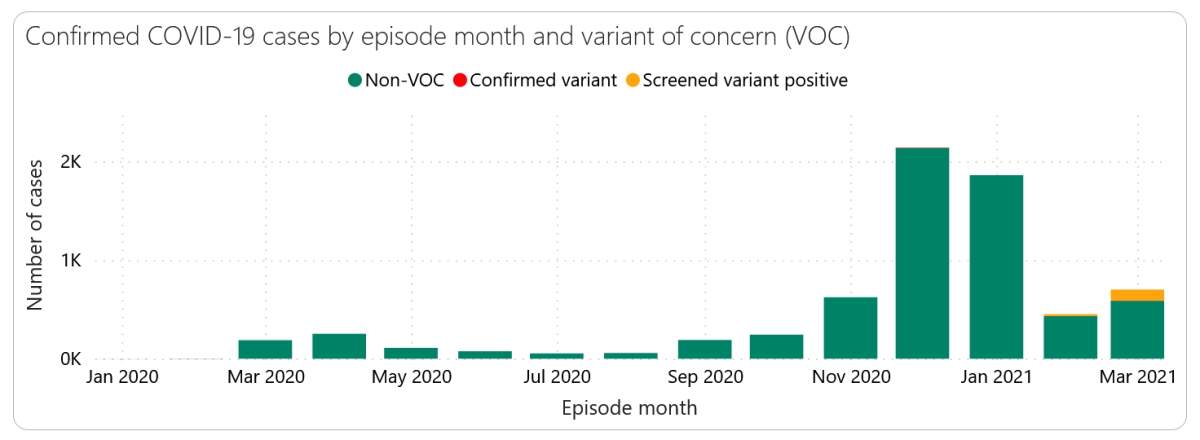
Health officials on Monday reported that the number of cases that had screened variant positive stood at 132, 21 more than the previous day.
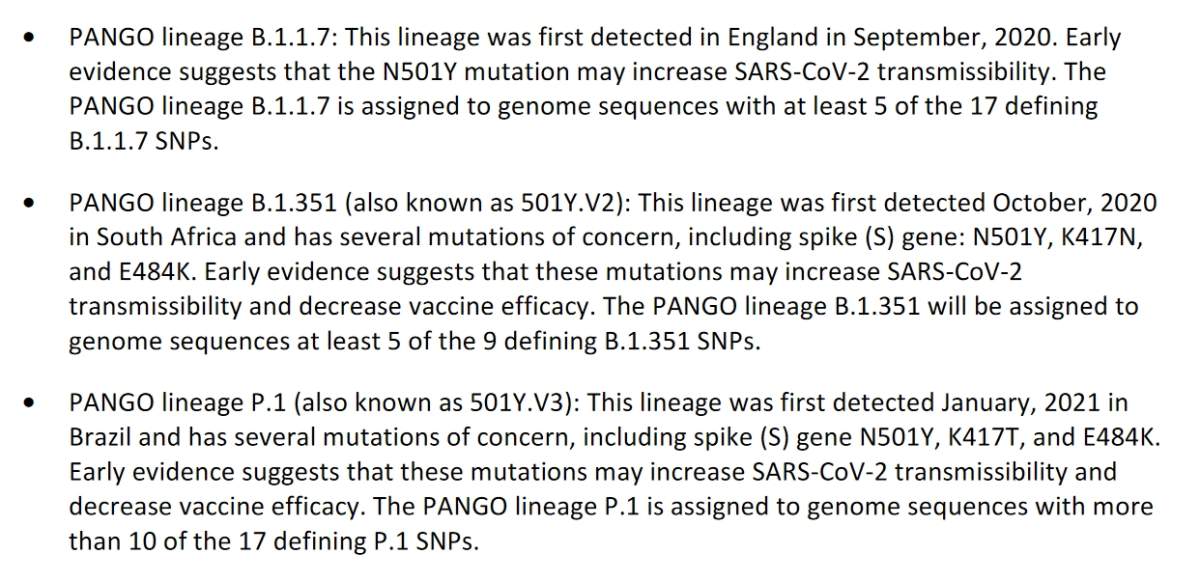
At least six cases have been confirmed to involve the B.1.1.7 variant, first detected in the U.K., while 122 are presumed to involve the variant, as they only screened positive for one particular spike gene mutation — N501Y.
Meanwhile, six cases have screened positive for both the N501Y and E484K spike gene mutations, while four have screened positive for just the E484K mutation.
The E484K mutation has been associated with both the B.1.351 variant, first detected in Suuth Africa, and the P.1 variant, first detected in Brazil.
The 12 cases that have screened positive for the E484K mutation are undergoing genomic sequencing.
According to the health unit, of the cases that have screened variant positive, more than half involve people under 30.
Thirty-five have involved people 19 or younger, while 47 have involved people in their 20s.
“We know those (variants of concern) spread around 50 per cent more easily. We also know from data released from Toronto over the weekend that those variants of concern can also be more fatal, particularly in young people,” Mackie said.
Mackie noted that three of the outbreaks involving Western University had been linked to at least one confirmed variant of concern case.
“Western has a lot going on right now. It’s still in the range of 20 per cent of our overall community problem… But there are problems throughout our community with people gathering indoors.”
At least 6,073 cases have been confirmed in the city of London since the pandemic began, while 273 have been in Middlesex Centre.
Elsewhere, 223 cases have been in Strathroy-Caradoc, 100 in Thames Centre, 59 in Lucan Biddulph, 43 in Southwest Middlesex, 41 in North Middlesex, 14 in Adelaide Metcalfe and two in Newbury.
At least 124 cases have pending location information.
Hospitalizations
At least 16 COVID-19 inpatients were in the care of London Health Sciences Centre as of Monday, the organization said — an increase of three from its last update on Friday.
At the same time, the number of patients in critical or intensive care has fallen by one from six to five or fewer.
Fewer than five staff cases are also active at LHSC, unchanged from Friday.
The organization had been dealing with a workplace outbreak in U4-Medicine 1, but LHSC officials say the outbreak has since been resolved.
At St. Joseph’s Health Care London, meantime, the organization says three non-outbreak cases are currently active involving health-care workers.
It’s not clear at which SJHCL facility the staff members work.
“While our occupancy remains in a relatively good position, this is not the case across the province where many hospitals outside the region are experiencing intense pressures as they reach or near capacity,” said Dr. Adam Dukelow, chief medical officer with LHSC.
Dukelow says the number of ICU patients with COVID across Ontario is six shy of the 415 that was recorded during the peak of the pandemic’s second wave.
“This is very different from the beginning of wave two, when there were less than 50 ICU patients across the province, where we eventually reached that peak of 415,” he said.
“As we look ahead to the upcoming holiday long weekend, we know we will need the support of our community to help prevent our local hospitals from experiencing the same capacity challenges.”
At least 378 people have been hospitalized for COVID-19 during the pandemic, including 68 who have needed intensive care.

Get weekly health news
Institutional outbreaks
No new institutional outbreaks have been declared and one has resolved.
The outbreak at University Hospital had been declared on March 12 in U4-Medicine 1, also known as 4IP General Medicine.
It had been linked to at least six patient cases and fewer than five staff cases.
“Our enhanced outbreak and precaution measures have proven to work effectively, as the outbreak remain contained with low associated case numbers and no deaths,” said Dr. Adam Dukelow during Monday’s briefing.
“We hope the swift resolution to this outbreak is reassuring to our community. We will continue to do everything we can to prevent future outbreaks and contain resolve any that do occur.”
There are three institutional outbreaks active in London-Middlesex, all located at seniors’ facilities.
One outbreak each is active at Glendale Crossing (Brighton), Henley Place Long-Term Care (Victoria Unit), and Kensington Village (long-term care, first floor).
Elsewhere, a non-institutional outbreak remains active at the city’s jail. The Elgin-Middlesex Detention Centre outbreak was declared on Jan. 18 and has been linked to at least 30 inmate and 29 staff cases.
At least one inmate case was listed active at the jail as of Thursday, according to provincial data. Similar information was not immediately available for staff cases.
Three non-institutional outbreaks are also active at three separate Western University student residences.
Schools
At least two new school cases have been reported in London-Middlesex.
The cases are associated with Mountsfield Public School and Sir Frederick Banting Secondary School, both under the Thames Valley District School Board.
They’re among at least 16 active school cases in the region. A full list can be found on the MLHU website.
One school outbreak is active in the region, associated with Woodland Heights Public School, which had two active cases as of Monday.
“We really don’t have a lot of spread of COVID in schools right now. We’re identifying one or two cases here and there by school… Variants have not been a big factor in those aged 10 to 19 in our community,” Dr. Chris Mackie said Monday.
“We mentioned last Thursday that we’d had over 100 of the tests done in asymptomatic people — 112 was the count on Thursday, and zero positive for COVID among asymptomatic testing and students in schools.”
At least 240 elementary and secondary school cases have been reported during the pandemic. At least 28 cases have been reported in child care or early years settings.
The health unit reported two active child care/early years cases, associated with London Bridge: Huron Heights Early Childhood Learning Centre in London, and YMCA Before and After School Program – North Meadows Elementary School in Strathroy-Caradoc.
In the post-secondary world, outbreaks are active at three Western University residences.
The outbreaks were declared March 2 at Essex Hall, March 25 at Ontario Hall, and March 26 at Saugeen-Maitland Hall.
The outbreaks in Ontario and Saugeen-Maitland halls were associated with 11 cases each as of Monday. Both have seen at least one variant case, officials have said.
Vaccinations and Testing
Starting Monday, residents in London-Middlesex are now eligible to receive the COVID-19 vaccine, health unit officials said.
It comes exactly a week after the health unit opened eligibility to people aged 75-79.
According to Dr. Chris Mackie, roughly 11,000 people aged 75-79 — roughly two-thirds of that population — had booked an appointment for a vaccine as of Saturday, with several thousand more since then.
According to the province, more than a third of those 75-79, and more than three-quarters of those 80 and older, had received at least one dose of vaccine as of Saturday, the health unit said.
More information on eligibility can be found on the health unit’s website.
Eligible residents are asked to visit covidvaccinelm.ca or call 226-289-3560 (9 a.m. to 7:30 p.m.) to book an appointment. Online appointments are encouraged due to the high call volume.
Three mass vaccination clinics are running in London-Middlesex with plans for a fourth at Earl Nichols Recreation Centre, however lackluster vaccine supply has delayed its opening.
Due to vaccine supply instability, the health unit has been booking appointments as far out as two weeks, but Mackie says officials may soon be able to push that to three weeks.
“We are starting to see the predictability of vaccines gradually improving. That means we have a little bit more visibility out beyond two weeks to know, if not exactly how much vaccine we’ll be getting, approximately how much,” he said.
The health unit has been vaccinating roughly 2,000 to 2,5000 people per day, he said. Adding a third week onto the booking window would add more than 15,000 additional appointment slots.
“We are opening about half of them up tomorrow or Wednesday, as we confirm the logistics of that, for anyone who is eligible by age, which includes now anyone age 70 and above,” he said.
“It’s a natural progression. As we finish the group of age 70 and above we’ll move on to the next group.”
Mackie noted that very little, if any, vaccine is being wasted in London-Middlesex, even in the event of appointment no-shows or cancellations.
“At the end of the day, when the last vial is opened and all the patients have been vaccinated, the staff are turning to either health-care workers in the clinic who haven’t been vaccinated yet… or to anyone who is already on the list to be booked over the next two weeks (and) calling those people in to get vaccinated,” he said.
“There also isn’t an issue with appointments not being filled, because if there are any appointments that aren’t filled in a given day, we simply put those back into the appointment calendar for the next two weeks.”


Details remain limited about the region’s possible involvement in the province’s AstraZeneca pharmacy pilot project, which has been giving the vaccine to people 60 and older in three public health units.
The pilot is set to expand to hundreds of locations across the province over the coming weeks, then to approximately 1,500 as more supply is available.
“We have heard various rumours through pharmacies about AstraZeneca vaccine coming to them sometime along a similar timeline, perhaps in the next couple of weeks. We haven’t heard any confirmation of that, and no direct communication about it from the Ministry of Health,” Mackie said last week.
The region’s two main assessment centres, located at Carling Heights and Oakridge Arena, remain open and operating by appointment.
The Carling Heights site saw an average of 429 daily visits between March 15 and 19, while Oakridge Arena saw an average of 346.
The region’s test positivity rate stood at 1.6 per cent as of the week of March 14, up from 1.2 the previous week.
Updated figures are expected this week.
Ontario
Ontario is reporting 2,094 new cases of COVID-19 today and 10 more deaths linked to the virus.
Health Minister Christine Elliott says there are 618 new cases in Toronto.
She also says there are 368 new cases in Peel Region, 277 in York Region, 132 in Ottawa and 104 in Durham Region.
Today’s data is based on 39,500 completed tests.
Ontario reports that 841 people are currently hospitalized with COVID-19 but the province notes that 10 per cent of hospitals did not submit data over the weekend.
- Changes to prescribing safer supply drugs approved by Ontario medical regulator
- Officials say N.S. had ‘most successful’ year for doctor recruitment, but gaps in care remain
- Quebec flu vaccine appointments open amid warnings of early flu season
- Contagious case of measles reported at Montreal’s airport


The province says that 50,453 doses of a COVID-19 vaccine were administered since Sunday’s daily report.
A total of 2,031,735 vaccine doses have been administered in Ontario so far.
Elgin and Oxford
In its first update since Friday, Southwestern Public Health reported one new death and 56 new coronavirus cases Monday in the Elgin-Oxford region.
The health unit does not issue coronavirus updates over the weekend.
The region’s pandemic case tally stands at 2,797, of which 2,636 have resolved, an increase of 39 from Friday’s update.
At least 69 deaths have been reported. Monday’s reported death involved a female in her 70s from Oxford County who was not related to a seniors’ facility, the health unit said.
At least 76 cases are active in the region as of Monday, with 26 in Woodstock, 24 in St. Thomas and 11 in Central Elgin.
The number of screened variant positive cases in the region stands at 65, eight more than Friday. At least 14 are still considered active.
Five cases have been confirmed to involve the B.1.1.7 variant, first detected in the U.K., while 59 others are presumed to involve the same variant as they screened positive for only the N501Y spike gene mutation.
One case, which has resolved, screened positive for the N501Y and E484K spike gene mutations. The E484K mutation has been associated with the B.1.351 and P.1 variants, detected in South Africa and Brazil, respectively. Investigation is ongoing to determine the specific variant involved.
The region remains in the orange-restrict level of Ontario’s COVID-19 response framework.

Like London-Middlesex, residents 70 and older in Elgin-Oxford are now eligible for the coronavirus vaccine.
Eligible residents are asked to visit covidvaccinelm.ca or call 226-289-3560 (9 a.m. to 7:30 p.m.) to book an appointment.
Health officials said last week that at least three pharmacies in Elgin-Oxford would begin carrying the Oxford-AstraZeneca vaccine in the coming weeks as part of the province’s expanded pharmacy pilot project. Details, however, remain elusive.
Further information on the local vaccination effort can be found on the health unit’s website.
No new school cases have been reported in the region.
At least 10 remain active in the region, with two at St. Patrick’s Catholic Elementary School in Woodstock, and one each at:
- Arthur Voaden Secondary School,
- College Avenue Secondary School,
- Davenport Public School,
- Harrisfield Public School
- Huron Park Secondary School
- Ingersoll District Collegiate Institute,
- Southside Public School,
- South Dorchester Public School
Meanwhile, no new institutional outbreaks have been declared and none are currently active.
The health unit says a total of 589 cases have been reported in Woodstock during the pandemic, while 464 have been in Aylmer, 459 in St. Thomas and 347 in Tillsonburg.
Elsewhere, 207 cases have been in Norwich, 164 in Bayham, 132 in Ingersoll, 117 in East Zorra-Tavistock, 65 in Central Elgin, 58 in Blandford-Blenheim, 57 in Zorra, 51 in South-West Oxford, 27 in Dutton/Dunwich, 25 in Southwold, 22 in West Elgin and 12 in Malahide.
The region’s test positivity rate stood at 1.6 per cent as of the week of March 14, up from 1.2 per cent the previous week, health unit figures show. Updated stats are expected this week.
Huron and Perth
Seven new coronavirus cases have been reported in Huron-Perth, local health officials said Monday.
It brings the region’s pandemic case tally to 1,414, an increase of six from the day before. The health unit says a previously confirmed case was reassigned to another health unit.
At least 1,348 cases have resolved, two more than the health unit’s previous update. At least 50 deaths have been reported, most recently on March 1.
At least 16 cases are active in the region, with six in Stratford and three each in Perth South and South Huron.
The number of screened variant positive cases stands at eight, an increase of two.
The region remains in the yellow-protect level of Ontario’s COVID-19 response framework.

The health unit says at least 17,451 doses in total have been administered in Huron-Perth as of March 17, the health unit said. The tally includes first and second doses.
Health officials opened vaccine eligibility to people 70 and older as of Friday, in addition to Indigenous adults and certain faith leaders.
Those looking to book a vaccination appointment are asked to do so via the health unit’s booking website or by calling 1-833-753-2098.
More information on the local vaccination campaign and eligibility can be found on the HPPH website.
One outbreak is active in the region, declared on Saturday at a long-term care home in South Perth.
The outbreak, located at Ritz Lutheran Villa, is tied to one staff case and is currently the only active outbreak in the region.
Meanwhile, no new school cases have been reported in the region.
Two are active — one at Romeo Public School and one at St. Michael Catholic Secondary School, both in Stratford.
At least 562 cases have been reported in Perth County, with 349 in North Perth and 138 in Perth East, while at least 462 been reported in Huron County, with 104 in South Huron and 101 in Huron East.
Stratford has reported at least 357 in total, while St. Marys has seen 33.
The region’s test positivity rate stood at 0.5 per cent as of the week of March 14, down from 0.8 the week before. Updated figures are expected this week.
Sarnia and Lambton
One new death and 26 new coronavirus cases were reported Monday by officials with Lambton Public Health.
It brings the region’s pandemic case tally to 2,804, of which 2,558 have resolved, an increase of 36 from the day before.
At least 49 deaths have been reported. Details on Monday’s reported death were not immediately available.
At least 197 cases are listed as being active in the region. Six people are listed as being in the care of Bluewater Health, an increase of one from the day before.
The health unit says at least 89 screened variant positive cases have been reported in the county, an increase of 15 from Friday. None have been confirmed to be a particular variant yet.
The region remains in grey-lockdown of the province’s COVID-19 response framework.

At least 16,454 vaccine doses have been completed in the region as of March 23, the most recent figures available.
An update on the local vaccination campaign is expected this week.
Eligibility has expanded to those aged 70-74 with residents asked to register online. An in-home caregiver who resides in the same households is also eligible.
More information on the local vaccine rollout can be found on the health unit’s website.
Those eligible to book a vaccine appointment are asked to visit the health unit’s website or call 519-383-8331.
Vaccinations are also ongoing to residents with high-risk chronic health conditions at four primary care practice groups as part of a local pilot.
The groups are Central Lambton Family Health Team, Twin Bridges Nurse Practitioner Clinic, Rapids Family Health Team, and North Lambton Community Health Centre.
At least two new cases have been reported at schools, both at St. Anne Catholic School in Sarnia, according to the St. Clair Catholic District School Board.
Updated case numbers weren’t immediately available from the Lambton-Kent District School Board.
Dozens of school cases remain active in Lambton, according to figures from the school boards, linked above.
One new school outbreak has been declared and two resolved.
The newest outbreak is associated with the Lambton-Kent board’s virtual learning elementary school – Petrolia, which has two listed cases, the health unit says.
The two resolved outbreaks were located at Northern High School (two cases) and Confederation Central Public School (five cases).
Active outbreaks remain at:
- Holy Trinity Catholic School (three cases)
- King George Public School (two cases)
- LKDSB Virtual Learning Elementary School – Petrolia (two cases)
- North Lambton Secondary School (13 cases)
- St. Patrick’s Catholic High School (two cases).
Meantime, no new outbreaks at seniors’ facilities or at workplaces.
Six seniors’ facility outbreaks are active, declared on:
- March 23 at Rosewood Retirement Village (13 resident cases, one staff case)
- March 20 at Fairwinds Lodge in Sarnia (one staff case)
- March 19 at Afton Park Place in Sarnia (two resident case, three staff cases)
- March 18 at Marshall Gowland Manor in Sarnia (one staff case)
- March 16 at Sumac Lodge in Sarnia (one staff case)
- March 11 at Trillium Villa in Sarnia (three staff cases)
Elsewhere, three workplace outbreaks are active, linked to four, four, and six cases, respectively. The three workplace outbreaks were declared on March 24 and 25.
Outbreaks have been linked to 532 of the region’s cases and 27 deaths. At least 84 outbreaks have been declared during the pandemic in Lambton.
The health unit says the county’s test positivity rate was 3.7 per cent the week of March 14, up from 3.3 a week earlier. Updated figures are expected this week.
— With files from The Canadian Press


Comments
Want to discuss? Please read our Commenting Policy first.