


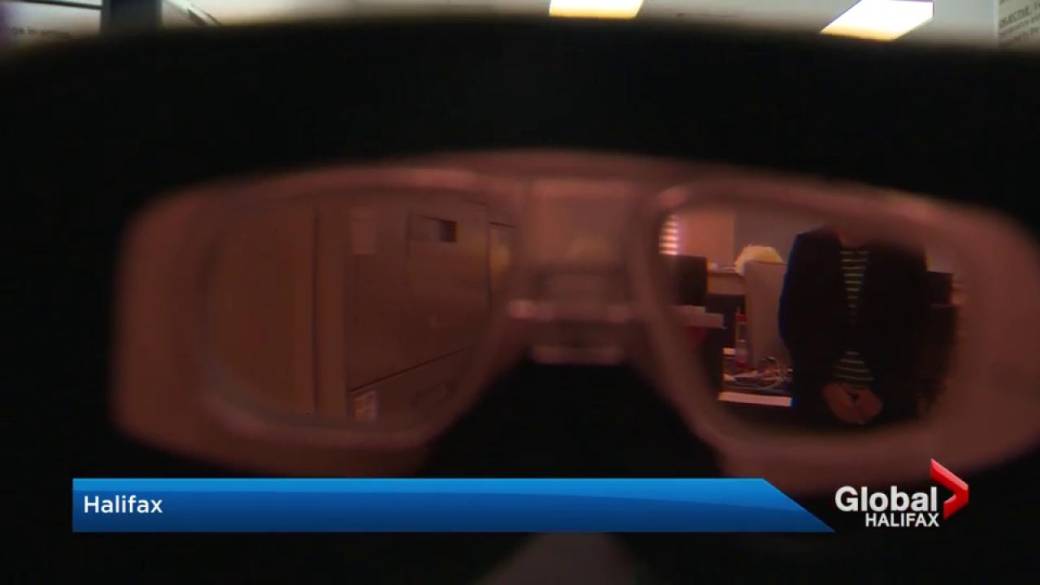
A Dalhousie University research team has created a set of “prism goggles” that shifts what the wearer sees to the right to help those with a brain disorder.

“The goggles shift your world in such a way that when you take them off, you’re actually focusing more on the left side of the world than you were before,” team member Dr. Gail Eskes, a psychiatry and neuroscience professor, said on Friday.
The device can help people with spatial neglect, which may develop after a stroke, she said.
Sufferers don’t pay attention to what’s happening on the left side of their bodies and subsequently may bump into things, or not notice food on one side of a plate and other such spatial issues.
Eskes had a team member partake in a game before an interview with Global News to illustrate the goggles’ results.

Get weekly health news
The participant threw beanbags at a target and succeeded in hitting it, or coming close, multiple times.
Next, she threw the beanbags again after putting the goggles on. Most of them fell to the right of the target.
- Bill to reduce availability of flavoured vapes in Manitoba not enough: advocacy group
- ‘Empty promises’: Mother alleges Fraser Health failed to pay for doula services
- As Ebola spreads, Canada to require 21-day isolation for those from region
- Squamish Nation master carver creates memorial pole for Lions Gate Hospital


She took off the goggles and threw the beanbags again. They mostly fell to the left of the target.
A Global News videojournalist was invited to try the experiment before her and produced similar results.
Someone with spatial neglect could use the goggles and relevant training to offset what they pay attention to, and essentially balance what they should see.
Eskes said the goggles have to be worn for about 10 minutes a day as a form of therapy.
“The brain gradually re-adapts to the regular world, so you have to keep reminding it,” she noted.
The team is developing an app, which includes a digital whack-a-mole-type game, to use in conjunction with the goggles for wearers to re-learn eye-hand coordination.
A clinical trial for the goggles is in the works. The team is also going to observe how someone’s brain operates when they’re wearing the goggles.
“We’re hoping that it’s going to have a good impact, and that’s why we’re doing this study,” Eskes said.


Comments
Want to discuss? Please read our Commenting Policy first.