


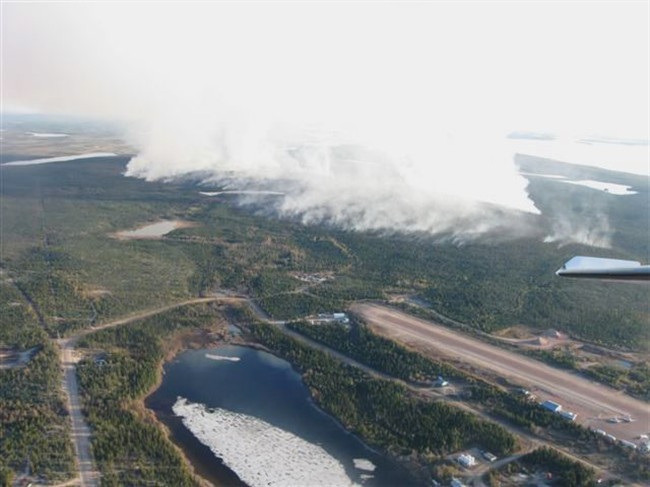
WOLLASTON LAKE, Sask. – Crews worked feverishly at the edge of a high school sports field in northern Saskatchewan on Thursday to try to fend off a forest fire and protect two communities.

Environment officials said the blaze near Wollaston Lake and the Hatchet Lake reserve had swelled to 40 square kilometres – up from five square kilometres Wednesday morning. It was fuelled by dry conditions in grass, bushes and trees.
“We had consistent 20 kilometre per hour winds, very high temperatures and low humidities. We had what we would consider rank five, which is the highest severity of fire behaviour all day (Wednesday),” said Steve Roberts, the province’s executive director of wildfire management.
The northern flank of the fire was burning at the southernmost edge of the communities – the high school property. That was the control point where firefighters were holding the line, said Roberts.
“Our focus is around the town – a small point on a big fire, but it’s also our critical priority.”
Roberts said the fire was expanding eastward, away from the communities, and wind was keeping smoke out.
It was good news for Ed Benoanie, acting chief of Hatchet Lake. He was one of about 15 residents who stayed to help with firefighting efforts after everyone else was airlifted out.
“The worst has pretty much passed us now, I think,” said Benoanie. “The fire was kind of around us on the reserve and it continued to the north. It’s still blazing in the north, but right now the smoke is almost clear.”

Get daily National news
Benoanie said there had been fears that homes would be lost.
“(Wednesday) was like a war zone here. It was ground zero just about, but … right now we’re much safer. It’s much better … that’s for sure.”
Wollaston Lake is about 840 kilometres north of Saskatoon and can only be reached by air at this time of year.
The fire was first reported to Saskatchewan Environment early Monday evening and was about one square kilometre in size.
Fifteen aircraft lifted out about 240 people Tuesday after an evacuation order came down. But smoke at the airport Wednesday hampered efforts to remove everyone. Those left behind hunkered down in two schools until military aircraft arrived to help.
Provincial fire commissioner Duane McKay said almost everyone – nearly 1,200 people – had been airlifted out by Thursday morning.
“The decision to call the military is because this was a very high risk situation, very dynamic and posed serious threat,” said McKay.
Four Griffon helicopters ferried residents to Points North, on the other side of the lake, on flights that took about 20 minutes. By sunrise, evacuees were being taken to shelters in Saskatoon on the bigger Hercules aircraft, which hold 96 people each.


“They seemed tired for the most part,” said Capt. Chris Jacobson, who piloted one of the Hercules aircraft. “I think a lot of them had been up for a lot of hours, but they seemed thankful, grateful and in generally good spirits.”
Saskatchewan Premier Brad Wall thanked everyone involved in the “difficult and often dangerous task.”
It’s not unusual for the province to move people when there are forest fires in northern areas, but it’s usually those considered vulnerable to breathing problems from smoke, such as children and elders. McKay said he believed the last time a community was completely evacuated was in 2005 when fire threatened Stoney Rapids.
Lightning has been ruled out as the cause of the fire near Wollaston Lake.
Roberts said the fire was started by human activity, but it’s not clear if the action was accidental or intentional. A team of investigators was flown in Thursday afternoon to look at the fire origin site in a forested area near the end of the airstrip, he said.
The Wollaston Lake fire is still considered out of control.
“The worst case scenario was we ended up with fire right in the town site, so that was our goal to prevent that. Most of the active fire component actually bypassed the town, went to the east, while we were working that southern flank,” said Roberts.
Roberts said the perspective from people on the ground is that fire activity is “much reduced” but the threat remains.
“There is still a fire on the edge of town. We still have a fair bit of work to do to secure those lines, but again we’re now looking at things like the cooler weather and lower winds to assist us in doing that.”
– By Jennifer Graham in Regina, with files from CJWW in Saskatoon.


Comments
Want to discuss? Please read our Commenting Policy first.