



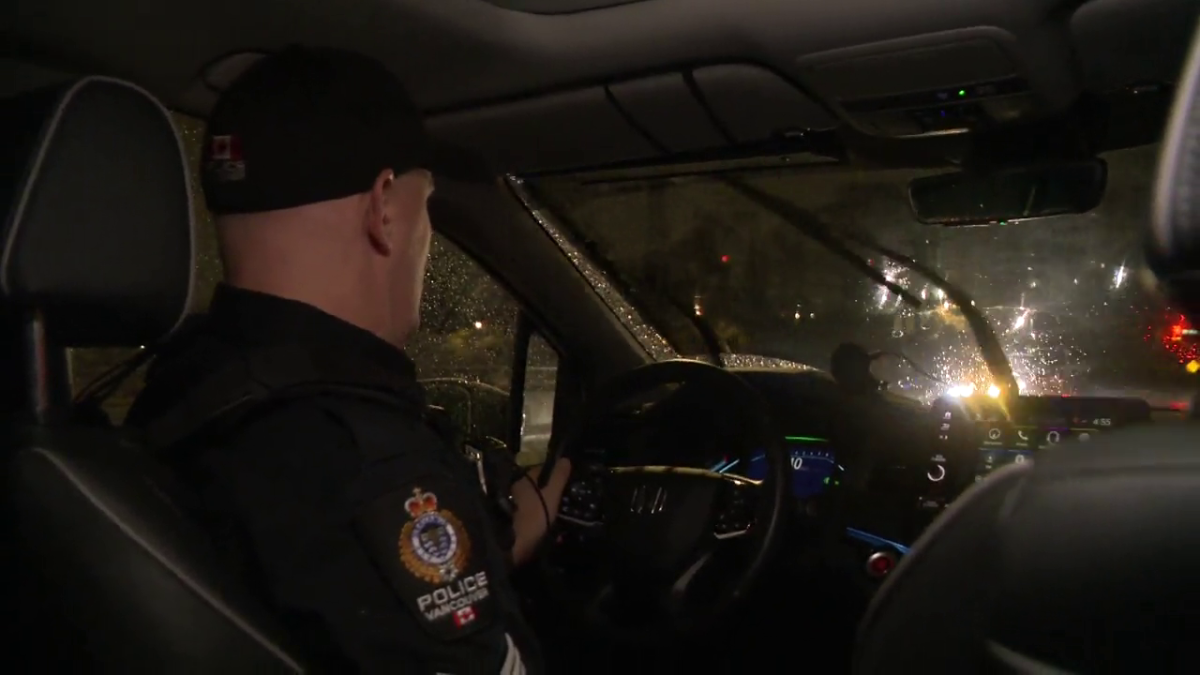
Vancouver police are targeting speeding and other dangerous road behaviour through Project Vigilance, a month-long traffic enforcement campaign aimed at reducing serious collisions during the darker, wetter months.

A morning ride-along with Vancouver police showed just how quickly routine traffic enforcement can escalate from a speeding ticket to a vehicle impoundment.
Officers monitoring a 50 km/h zone stopped several drivers travelling well above the posted limit, including one clocked at 96 km/h.
That driver was issued a $368 ticket, received three penalty points and had the vehicle impounded for seven days, according to police.
Sgt. Ryan Wray said the morning was typical of what officers encounter while targeting some of the highest speeds on major routes into Vancouver.
“We’re out there targeting the highest speeds,” Wray told Global News. “What we saw today was many drivers who were travelling in excess of 80 kilometres an hour on surface roads.”
Another driver was clocked at 92 km/h in a 50 km/h zone. Wray said that speed fell into the excessive-speed range, but the officer exercised discretion and issued a $196 speeding ticket instead of impounding the vehicle.
Wray said discretion can be appropriate when a driver’s measured speed is close to a threshold. Driving history can also factor into an officer’s decision, he said.
That discretion wasn’t extended to the motorist clocked at 96 km/h. Wray said a check showed the driver had three previous speeding convictions as well as a previous conviction for excessive speeding.

Get breaking National news
“In this instance, it wouldn’t be appropriate to give a warning or reduce the fine because of the past history,” he said.

Wray said officers aren’t focused on motorists travelling only a few kilometres over the limit.
“We’re not out pulling people over for doing 57 kilometres an hour in a 50 zone,” he said.
Instead, the campaign is targeting driving and road behaviour police believe presents the greatest danger to others.
The Vancouver Police Department (VPD) launched Project Vigilance this month, focusing on high-risk intersections and corridors, including school zones. Police said enforcement would include speeding, distracted and impaired driving, jaywalking and helmet use.
Wray said the project also extends beyond motorists to cyclists, pedestrians and people using e-scooters.
“The hope is that by doing so we can educate people to change their behaviour in a manner that’s going to keep everybody safe,” he said.


Police say the timing is deliberate.
Wet roads, longer periods of darkness and reduced visibility can make it more difficult for drivers to react and stop, while pedestrians and other vulnerable road users can be harder to see.
Wray said drivers can underestimate the impact speed has on their ability to avoid a collision, particularly in poor weather.
“The level to which somebody has to be speeding to fall into the excessive category means that they are travelling in excess of 40 kilometres an hour above the speed limit,” he said.
“Stopping distances are increased. And in particular with wet weather … people tend to underestimate their own speed and have a sense that they have more time than they do have in the event that they’d have to avoid a collision.”
The VPD has also been focusing attention on e-scooter safety. Its Project Vigilance announcement followed several serious road incidents in Vancouver and said officers would continue enforcement and education aimed at people using different modes of transportation.
Wray, who said he has been with the Vancouver Police Department for almost 25 years, said officers regularly see some road users behaving far outside the norm, whether they are motorists, cyclists, pedestrians or scooter riders.
Those decisions, he said, can have consequences well beyond a traffic ticket.
“These are not just stats on paper,” Wray said. “These are people whose lives have been altered forever and, in the worst cases, people whose families have been impacted for years beyond the incident itself.”
His message to people sharing Vancouver’s roads is simple.
“We are all in this together; we are all busy, we’re all trying to get places and regardless of our mode of transportation, we need to be considerate of those around us.”


Comments
Want to discuss? Please read our Commenting Policy first.