




The soaring number of people killed on Calgary roads shows no sign of letting up, despite pleas from the city and police for people to slow down and pay more attention to their surroundings.

Calgary police said there were nearly 8,700 crashes between Jan. 1 and April 30 of this year, and about 900 of them have involved injuries to pedestrians and motorists.
While the total number of crashes is down compared with last year, when there were just over 9,500 crashes, there have been 10 people killed this year, including five pedestrians.
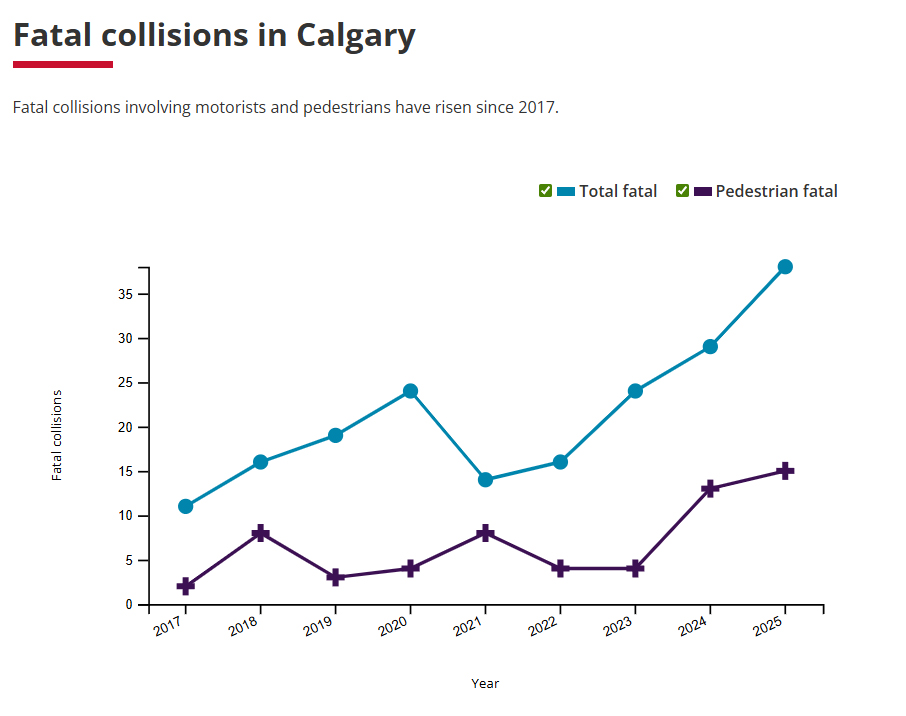
That’s two more deaths than during the same period in 2025 and puts Calgary on pace to surpass last year’s grim total of 38 fatal crashes, including 15 pedestrians, which was the highest total in more than a decade.

Jacob Lamb, a professor at the University of Calgary’s Schulich School of Engineering, says research from across North America shows that increased urbanization and the increasing size of vehicles are factors in many crashes.
“As we move into the 21st century — in general, as well, vehicles got a lot larger — we saw a massive increase in SUVs over sedans. So right now it’s more than 90 per cent, I believe, at last count of vehicles sold in Canada are SUV class or above. These vehicles are taller, tend to have worse visibility, actually — even though they might feel that they have better visibility for them — particularly vulnerable road users, so pedestrians and cyclists,” Lamb said.

Reducing the number of crashes, Lamb said, will need to involve not just drivers and vehicles, but also safer road designs and long-term urban planning, which is part of what the City of Calgary’s Safer Mobility and Vision Zero plans — to reduce the number of serious injuries and fatalities in the city — are about.


As an example of what is achievable, he points to Helsinki, Finland, where the population of the metropolitan area is more than 1.5 million people and it has a similar climate to Calgary, but where Lamb says there have been no deaths on its roads since July 2024.
“If we look at the rate — a per capita incidence — it is vastly much lower than Calgary. And we can compare a lot of things that Helsinki is doing to have achieved this vision zero. They’ve redesigned streets to make them safer intersections, elevated crosswalks, improved lighting. They’ve lowered their speed limit across the city, which Calgary did to 40 in many places, but in Helsinki, it is now 30,” Lamb said.
“They’ve encouraged a lot more active mobility, cycling and public transit enhancements as well as stepping up enforcement. So recognizing that vision zero that’s part of the Calgary Safe Mobility Plan, that safe system approach of tackling and addressing all those different contributors to road collisions, the speeds, the road users themselves, the vehicles, the road design and the land use plan.”

Get daily National news
Lamb says the trends Calgary is now seeing are the result of decisions made decades ago and changing them will take time, so we may not see the benefits of any changes now being made for decades to come.



Hammer down, motherfuckers!
Yes blame the SuV’s same old same old. I drive the city for a living. I see multiple jay walkers a day and a least one person a day walkout into the street on their phone. This isn’t counting the fentinalers. Maybe see both side of the equation. Especially if your comment represents a center for “higher learning “
How many cars are owned in Helsinki? How many kilometres are these cars driven daily? What condition are roads there in winter? What penalties are imposed on drivers at fault? What are accident rates like in other Canadian cities per capita? And so on.
A special thanks to all the oblivious brown stain durka durkas that flood here from third-world countries where the rules of the road are only a suggestion!
“The rate of incident for people within a vehicle has gone down in a per-kilometre basis”
so despite the title, things are getting better in Calgary. Great!
Not sure how the author thinks the size of the vehicle has any bearing on the number of crashes.
Maybe new Canadians who don’t understand traffic signs and who have ‘dodgy’ drivers licenses. Also pedestrians who walk around with ear buds or cell phones.