


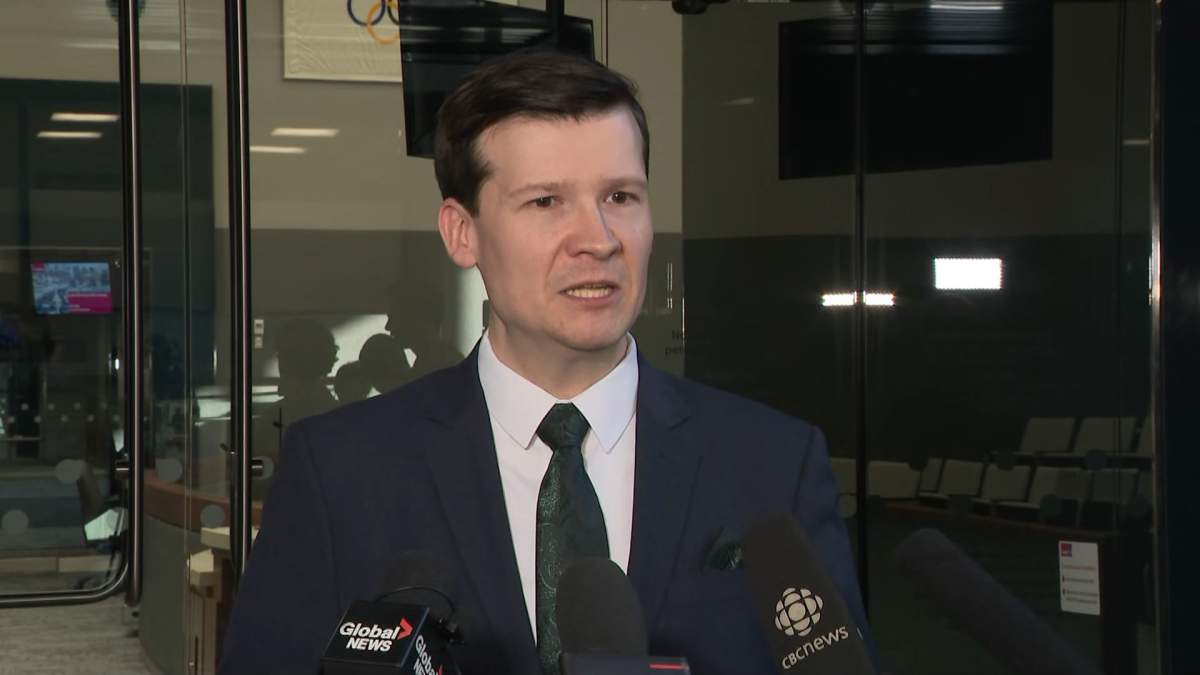
“We have a huge deficit, so that means the debt is going up, spending is going up, and taxes are going up. So it was really terrible to see this today,” said Kris Simms, Alberta director for the Canadian Taxpayers Federation, when asked her reaction to the 2026 Alberta budget that was tabled in the legislature on Thursday by provincial finance minister Nate Horner.

The biggest news out of the budget is a predicted $9.4-billion deficit, which the UCP government blamed on lower than expected oil prices and higher than expected spending due to rapid population growth.

Opposition NDP Leader Naheed Nenshi said the budget shows the UCP has mismanaged the province’s finances, broken its own rules, and lost the moral authority to govern.
He said the budget, despite record levels of oil production, makes the cost of living more expensive with a string of new fees — $360 million this year alone – while failing to solve fundamental problems in health care and education.
And to top it off, he said, “Danielle Smith and the UCP have saddled future generations, our kids and our grandkids, with billions and billions of dollars in debt with no path to balance.”
Premier Danielle Smith has been signaling for weeks that the deficit would be “significant,” but also promised there would be no tax hikes or “deep” service cuts to combat the deficit.
However, among the new fees and levies included in the budget are big increases in the education property tax that municipalities collect on behalf of the province, that will cost the typical homeowner in Calgary $340 more a year and in Edmonton, $154 more.
![Kris Simms, Alberta Director of the Canadian Taxpayers Federation called the province's decision to hike many fees and levies as "sneaky ways of having tax hikes without trying to call them tax hike." [00:01:33][6.2]](https://globalnews.ca/wp-content/uploads/2026/02/taxpayers_1.jpg?quality=65&strip=all&w=1200)
As for where the province could cut spending, Simms said the government should “go through AHS with a fine-toothed comb.”
“Why do we still have directors directing directors there, all making well over a hundred grand?,” asked Simms.

Get breaking National news
“If they would have just cut that number of directors in half, taxpayers would be saving more than $20 million,” added Simms, saying “It shows a lack of fiscal responsibility and accountability.”
She said the province also “could’ve gotten rid of all corporate welfare — that includes not giving millions of dollars to NHL teams for arenas and plazas because they want them.”

Calgary Mayor Jeromy Farkas reacted by taking aim at the province’s decision to hike education property taxes.
“Calgarians at this point are contributing more than ever before in provincial property taxes and the provincial portion of the property tax increased by 15.6 per cent in 2025 and we’re going to see a very similar increase in 2026. This represents an increase of more than 30 per cent over the past two years. An equivalent to a total of more than $1.1 billion annually,” said Farkas.
“We’re pretty much on track for having about a 50-50 share of property taxes being delivered to the city and to the province. What this means essentially is that we’re getting very close, perilously close, to half of every property tax dollar being collected in the City of Calgary going to the provincial government to fund provincial priorities without a very clear line of sight in terms of whether that’s being invested back here in the city of Calgary.”
“If property taxes are being jacked up for Calgarians and that money is being spent elsewhere in other municipalities, we’re just seeing another version of equalization like Alberta is being taken advantage of in total, when we think about confederation,” said Farkas, who suggested the province could also take a lesson from Calgary’s new city council on how to control the tax increases.
“Our focus as a council has been doing our fair part. We inherited about a six per cent property tax increase proposed by our city administration at the end of last year. We did the hard work to lower tax increase to about 1.6 per cent.”
“We did that at the same time as investing in critical infrastructure,” added Farkas, pointing to the need for the city to replace the “terminally ill” South Bearspaw Feeder Main at a cost of $200 million as an example.


“We’ve done our part and we’re calling on the provincial government to do their part, too.”
Farkas’ counterpart in Edmonton, Andrew Knack, was also critical of the failure by the provincial government to include more funding for critical infrastructure projects.
“Through consecutive provincial governments for the last 15 years — this is an issue that municipalities across the province continue to face — what is the plan to begin to start to address that? We appreciate it’s a tight budget, but what is that forward-looking plan that allows municipalities to start catching up with the incredibly rapid population we’ve been seeing over the last 15 years and how can we work together to make sure we’re serving the folks we represent across the province.”
As for the hike in the education property tax, Knack called it “a good investment” and said the city of Edmonton will “happily collect” the additional money for the province if it’s used to help build and staff more schools.
Overall, Knack was more conciliatory than Farkas, saying “since becoming mayor, it’s been about four months and I’ve had some incredible conversations with the premier and a number of ministers. I felt it’s very constructive.”
“At the end of the day, it’s what I expected. I think it’s a very sort of neutral budget,” added Knack.
His comments a sharp contrast to Kris Simms of the Canadian Taxpayers Federation, who said, “I can’t really think of good things to say on this budget.”
This year’s $9.4 billion deficit is also forecast to be the first of three years of the province being deep in the red, with forecasted deficits in the following years of $7.6 billion and $6.9 billion.



NDP talking about DEBT, OMG. Alberta had $20Billion DEBT in 2015, NDP & NUTLEY took over & in 4 Years the UCP inherited $82 Billion debt from the NDP. In 2026 the Total Debt is $90 Billion, best debt/Citizen in the Country. Add that to Lowest Taxes, No PST, Best Economy, Best Job Creators & affordable Housing & rent etc, yet Alberta is so BAD, Ontario $461 Billion Debt, Canada $1.3 TRILLION Debt, so tell me again who is Managing their Economy, ALBERTA UCP.
A little increase to the education property taxes. The UCP should have passed on the entire amount that the teachers got in wage increases. If the taxpayers saw a jump of $600 to $800 on their education portion of their property taxes maybe the public would think twice about supporting teachers fat wage increases.
..Global quoting Canadian Taxpayer Federation, biggest part of story. How low can they go?