


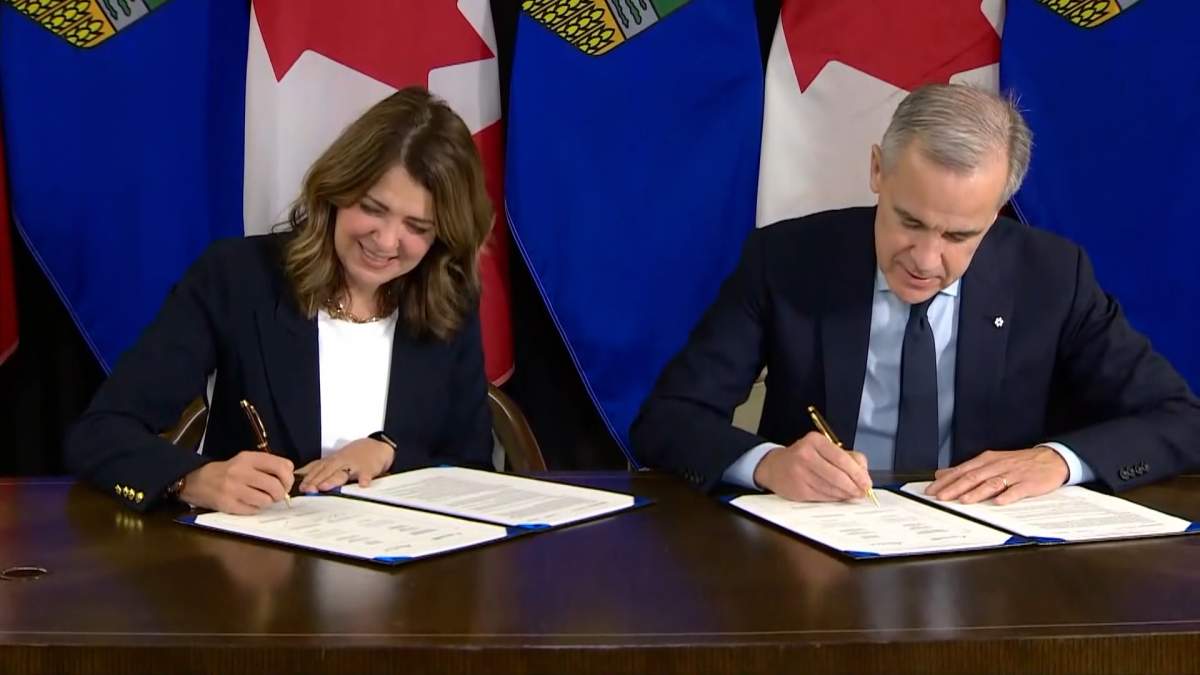
Prime Minister Mark Carney and Alberta Premier Danielle Smith have signed a memorandum of understanding that commits them to working toward building an oil pipeline to the West Coast.

At a signing ceremony in Calgary Thursday, the two agreed to terms that commit Ottawa to adjusting the West Coast tanker ban if a pipeline project is approved as a project of national interest under the Building Canada Act and provides “opportunities for Indigenous co-ownership and shared economic benefits.”
It also says Alberta will implement an industrial carbon price of $130 per tonne by April 1 — bringing it above the federal benchmark — and that Ottawa will immediately suspend the clean electricity regulations in the province pending a new carbon price agreement.
The agreement pairs the pipeline project to the proposed Pathways Alliance carbon capture project and government officials say the two projects must be built in tandem.
Carney described the signing as “a great day for Canada” that sets the stage for “an industrial transformation” that will make the country stronger.
But, he also admitted there is more work to do, specifically to get the government of British Columbia and B.C. First Nations to agree to construction of the pipeline.
On Wednesday, a group of First Nations in B.C. said a pipeline to the Pacific coast will never be built, and B.C. Premier David Eby has said lifting the tanker ban would threaten other projects already in development in the region.
In a press conference following the signing, Smith insisted the MOU does not give B.C. or First Nations a veto over the project, but she also admitted there is a need for more consultation and believes it is imperative for First Nations to have an ownership stake in the project.
“We’re looking forward to having genuine consultation and ownership,” said Smith.


“As for Premier, Eby, I spoke with him last night and there’s lots of the agreement that we can focus on together. We may not be in agreement with everything that is in this proposal, but we’re going to have trilateral talks to make sure that we can move forward on the elements in this plan.”

Get breaking National news
The MOU signed Thursday says Ottawa and Alberta will engage with B.C. on the pipeline development and work with the province to advance its economic interests through other projects of national interest.
Speaking during a visit to a local Iron Workers union office following the signing, Carney avoided answering a question about whether Ottawa is willing to approve construction of the pipeline without the agreement of the B.C. government or First Nations.
“Several things have to happen before a pipeline is built, and one of those is a private sector proponent,” said Carney.
“Secondly, there needs to be full partnership, including equity ownership, substantial economic benefits with First Nations, First Nations in Alberta, First Nations in British Columbia, as well as agreement and substantial economic benefits for the people of British Columbia. So we look at this as the start of a process,” Carney added.
Speaking to reporters in Regina on Thursday, Saskatchewan Premier Scott Moe described the MOU signing as a positive step for his province, saying any new pipeline could be used to help deliver more Saskatchewan oil to overseas markets.
But echoing comments from Carney and Smith, he said there’s still a lot of work to do to obtain the support of both Indigenous and non-Indigenous communities.
“Ultimately at the end of the day the province of British Columbia will represent the the people of British Columbia. But I would say there’s a broader opportunity for Canadians and for British Columbians to really share in the wealth that this type of economic infrastructure can create, which should be also good for all levels of government and good for Canadian families,” said Moe.
However, B.C. Premier David Eby reacted to the signing of the MOU by saying Alberta’s and Ottawa’s efforts to build a pipeline risk “taking our eye off the prize, of distracting the federal government and distracting resources from (other) real projects that can be delivered in the near term.”
As an example, Eby pointed to the proposed LNG Canada Phase Two project in Kitimat, B.C., that has already been selected as one of Ottawa’s major nation-building projects and is expected to attract $33 billion in private-sector investment.

“For this new pipeline proposal, it has no company that has stepped up and said even under the most optimistic conditions, they would be interested in building it; that if it were already built, they would be interested in buying it. Which leaves only one possible way it could get built, which is through massive, taxpayer-funded support,” said Eby.
“British Columbia has some projects that could compete with this one that would create just as much opportunity and be significantly cheaper to taxpayers, but we’re not even asking for taxpayer dollars,” added Eby.
There is unlikely to be a proponent and even if there were a proponent, one of the key hurdles of coastal First Nations support has not been achieved and it has been their position since 1977 that the oil tanker ban needs to be in place because if there were an oil spill their way of life would end as would $1.7 billion in economic activity on the coast.



Comments
Want to discuss? Please read our Commenting Policy first.