


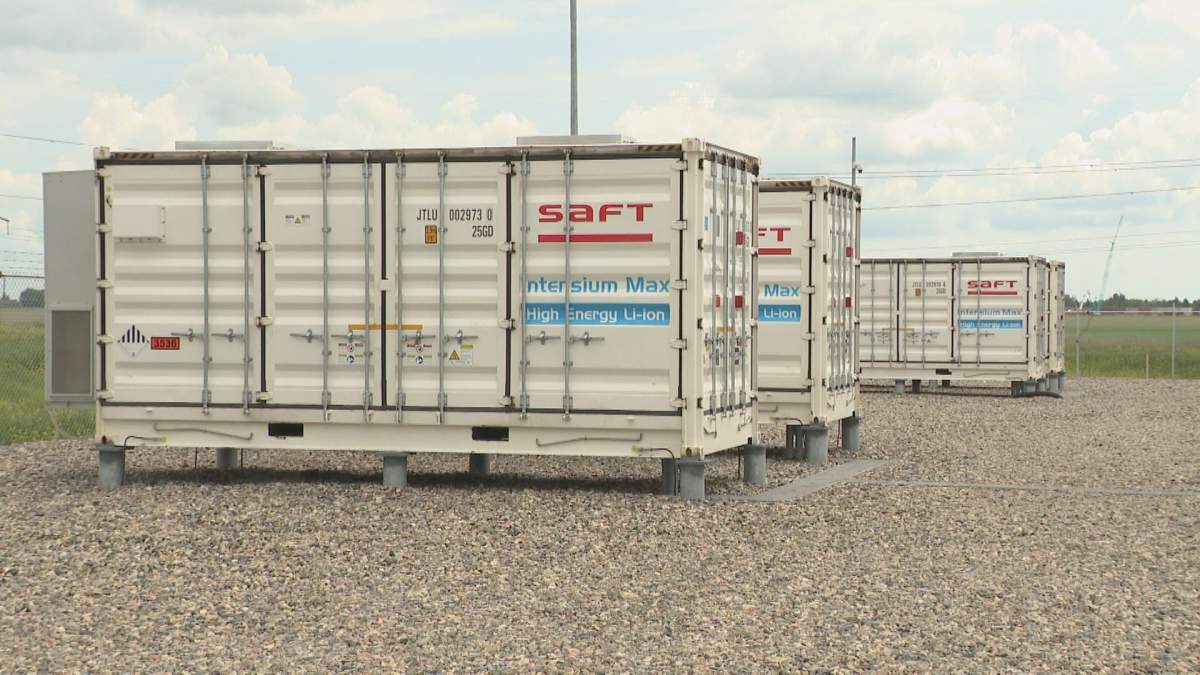
An event was held on Wednesday afternoon to mark the commissioning of Saskatchewan’s first-ever utility-scale battery energy storage system (BESS), which is now online.

The system can provide up to 20 megawatts of power to the grid, which is the equivalent of powering up to 20,000 homes for one hour.
Rupen Pandya, SaskPower’s president and CEO, said this is a historic day for SaskPower as it marks the official commissioning of the first utility-scale BESS into the company’s fleet.

Get breaking National news
“This is a first-of-a-kind project that our company is endeavoured on, and it is a welcome addition to the entire SaskPower system,” Pandya said. “Battery energy storage provides flexibility to our grid because it can respond quickly to short-term power fluctuations, and it also supports our goal of achieving net zero greenhouse gas emissions by 2050 or sooner.”
The Saskatchewan minister responsible for SaskPower said the addition of battery storage will enable SaskPower to better respond to the fluctuating demands of the province’s electrical grid.
- Saskatchewan Premier Scott Moe talks trade at international conference
- Thieves cut hole in roof at Kelowna Curling Club in elaborate break-in, theft
- Calgary’s GlobalFest moving locations, leaving community in lurch
- Progress slows on Calgary housing strategy due to rezoning repeal, resource constraints
-
![]() Canadian government short on rolling back international student permits, report reveals
Canadian government short on rolling back international student permits, report reveals -
![]() U.S., Russia interfering in Alberta separatist debate, report says
U.S., Russia interfering in Alberta separatist debate, report says -
![]() Canadians can trust ChatGPT to handle personal data, federal privacy watchdog says after review
Canadians can trust ChatGPT to handle personal data, federal privacy watchdog says after review -
![]() Social media issues should be fixed before considering ban for youth: Canada’s privacy commissioner
Social media issues should be fixed before considering ban for youth: Canada’s privacy commissioner


“SaskPower’s clean energy transition is well underway and will only accelerate in coming years, with up to 50 per cent of power coming from renewables by 2030 and 3,000 MW of renewables added to the grid by 2035,” Dustin Duncan said.
“Battery energy storage has the potential to enable and support renewable power development for years by balancing the demand for power with the availability of clean energy generation. The Regina battery energy storage system is just the first step down that road.”
BESS construction began in 2022 in Regina. The facility cost $34 million to build.


Comments
Want to discuss? Please read our Commenting Policy first.