






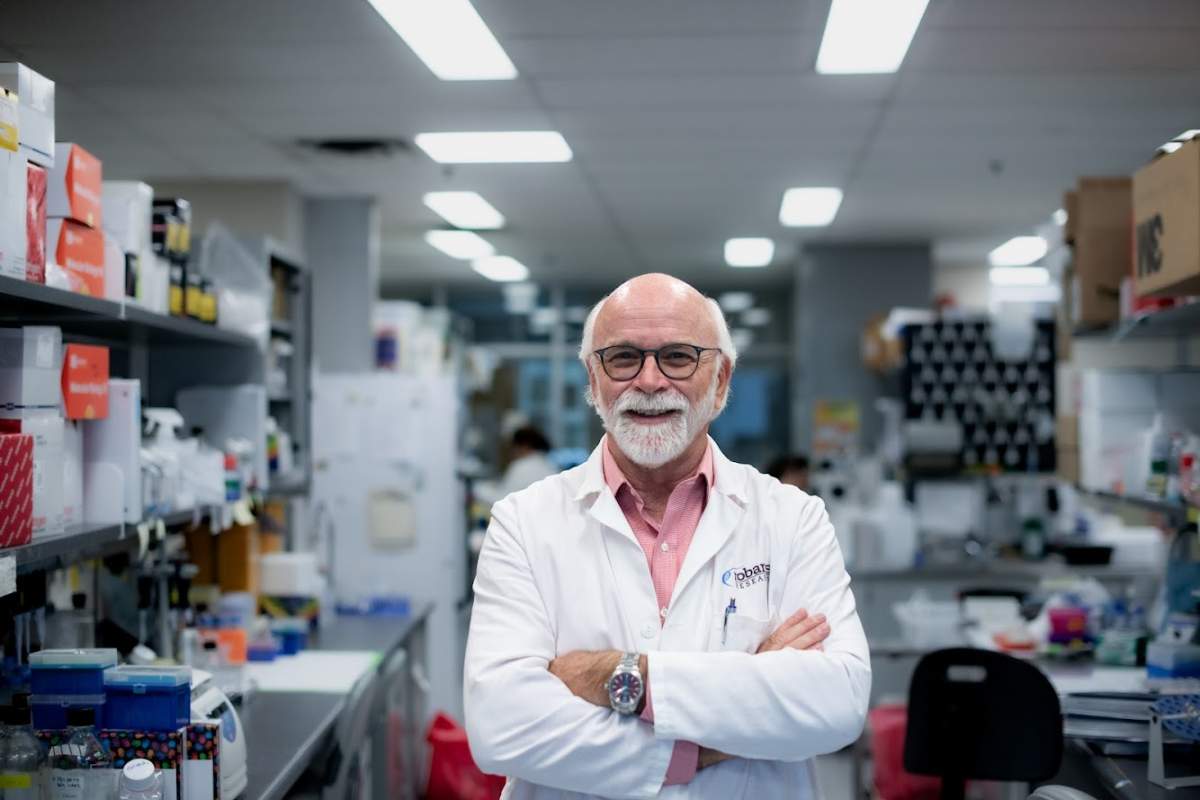
Fueled by a $10-million donation from the Temerty Foundation, a possible new amyotrophic lateral sclerosis (ALS) treatment could move to clinical trials in three to five years.

Researchers at Western University have made a discovery, showing that a protein can reverse, halt or prevent the death of motor neurons, which are responsible for movement. ALS, also known as Lou Gehrig’s disease, is caused when nerves that supply the muscles seem to die. The research at the university is led by Dr. Michael Strong, who has been studying ALS since the 1980s.
“For the vast majority of patients who have Lou Gehrig’s disease about 90 per cent of them,” says Strong. “When we look at their motor neurons in the spinal cord under a microscope after they’ve died, we see the accumulation of protein in their motor neurons.”
ALS is a debilitating neurodegenerative disease that progressively impairs muscle control, leading to paralysis and death. The protein at play is referred to as TDP-43, and the second protein (RGNEF) counteracts the one seen in ALS cases.
The current life expectancy of an ALS patient post-diagnosis is between two and five years. This research provides the opportunity to get their life back. Not only this, but the interaction of the two proteins could be a first step in finding treatment for other related neurological conditions like frontotemporal dementia.
Though protein is inherently normal, it becomes abnormal in location and how it’s functioning. However, this breakthrough in research shows a second protein that seems to counteract that. Currently, this protein has been used in animal trials.

Get weekly health news
In fruit flies, the average lifespan is between 60 and 90 days, but if they have the protein responsible for ALS, they could not walk within a week or two. With the protein that counteracts the process, they lived and functioned the same amount of time. Following this discovery, researchers moved on to mice.
“We can see quite a striking difference,” says Strong. “And now we have a pretty good idea of exactly how the two proteins interact.”

In the early 2000s, a colleague of the research team at Western University noticed a protein in mice which caused difficulty in muscle function when abnormal. The team was able to find there is a very similar protein in humans, which can reverse the process or at least pause it from further deterioration. When modified with the protein, the mice would die within 10 to 20 days, but with the second protein, they were still alive at 18 weeks.
“The importance of the report today is identifying that this protein exists, showing it actually works on two different animal models and providing some insight into how it would work,” says Strong. ‘The important piece then comes over the next three to five years.”
Researchers have spent the past 15 or so years working on this project, and the first clinic for ALS was established around the 1980s. The risk of getting ALS is around one in 300 or one in 400, averaging to around two per 100,000.


“When you think about London, we’re 400,000 people, so you’d expect to see between eight and 10 ALS patients every year,” says Strong. “And yet we see far more than that. I’m seeing two or three new patients every week, so this is a very common disorder.”
The study began with identifying to most significant part of this larger protein, and over time became more specific. Strong says its like looking at a yard stick, which is too big to look at in detail, but the first two inches is not. Over time, when narrowing down which of those two inches is most relevant, it can be brought down to one inch, then half an inch, until the exact area is isolated.
“We think this is a really important region that is actually affecting how this protein works against the process that’s at play in Lou Gehrig’s disease,” says Strong. “That’s what we did, we managed to trim this whole thing down to get to the finest little part. And then once we would identify that part of it so that one inch from that yardstick.”
Though not often considered, ALS is one of the big three for degenerative neurological diseases of aging, along with Alzheimer’s and Parkinson’s. There are currently medications available that can treat several features of ALS, but nothing that will stop it.
“We have two rare genetic variants of ALS, they’re less than 1 per cent of patients, but its that 1 per cent that really proves that you can do something that will change the course of its disease,” says Strong. “This is a real signal of hope for ALS patients and their families.”
“It’s not today that’s going to be effective, but after years and years of work, I’m really comfortable (saying), ‘Look, we’re on the right path now to actually having something that will work.’”
The study has been published in the journal Brain.


My husband had ALS/MND programme about 4 months ago. he no longer requires a feeding tube, sleeps soundly, works out frequently, and is now very active. It doesn’t make the ALS go away but it did give him better quality of life. we got the treatment from limitlessnaturalwellness. com
I was living a normal life with my family when, at 52, I began experiencing muscle stiffness and twitching. After seeing a neurologist, I was diagnosed with ALS. It was a tough reality, and as the disease progressed, I eventually lost the ability to walk and relied on a wheelchair. A friend recommended Limitless Herb Center (www. Limitlesshealthcenter .com), where I began their ALS/MND protocol. After about three months, I noticed significant improvements, less stiffness, fewer symptoms, and I was able to walk distances again.