

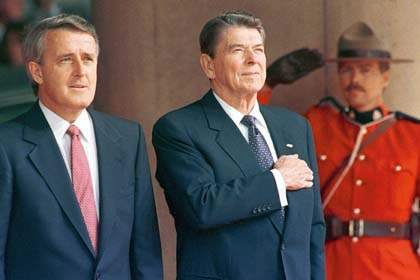
The latest bilateral meeting between Canadian Prime Minister Stephen Harper and U.S. President Barack Obama has prompted us to look back at past relationships between leaders of Canada and the United States.
Roosevelt & King
On August 18, 1938, with both Canada and the U.S. trudging through a recession and Nazism taking root in Europe, President Franklin Roosevelt visited Queen’s University to receive an honorary degree.
The president delivered a groundbreaking speech.
“I give to you assurance that the people of the United States will not stand idly by if domination of Canadian soil is threatened by any other Empire,” he said, bringing the crowd to its feet.
It was a break from isolationist American foreign policy, and in a historical context, the pledge changed Canada-U.S. relations forever.
Despite the fact that Roosevelt and Prime Minister Mackenzie King governed during one of the most volatile times in recent history, the two maintained a close friendship.
The day after he was sworn in to office in October 1935, King visited American Minister to Canada Norman Armour. The meeting set the stage for a Canadian-American trade agreement signed by King and Roosevelt the next month.
Roosevelt visited Canada a record eight times during his first three terms, and had a summer home on Campobello Island, off New Brunswick.
The friendship between the two leaders developed in meetings leading up to and after the outbreak of World War II. On August 18, 1940, King and Roosevelt signed the Ogdensburg Agreement, setting up a Permanent Joint Board of Defence, tightening the countries’ defence bonds.
In a 1943 speech to Parliament, Roosevelt said to the Prime Minister, “Mr. King, my old friend, may I through you thank the people of Canada for their hospitality to all of us. Your course and mine have run so closely and affectionately during these many long years that this meeting adds another link to that chain.
“I have always felt at home in Canada and you, I think, have always felt at home in the United States.”
Kennedy & Diefenbaker
John Diefenbaker shared an amiable relationship with Dwight Eisenhower, but the niceties ended when John F. Kennedy moved in to the White House in 1961.
Kennedy visited Ottawa in May of that year and told parliament, “Geography has made us neighbours. History has made us friends. Economics has made us partners. Necessity has made us allies.”
But behind the scenes, the relationship was far less cordial. Kennedy was pressuring Diefenbaker to increase NATO contributions and defence spending, and to join the Organization of American States.
Kennedy mentioned the OAS issue in his speech to parliament after Diefenbaker had already declined, angering the prime minister.
Kennedy’s staffers accidentally left behind a strategy memo, confirming their intentions of pressuring Canada on certain issues. Diefenbaker reportedly kept the document to use against Kennedy at a later date, angering the White House.
Kennedy failed to consult Diefenbaker before announcing the blockade of Cuba in 1962 – a violation of the NORAD agreement.
The U.S. then requested that Canada place its forces on alert, to which Diefenbaker did not respond. Canadian Defense Minister Douglas Harkness acted in defiance of Diefenbaker and readied Canada’s NORAD forces.
The PM was quoted as calling Kennedy “a boastful son of a bitch,” while Kennedy said Diefenbaker was “boring” and “a prick.”
Johnson & Pearson
If the Diefenbaker-Kennedy relationship didn’t bring Canada-U.S. relations down enough, Lyndon Johnson and Lester Pearson took the special relationship to a new low.
Pearson resisted pressure by the U.S. to become involved in the Vietnam War, and in 1965, gave a speech at Temple University in Philadelphia that called for an end to U.S. bombing of North Vietnam.
Johnson was livid. The president called Pearson to Camp David, where he reportedly picked Pearson up by his shirt collar and shook him, telling Pearson not to “come into my home and piss on my carpet.”
The two leaders had a bad relationship from the start. At the first Washington summit between the two in January 1964, Pearson is reported to have gossiped during dinner with Secretary of State Dean Rusk – a fellow Oxford alumnus – which upset Johnson.
The two met again at the LBJ Ranch in Texas one year later, where Pearson showed up in a full black suit, the formal diplomatic attire. Johnson was decked out in a cowboy hat, boots and dungarees.
The leaders held a press conference, where Johnson reportedly referred to Pearson as “Prime Minister Wilson.”
Nixon & Trudeau
The Nixon-Trudeau relationship was another acrimonious one between Canadian and American leaders.
Nixon was recorded calling Trudeau “an asshole” and a “pompous egghead” on the infamous Oval Office recording system after a two-hour discussion of trade issues with the prime minister.
Upon hearing this, Trudeau is quoted as saying, “I’ve been called worse things by better people.”
We also now know that the FBI watched Trudeau very closely. The agency released a 161-page file on the prime minister after his death in 2000.
Canada’s lack of commitment in Vietnam was a major factor in the tense relationship. But apart from Vietnam, Canada was generally in harmony with Nixon’s policies.
According to former Secretary of State and National Security Advisor Henry Kissinger, Nixon “accorded Trudeau both respect and attention.” Kissinger said that although the two leaders were formal, they were productive and polite.
Indeed, after the assassination of Quebec cabinet minister and Trudeau friend Pierre Laporte by the FLQ, Nixon called Trudeau to offer his condolences. Trudeau reportedly appreciated the gesture.
Trudeau was known to have little interest in U.S. news; his former campaign manager Keith Davey once said, “The only American media he bothered following was American movies.”
But Trudeau was the first foreign leader to visit Nixon at the White House in 1969, and became one of only three Canadians to address Congress on February 22, 1977 (the others were Governor General Vincent Massey in 1954 and Prime Minister Brian Mulroney in 1988).
He also sent Marcel Cadieux as ambassador to Washington, one of the country’s best and most experienced diplomats.
Reagan & Mulroney
Relations between the two countries got cozy with Prime Minister Brian Mulroney and President Ronald Reagan.
Mulroney believed that the Trudeau government had allowed the relations between the two neighbours to deteriorate, and made Canada-U.S. relations a major priority.
The relationship was epitomized by the leaders, both with Irish ancestry, singing a duet of “˜When Irish Eyes are Smiling’ at the St. Patrick’s Day “˜Shamrock Summit’ in Quebec City in March of 1985.
In fact, the press criticized Mulroney for being too close to Reagan leading up to the signing of the Canada- U.S. Free Trade Agreement three years later.
Other Canadian governmental officials were not as welcoming of the president as Mulroney. During the president’s next visit, he was met by jeers and catcalls while he made a speech to parliament.
An embarrassed Mulroney watched as NDP MP Les Benjamin yelled “He’s mad!” and fellow MP Svend Robinson called out “Stop Star Wars now!”
Star Wars referred to Reagan’s Strategic Defence Initiative, which was one of the relatively few irritants in the Canada-U.S. relationship at the time. Mulroney supported the program, but heavy opposition forced the government to decline participation.
After Reagan’s death in 2004, Mulroney visited the presidential guest quarters near the White House to offer his condolences to former first lady Nancy Reagan. “I have been truly blessed to have been a friend of Ronald Reagan,” said Mulroney.
“I am grateful that our paths crossed and that our lives touched. I shall always remember him with the deepest admiration and affection.”
Mulroney recalled teasing Reagan that the Los Angeles Kings would not be championship contenders without Canadian acquisition Wayne Gretzky.
“Well,” Reagan reportedly replied, “That’s free trade.”



Comments
Want to discuss? Please read our Commenting Policy first.