


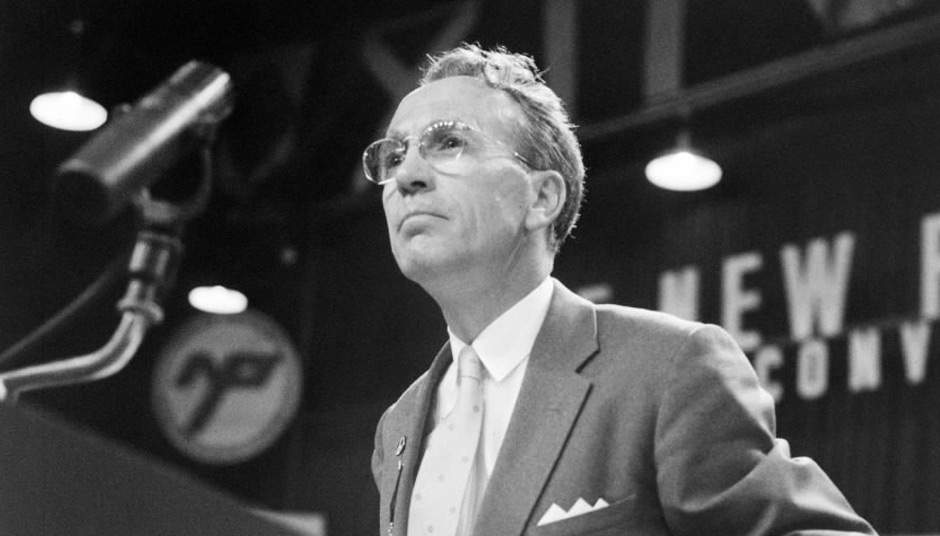
On Wednesday, opening arguments were heard in the court battle over decades-old intelligence files on Tommy Douglas.
Douglas, sometimes referred to as the ‘father of Canadian health care,’ was spied on by the RCMP from the late 1930s to shortly before his death in 1986.
A number of declassified documents show that the Mounties attended his speeches, dissected his published articles and, during one Parliament Hill demonstration, eavesdropped on a private conversation. Hundreds of other pages, though decades old, remain completely sealed.
Who was Douglas, and why was the RCMP so interested in him? Global News takes a closer look at the Canadian socialist icon.
He was born in Falkirk, Scotland in 1904.
He lived there with his working-class family before they moved to Winnipeg in 1910, at the age of six. Winnipeg was the centre of a working class movement in the country at the time.
Douglas left school at 14 to become a printer’s apprentice. As a teenager, he witnessed the police suppression of the Winnipeg General Strike in June 1919.
In later years, Douglas would reveal the impact this had on his perception of organized labour in the country.
He looked down on to Main Street from a rooftop as police charged at protesters and street cars were lit on fire by demonstrators.
Douglas became involved with the Labour party in the 1920s, and trained to be a Baptist minister.
By 1930, he was officially ordained, and was soon preaching full-time at a ministry in Weyburn, Saskatchewan. He married a musical student in Brandon named Irma Dempsey.
The couple would have two daughters. One of their girls, actor Shirley Douglas, would marry actor Donald Sutherland, and the pair would have a son, Kiefer.
Medicine to ministry
After receiving an MA from McMaster University by correspondence, Douglas enrolled at the University of Chicago medical school.
But the pull of preaching was too much, and Douglas abandoned his plan in order to continue working full-time at a ministry in Weyburn.
As a minister, Douglas preached the social gospel, which combined elements of Christian belief with social reform. The hardship of the Great Depression in Saskatchewan got him interested in politics.
Douglas created a branch of the Independent Labour Party in Weyburn, and helped create the Co-operative Commonwealth Federation (CCF), a political party that joined a number of socialist, farming and labour groups.
He entered politics, as a candidate for the Farmer-Labour Party in the Saskatchewan provincial election in 1934, but was defeated.
But the following year, he won a federal seat in the 1935 election as a candidate for the CCF.
As a CCF MP in 1939, Douglas urged a group of labourers in downtown Ottawa to push for legislation beneficial to the unemployed.
This is the event that first attracted the RCMP’s attention. A constable quietly attended the session, filing a secret two-page account to superiors.
The RCMP kept the file open and spied on Douglas until shortly before his death in 1986.
A number of declassified documents show that the Mounties attended his speeches, dissected his published articles and, during one Parliament Hill demonstration, eavesdropped on a private conversation.
Back to provincial politics
In 1944, Douglas left federal politics to return to the provincial fold, this time to as the leader of the Saskatchewan CCF party. A CCF victory that year made Douglas premier of the province.
Douglas’ administration was the first provincial government to enact hospital coverage (in 1947) and medical coverage (in 1962).
A royal commission recommended a national health care system modeled on the Saskatchewan plan, and four years later the Medical Care Act was passed, earning Douglas the nickname "the father of Canadian health care."
Under Douglas, the party would go on to win four more elections in Saskatchewan, before he resigned in 1961 to become the first leader of the federal New Democratic party.
As the politician became more prominent, the RCMP’s interest in him increased.
In late 1964, the RCMP received a letter alleging that Douglas had once been an active member of the Communist party at the University of Chicago, where he had done postgraduate studies.
A top secret memo from a senior RCMP security officer to the force’s deputy commissioner of operations indicates there was no reliable information to substantiate the tip.
During a March 1965 rally on Parliament Hill, an RCMP constable "observed a meeting" between Douglas and missionary peace activist James Endicott.
A report notes that Endicott, after congratulating Douglas on his speech, mentioned he had recently been to Saigon, where war would soon boil over.
The RCMP file reflects Douglas’s interest in anti-war causes, including opposition to nuclear weapons and criticism of UN policy on Korea.
There are also occasional references to allegations that the CCF harboured members with Communist ties.
Portions of several documents in Douglas’s file were withheld from release because they concern international security matters still deemed sensitive – or personal information, such as confidential sources or the names of others who came under RCMP scrutiny.
Douglas died of cancer on Feb. 24, 1986, at his Ottawa home.
With files from the Canadian Press



Comments
Want to discuss? Please read our Commenting Policy first.