


A pilot project intended to get more ambulances back on the street faster after dropping off patients at the hospital has been cancelled, according to internal Alberta Health Services (AHS) documents obtained by Global News.

The Hospital EMS Liason Officers Program, also known as HELO, was implemented in November 2018 at eight hospitals in Calgary and Edmonton.
The program stationed advanced care paramedics in emergency rooms at each hospital and would monitor patients transported to hospital by ambulance, which meant ambulance crews could return to service in a timely manner.
The program was expected to increase EMS coverage in the community.
“EMS practitioners have become accustomed to spending lengthy amounts of time at a hospital, which has contributed to decreased EMS resource availability within the community,” an AHS memo obtained by Global News read.
According to the AHS memo, early results of the program were positive, with EMS crews noticing a reduction in the time they spend in the hospital and fewer long distance calls due to more ambulances available to respond.
AHS monitors the time it takes from when EMS arrives at the emergency department until the ambulance is available to respond to another call, a period it calls EMS destination intervals.
According to AHS documents, the target for the EMS destination interval is 90 minutes, 90 per cent of the time. Calgary, however, has always had a lower destination interval, the document said.
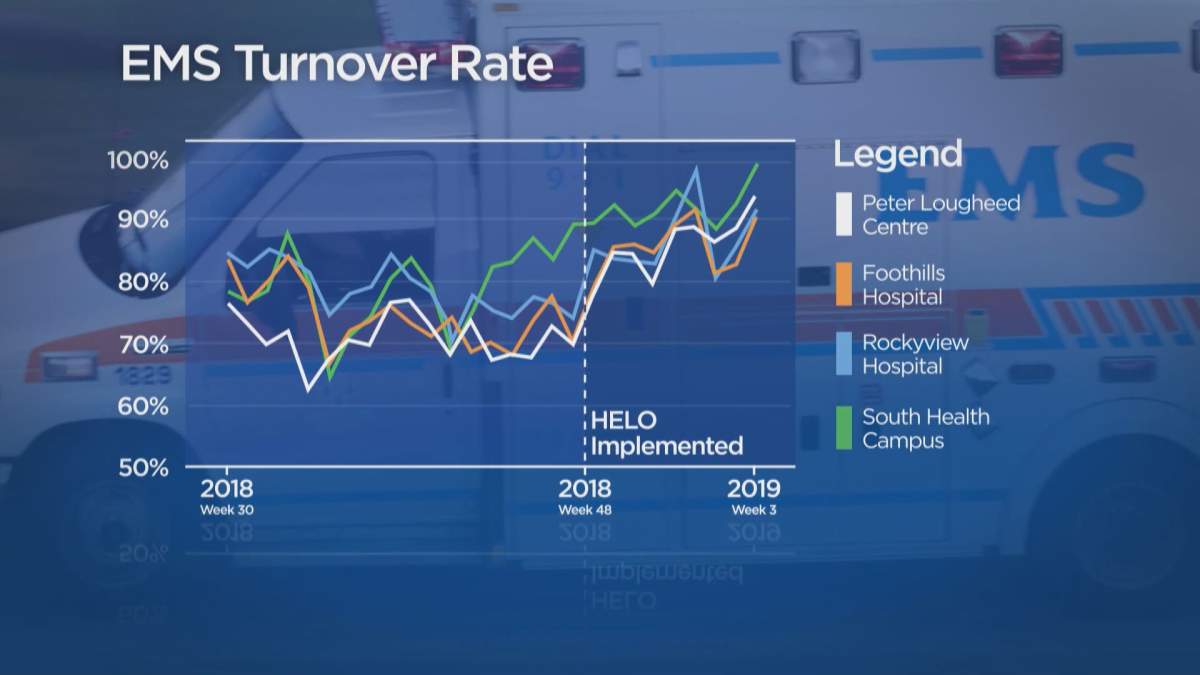
The documents also included charts of four Calgary hospitals that showed modest improvements in EMS destination interval times.
“There appears to have been an improvement in compliance to the 90 minute destination interval target in Calgary coincident with the implementation of these two initiatives,” the AHS memo read. “There does not appear to be an improvement in destination interval in Edmonton since the implementation of the HELOs.”

Get weekly health news
The pilot project was cancelled in July, following a review by AHS.
“Our full review of the pilot at its conclusion confirmed that no sustained or measurable improvement in overall EMS offload times or EMS wait times in hospitals were realized through the program,” an AHS official said in a statement to Global News.
“As such, AHS did not extend this program beyond the original eight-month pilot period.”

But the Health Sciences Association of Alberta (HSAA), a union that represents over 27,000 health care workers, including 4,500 paramedics in the province, said their membership believed the program was beneficial for both paramedics and patients.
“When you use the HELO project, when you use any other systems that get them back on the road, it’s better for everyone: the workers, and the citizens of this province. This was another attempt to try and improve that,” HSAA president Mike Parker said.


“Yes our members are concerned,” he continued. “They’re desperately concerned about being stuck in a hospital hallway when there’s patients out on the street requiring their services.”
According to Parker, the HELO program was cancelled without any consultation with the HSAA, and he believed the cancellation was due to budget concerns. But an AHS official told Global News that the program was budgeted through existing funding.
“It’s not going to reduce costs by cancelling this program,” Parker said. “The wait times, we can trend, will be steadily increasing as we go forward unless there’s active and aggressive actions to help reduce that in hospital time.”
David Shepherd, MLA for Edmonton-City Centre and official opposition health critic, said he is disappointed the HELO program was cancelled. Shepherd said that he would like to see the program reinstated.
“If they were truly concerned that they didn’t have quite enough data, I think it would make sense to continue the program, collect more data and indeed make sure they were talking to the front line workers that this impacts the most,” Shepherd said.
According to AHS, there were no job losses as a result of the cancellation of the HELO program, and all staff members that were assigned to the project have returned to their regular duties within EMS.
“AHS EMS will continue to seek targeted investments and opportunities that will provide additional support to staff and patients,” read a statement from AHS to Global News.
Alberta’s Ministry of Health did not respond to Global News’ request for comment.


Comments
Want to discuss? Please read our Commenting Policy first.