


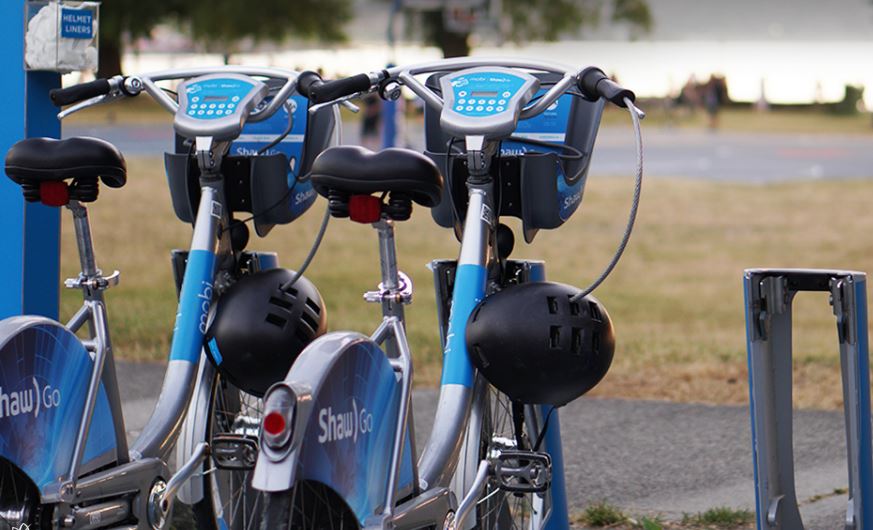
The City of Burnaby could be the next in B.C. to get a bike-sharing program on the road.

Council voted Monday night to advance a Request for Qualifications (RFQ) followed by a Request for Proposals (RFP) to pilot a bike-sharing program, and asking staff to develop a policy framework for the service.
In a report to council, staff said a bike share program would help meet several key city goals, including its transportation plan, providing healthy and affordable transportation and supplementing transit.
READ MORE: Uber heads into bike-sharing business
“Bike-sharing is well aligned with many of the City’s strategic plans and policy directions,” reads the report.
“It supports the goals of a transportation system for Burnaby citizens that is accessible, healthy, prosperous, safe, green, and connected, and contributes to a viable transportation alternative that is affordable.”
WATCH: ‘Dockless’ bike-sharing could set up on Calgary streets by summer

However, it also highlights “challenges that have been experienced in other jurisdictions.”

Get daily National news
Some of those challenges include an over-supply of bikes, helmet law issues, long-term financial stability and “clutter” on sidewalks.
The report lays out docked and dockless bike share options, each of which comes with their own costs and benefits.
Docked systems, where bikes are parked in a fixed rack, can come with a higher capital cost and require public subsidy, the report argued. Dockless systems come with maintenance challenges and potential problems with bikes being left in inconvenient places.
It also lays out several potential operating models, including fully publicly owned, fully privately owned, or publicly owned and privately operated.
WATCH: How has the bike share program in Kelowna fared this summer?

The report says the city has already been approached by multiple operators interested in participating in a bike share program.
“Accommodation of a pilot program at no cost to the City is recommended,” says the report. “Any additional temporary resources that may be required to manage the program would be funded by the proponent.”
The report says after an 18-month pilot, the city could opt to discontinue it, to continue it, to open it up to multiple operators or to issue a new RFP.
READ MORE: Mobi bike share extending into East Vancouver, and it’s a sign of growing demand: UBC Prof
The City of Vancouver has been operating the region’s first bike share program, Mobi by Shaw, since 2016. The system uses fixed docking stations.
Since then, UBC has implemented its own bike-sharing program, operated by Dropbike, which uses dockless bicycles.
The cities of Richmond and Port Coquitlam are also exploring bike share pilot projects.


Comments
Want to discuss? Please read our Commenting Policy first.