


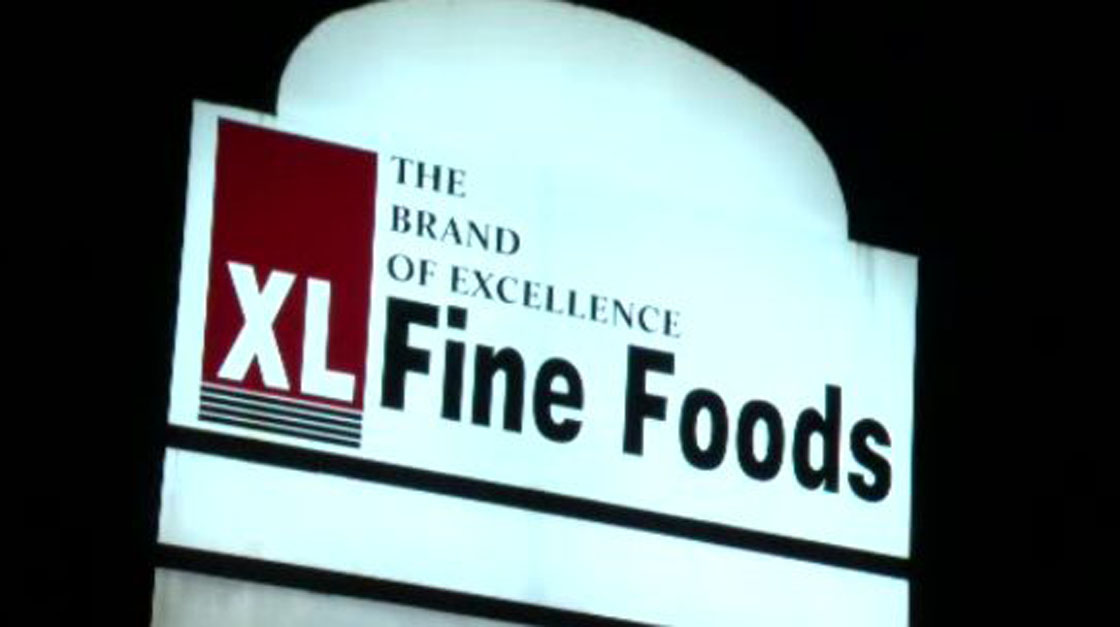
TORONTO – While heaping truckloads of recalled beef from a troubled Alberta meat processing plant were dumped in landfills this week, another 5.5 million kilograms of product not included in the waves of recalls sits in limbo.

Depending on what XL Foods decides to do, the meat from its plant could end up on grocery store shelves in canned soups, meat sauces or frozen meals, one beef industry expert says.
On Tuesday, the Canadian Food Inspection Agency restored the operating licence for XL Foods and its plant in Brooks, Alta., which means the company’s operations can resume under enhanced surveillance by food safety officials.
What’s unclear is the fate of 5.5 million kilograms of product that remains at the facility’s establishment 38. Unlike the recalled product now sealed in a landfill, the meat was not affected by the recall, the CFIA has told reporters.
Instead, XL Foods can choose to either render the meat or subject it to a high temperature treatment.
Ted Haney, a former president of the Canada Beef Export Federation, says that if XL Foods chooses to put the meat through high temperature treatment, the result could be pre-cooked ground beef that’s then sold to manufacturers of canned goods, meat sauces or other pre-cooked beef products.
He assured the public this meat would be safe to eat and will be cooked at high temperatures so any potential bacteria would be killed.
The CFIA told Global News that the federal agency will oversee the “effectiveness” of the high temperature process should XL choose this route but once it’s cooked, it’s unclear what will happen to the resulting product.
“It is the company’s decision what they do with the meat once it has undergone high temperature treatment,” the CFIA said in a statement sent to Global on Tuesday.
High temperature treatment process used for pre-cooked meat products
In a high temperature treatment, meat is cooked at at least 71C to kill any E.coli bacteria.
This is not done in-house – the meat is traded to companies that specialize in cooking meat and selling pre-cooked products to manufacturers, Haney says.
While there are businesses in Canada that cook and sell pre-cooked meat, the bulk of this industry is in the United States.
“High-temperature cooking means anything over 71C, which is a medium state. If it’s cooked any higher than that then it’s excessive cooking for other processes,” Haney said.

Get weekly health news
Haney has decades of experience within the industry and is now a consultant to the beef sector.
According to the CFIA, this high-temperature treatment is an “established process” for dealing with E. coli contamination. U.S. authorities have already permitted recalled product to undergo this process.
Once the meat is cooked, Haney says it’s typically sold to manufacturers that use pre-cooked meat for soups, canned meat sauces, frozen meats such as hamburgers or sausages and other pre-cooked products.
“Again, this is meat that was not affected by the recall and has been under CFIA detention since the plant’s license to operate was suspended,” the CFIA told Global News on Tuesday.
Still, high-temperature cooking is expensive.
A pound of AAA-certified beef, for example, comes with a $20 price tag on average. If it’s sold to companies dealing with high-temperature cooking, its value drops to $2 a pound at most, Haney estimates.
“From an industry perspective, it’s kind of a disposal method for product that you just can’t, for whatever reason, sell into the fresh and frozen market,” he said.
“Costs associated with cooking and the value of the subsequent cooked product is relatively low, so all of that put together: this is not an economically very happy outcome.”
Rendering meat strips product of nutrition and economic value
Rendering meat is a completely different option at play for XL Foods to decide on, Haney said.
“Rendering absolutely neutralizes any bacteria or viral concerns,” he said, calling the process an “ultra-high, high temperature” cooking process.
He says that in the rendering process, meat is cooked in extremely high temperatures resulting in dehydrating the product leaving behind only tallow and meat and bone meal.
Tallow is the hard fat obtained from parts of the cattle. It comes in edible forms, such as oils or lard used in some food, or inedible forms used in soaps, candles, or lubricants.
Meat and bone meal, which resembles a hard, grainy substance, can be used as feed for chicken or pigs or as a fertilizer for industrial purposes, Haney explains.
According to him, the XL Foods plant has one of the best state-of-the-art rendering facilities in Canada and abroad.


Reassuring the Canadian consumer
The CFIA has gone so far as to say that whatever route XL Foods chooses, department officials will monitor the process.
“If the company chooses to use a high temperature treatment, the CFIA will oversee the effectiveness of this process and as an extra precautionary measure, will test afterwards to ensure the product is safe. U.S. authorities have already permitted recalled product to undergo this process,” a spokesperson said in a statement to Global News.
Haney says that, for the most part, rendering is automatically overseen by health officials, while high-temperature cooking is monitored in the U.S. by the CFIA’s counterpart agency.
But retesting after the product is cooked is another extensive step the CFIA is adding. “That’s standing on your head to prove safety,” Haney said.
“It’s laudable I guess… it’s a little over the top. But it’s a different time right now,” he said.
Additional inspectors are also staying onsite at the Brooks, Alta. plant to keep a watchful eye on the company’s procedures and food safety controls.
“This enhanced oversight of the slaughter and processing operations will allow the CFIA to ensure that food safety controls are being implemented consistently within ongoing daily operations,” CFIA spokesman Paul Mayers told reporters at a news conference.
Rick Holley, a professor of food science at the University of Manitoba, says the CFIA is stuck between a rock and a hard place “with respect to the regulations.”
“There has clearly been uncertainty in part of the regulator in knowing what to say to the consumer,” he said.
The federal agency and XL Foods may be treading carefully, removing meat products that otherwise could be edible if cooked, to maintain control over the situation in the eyes of the public, Holley suggests.
Tweaked meat could be sold to the masses
If XL Foods chooses to put the meat through the high-temperature cooking process, it could end up on grocery store shelves in the form pre-cooked goods.
“I think this is more common than we think . . . that products get reconditioned,” Holley said.
“From a consumer concern perspective, I don’t like going to the store to buy anything that’s been reworked at all . . . a reworked product represents a mistake in some fashion,” he said, pointing to microbiological hazards, physical hazards or even recipes that haven’t been executed properly as examples.
But he says consumers shouldn’t be worried.
“From a hazard perspective, in terms of microbiology, there is no concern here,” he said.
Haney says the CFIA needs to be clear about when this 5.5 million kilograms of meat was fabricated – meaning cut and packaged. He asks officials why meat that wasn’t involved in the recall process needs to be rendered or heat-treated.


Comments
Want to discuss? Please read our Commenting Policy first.