


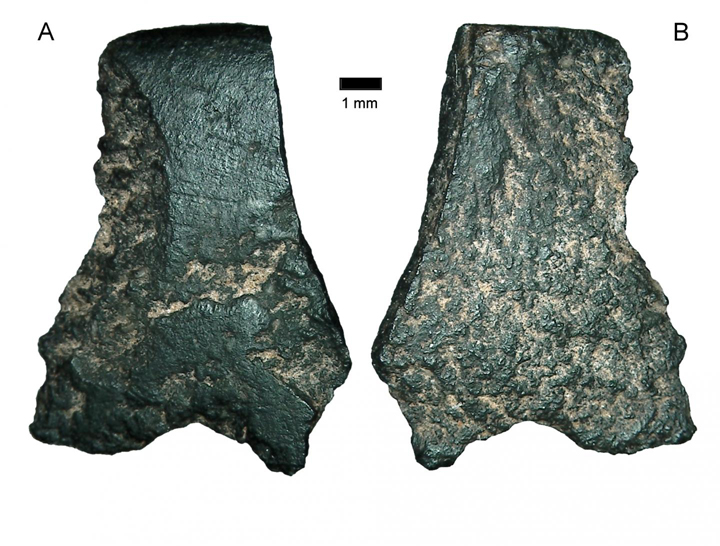
Archaeologists from the Australian National University and the University of Sydney made a surprising discovery when they found axe fragments that date back tens of thousands of years.

The fragments were found in the Kimberly region of Western Australia and date back somewhere between 45,000 and 49,000 years ago, a time when the first humans arrived on the continent.
The axe fragments were initially found in the early 1990s at a site at a shelter believed to be one of the oldest occupied by modern humans. But in 2014, an archaeology team re-examined a small fragment of a polished axe.

Get daily National news
READ MORE: Archaeologists uncover Britain’s Bronze Age ‘Pompeii’
The newly analyzed fragment is believed to have come from an axe that was shaped from basalt which was polished by grinding it on another rock. It likely came off the whole axe when it was being resharpened. The axe itself was likely carried off to be used elsewhere.


“Polished stone axes were crucial tools in hunter-gatherer societies and were once the defining characteristic of the Neolithic phase of human life. But when were axes invented? This question has been pursued for decades, since archaeologists discovered that in Australia axes were older than in many other places. Now we have a discovery that appears to answer the question,” said the University of Sydney’s Peter Hiscock, the lead author of the analysis.
Archaeologists believe that the technology of axes was developed in Australia, as no other axes have been uncovered in islands to the north of Australia.


Comments