

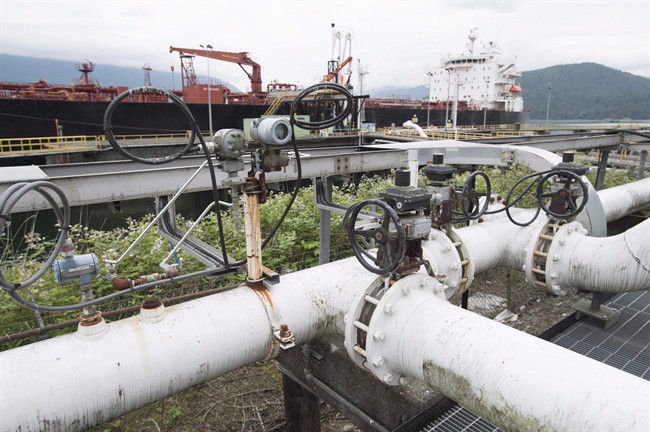
VANCOUVER – A Vancouver-area mayor is urging Prime Minister Justin Trudeau to immediately suspend National Energy Board hearings into the proposed Trans Mountain pipeline expansion.

Burnaby Mayor Derek Corrigan has sent a letter asking Trudeau to put the review on hold while the federal government implements promised changes to the way the regulator evaluates projects.
“I am now writing to request that the amendments be expedited to avoid perpetuation of the current, deeply flawed NEB process that the public and your government have already acknowledged is inadequate,” he wrote.
Interveners filed final written arguments Tuesday ahead of hearings starting next week on Kinder Morgan’s US$5.4-billion proposal to triple the capacity of its Trans Mountain pipeline from Edmonton to Burnaby.
Critics have condemned changes the Conservative government made to the review process, including setting time limits for hearings and assessments and limiting who can participate.
READ MORE: Alberta urges twinning of Trans Mountain line
Trudeau promised in June to engage in a “new open process” for all pipelines, including analysis of upstream impacts and greenhouse gas emissions.
He also said in August that a Liberal government overhaul of the process would apply to existing pipelines and that the Trans Mountain review “needs to be redone.”
Burnaby Coun. Sav Dhaliwal said the city was disappointed that little progress had been made on the promises.
“We are very concerned that the federal government has not really taken their commitment seriously,” he said.
Dhaliwal said an amended review should require Kinder Morgan to respond to all questions posed by interveners and face cross-examination in hearings. It should also consider the project’s impact on climate change, he said.
Corrigan first asked Trudeau to pause the review in November. At the time, Natural Resources Minister Jim Carr said the government would soon announce changes to the pipeline approval process, but the Trans Mountain review would continue.

Get breaking National news
Micheline Joanisse, a spokeswoman for Carr, said Tuesday that the board is conducting a “thorough, science-based review” of Kinder Morgan’s proposal.
“The government has committed to regaining public trust by ensuring projects undergo credible and robust environmental and regulatory reviews,” she said.
“Our plan will include a transition period for projects currently under review to provide some certainty through the modernization process. No project proponent will be asked to return to square one.”
The City of Vancouver concluded in its final submission that the project’s adverse effects outweigh any possible benefits and the environmental assessment is incomplete.
“Of the nearly 1,400 questions submitted by the city to Kinder Morgan, at least 40 per cent of responses given by Kinder Morgan were deemed by the city to be unsatisfactory,” the city said in a release.
North Vancouver’s Tsleil-Waututh Nation said in its final argument that the risk of a spill due to a seven-fold increase in tanker traffic in Burrard Inlet was too great.
“Our obligation is not to oil. Our obligation is to our land, our water, our people, our life,” it said. “This project represents a risk that we, the Tsleil-Waututh people, are not willing to take.”
The province of B.C. said this week it could not support the project due to concerns about spill response and aboriginal support. Alberta offered its endorsement Tuesday, citing economic benefits.
Premier Christy Clark said her government was “mostly satisfied” with the NEB process.
“There have been some bumps in the road, certainly, in terms of our participation, but we think they’ve been addressed by the NEB.”
In May, a three-member panel is set to inform the federal cabinet whether it approves the project. Ottawa will then have three months to make its decision.
Quick facts on the Trans Mountain pipeline
Here are a few quick facts about Kinder Morgan’s proposed Trans Mountain pipeline expansion.
The proposal: Kinder Morgan hopes to triple its bitumen-carrying capacity to 890,000 barrels a day by laying about 980 kilometres of new pipe near the existing Trans Mountain pipeline that runs from a community near Edmonton to the Vancouver area.
The sales pitch: Kinder Morgan says the project is expected to generate $46.7 billion in government revenues and create 14,000 jobs during construction followed by a further 3,300 direct and indirect jobs per year of operations. Proponents say it would help diversify Canada’s energy economy by increasing access to Asian markets for Alberta crude.
The opponents: The cities of Vancouver and Burnaby staunchly oppose the project, citing climate change and fears about spills resulting from a seven-fold increase in tanker traffic in Burrard Inlet. British Columbia said this week it cannot support the expansion because Kinder Morgan has not yet met its five conditions for approval, including a world-leading spill response plan and addressing aboriginal treaties. North Vancouver’s Tsleil-Waututh Nation, whose traditional territories include Burrard Inlet, and numerous environmental groups oppose the project.
The supporters: Alberta Premier Rachel Notley said in a written submission to the National Energy Board on Tuesday that the pipeline expansion would be in the best interests of both Alberta and Canada. She cited reports that estimated the project could increase western Canadian crude oil revenues by $73.5 billion in the first two decades of operation. The City of Kamloops and the Whispering Pines-Clinton Indian Band are among the project’s supporters in B.C.
The review: The National Energy Board is currently reviewing the project. A three-member panel is expected to inform the federal cabinet whether it approves the project by May 20. The government then has three months to make a decision. The review has been a target of criticism for excluding oral cross-examination from hearings and not considering the project’s impacts on climate change.
The delay: The NEB postponed hearings in August after striking from the record economic evidence prepared by a Kinder Morgan consultant who was to begin working for the regulator in the fall. Steven Kelly won’t be involved in the Trans Mountain assessment, but the NEB said it wanted to ensure no questions were raised about the review’s integrity. The hearings are set to begin next week in Burnaby and concluding next month in Calgary.
The new prime minister: Justin Trudeau vowed on the campaign trail to engage in a “new open process” for all pipelines, including analysis of upstream impacts and greenhouse gas emissions. Burnaby Mayor Derek Corrigan has called on Trudeau to suspend the Trans Mountain review and expedite changes to the process. But Natural Resources Canada says the plan includes a transition period for projects currently under review, and no project proponent will be asked to return to square one.


Comments
Want to discuss? Please read our Commenting Policy first.