


The month-old Occupy Wall Street movement enjoyed its new momentum Monday, with nearly $300,000 in the bank from donations and is now drawing the attention of others around the globe protesting major economic inequalities.

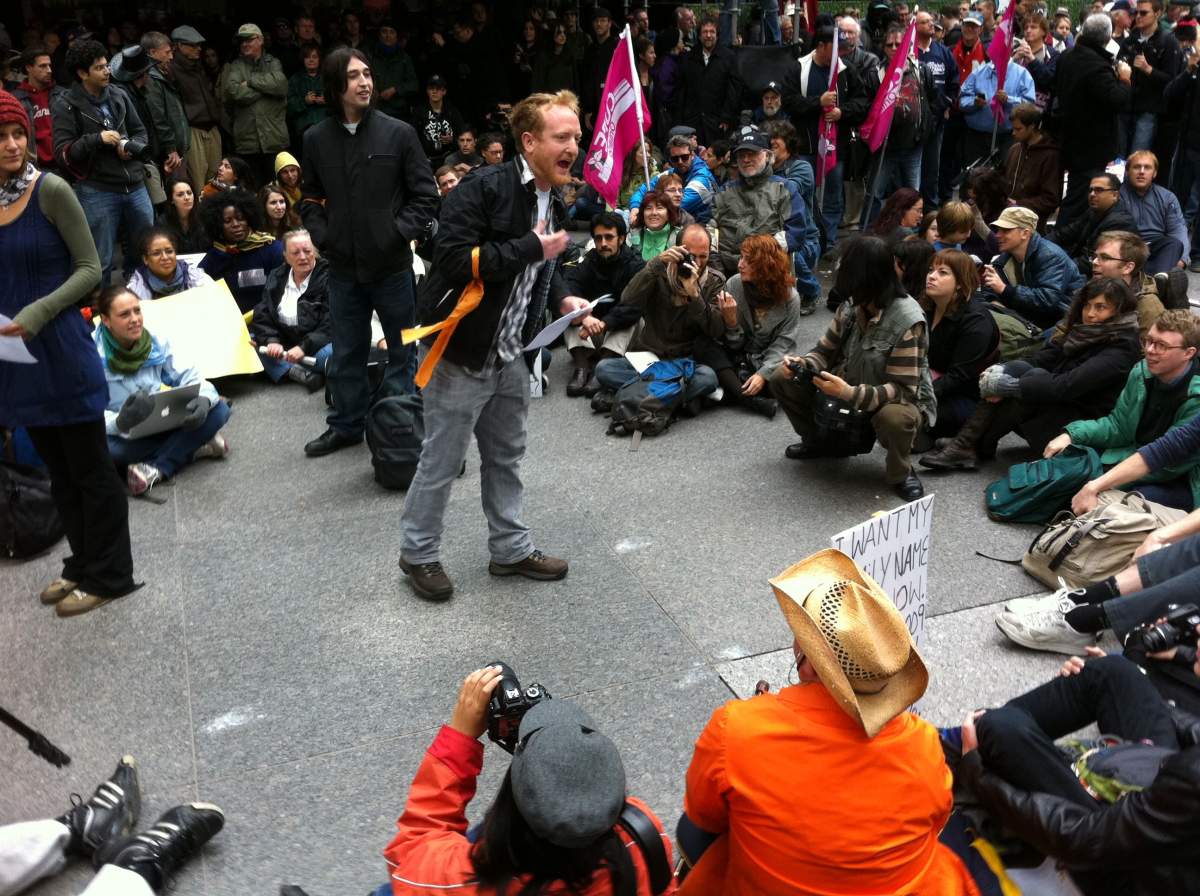
On Saturday, October 15th, the protests spread to cities across Canada – including Toronto – with about 1000 demonstrators attending a rally at St. James Park near King and Jarvis. While the protestors in Toronto are looking for parallels with their counterparts in the United States and Europe, the situation may not the same here in Canada.
But despite those differences, the Occupy movement in Canada could gain traction according to York University Professor David McNally.
The financial situation is bad in the United States and in Europe but things are relatively stable here in Canada. Can these movements really make an impact here? Can they gain traction?
They seem already to be gaining traction. It’s true that youth unemployment here is not as bad as in Europe or the U.S. But young people in Canada are still facing a future of McJobs and declining social services alongside obscene wealth for the one percent. Their message is having a real resonance, particularly among young people.
Again, I think it is more a question of whether these movements change the political climate by making corporate greed and the corruption of democracy burning issues of our age. If they do that, then you will see a resurgence of grassroots social movements the like of which we haven’t seen for decades. Most importantly, they can change the political climate. They can create a powerful movement against corporate domination. And in place of apathy and disillusionment, they can create a sense of hope, a belief that radical change is possible.

Get daily National news
What are they protesting?
They are protesting the immense increase in social inequality in recent decades, the domination of politics by money and corporate influence, the global bailouts of banks while social services are slashed, and the bleak prospects for young people in today’s economy. Bay Street is the center of corporate power in Canada. Not only is it home to many of the banks and corporations, it is also the site of the Toronto Stock Exchange. It symbolizes the symbiosis of money and power.
Economic problems are much worse in the United States, does the relative stability of the Canadian economy dampen the effect of these movements?
Not entirely. Social inequality — the gap between the one per cent and the rest — has been rising faster in Canada than the U.S. in recent years. And problems of heavy student debt loads and poor job prospects are very widespread in Canada.
What is this movement doing that is successful?
It is mobilizing young people and re-framing the public agenda. It has brought opposition to social inequality and corporate power into the mainstream in an almost unprecedented way. And it is doing all this by unconventional means — occupations of public space — that rewrite the nature of social and political action.
It will need to connect with many of the day-to-day issues that affect specific communities, from unemployment, to resisting the sell-off of social housing, from supporting immigrant rights to stopping soaring tuition rates. This will make the idea of “we are the 99 per cent” much more meaningful to wider numbers.
Why does there seem to be an aversion to individual leadership within the movement?
This is a movement that has seen the corruption of professionalized, bureaucratic politics and wants no part of it. They want grassroots democracy and people power. Any leadership will have to be transparent, accountable and shared.
With the economy now globally interconnected, do these movements gain traction simply by things being bad around the world?
In part that’s true. We are all exposed to global issues today. But most importantly, the great slowdown in the world economy hits young people everywhere especially hard. As a result, youth have shared grievances in one part of the world after another.
Do you think the general population of Canada cares about these protests?
Yes. Certainly, many people remain tuned out about them. But what is remarkable is the number of ordinary people with no history of activism who express sympathy with these protests. The idea that the system has been benefiting only those at the top while the interests of the vast majority get ignored is striking a very powerful chord.
Is there a level of discontent present that would allow these movements to make an impact?
Often we read things like low voter turnout in the last Ontario election as expressing apathy. But there is good reason to believe they express disaffection. It is fascinating to see the polls that tell us that Occupy Wall Street is twice as popular in the U.S. as is the right-wing Tea Party. That tells me that huge numbers of people identify with the movement’s message. No one predicted that the movement would take off the way it has. That tells me there is a level of discontent with which it is connecting.
With files from the Associated Press


Comments
Want to discuss? Please read our Commenting Policy first.