

MONTREAL – For an agency responsible for the safety of millions, it should be an alarming statistic: Sixty-one per cent of Montrealers do not believe Transport Quebec when it says overpasses, bridges and tunnels have been inspected and are safe.

But when asked about the Léger Marketing survey this week, Transport Minister Sam Hamad did not say changes would be made to regain public trust. Instead, he said he doesn’t comment on polls.
Transport Quebec’s shifting story of who may be to blame for Sunday’s Ville Marie Expressway collapse and the contradictory and incomplete information it is doling out about the cave-in show why Montrealers might not trust the ministry, responsible for 29,000 kilometres of road across Quebec.
Transport Quebec’s behaviour raises questions about two other worrisome structures under its watch – the Mercier Bridge and the Turcot Interchange. How has the department handled inspection warnings and ensuing repairs to those structures?
After blocking The Gazette’s attempts to obtain inspection reports for the Mercier and Turcot, Hamad now says reports will be made public for both in coming weeks. But based on the Ville Marie experience. it’s unclear how full that disclosure will be.
Here’s what Transport Quebec has said since Sunday, the day tonnes of concrete fell on the Ville Marie, narrowly missing passing cars:
On Sunday, Hamad, standing near the collapse, says “if a bridge or a road is open in Quebec, it’s because it’s safe.”
On Monday, Transport Quebec initially refuses to make public inspection reports for the Ville Marie.
It is only after Premier Jean Charest, speaking in Chibougamau in the afternoon, says there will be complete transparency that two inspection reports are made public, just before 5 p.m. One, from 2008, is detailed; the other indicates no new problems were found in 2010. No one at Transport Quebec will comment on the reports.
“The state of the tunnel is critical when it comes to user safety,” the 2008 report states. It also recommends a “structural analysis” of the ceiling that eventually collapsed, noting the concrete ceiling and beams required repairs.
The reports were delivered to Quebec under the watch of Julie Boulet, transport minister from 2003 to 2010. The 2008 report is by SNC-Lavalin, one of three firms Quebec later hired to plan and supervise Ville Marie repair work.
On Tuesday, Transport Quebec holds a news conference at which deputy minister Anne-Marie Leclerc assures the public all critical work recommended in the 2008 report was done as part of a $37.5-million 2009-2012 overhaul. (So far, only about $15.5 million has been spent.)

Get daily National news
Leclerc notes the collapse occurred while work was being done on a tunnel wall, leaving the impression the contractor may have been responsible. She says the recommended structural analysis was done and indicated the ceiling was safe. When asked for a copy, Leclerc says Transport Quebec will “think about” making it public.
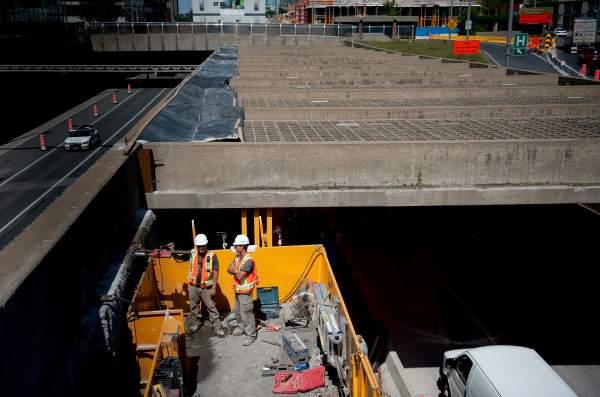
At the time of the accident, Laco Construction workers were breaking up concrete on a wall that supported concrete beams that held up the ceiling – a grid-like concrete structure whose holes allow light to enter the tunnel. The beams are shaped like upside down Ts and rest on a 30-centimetre ledge at the top of supporting walls. Some wall concrete was being removed so new concrete would better adhere to the wall.
On Wednesday, Hamad holds a news conference at which he refers to the consortium of engineering companies that put together the detailed plan for the work on the Ville Marie wall and were supervising the work – SNC-Lavalin, Dessau and CIMA+.
(This is the same consortium Transport Quebec has hired to keep the condition of the Turcot Interchange under constant surveillance.)
A photo is made public indicating workers broke up concrete directly under the location of the beam that fell, causing the collapse.
Hamad says an investigation will determine who is to blame but he indicates responsibility may lie with the consortium that prepared the repair plan.
Asked about the still-secret structural analysis, Hamad says it will be made public but he won’t say when.
Transport Quebec’s Maroun Shaneen says steel support structures are being added under two beams near the one that fell. Hamad says extra support is needed so the tunnel is ready when walls are repaired in the future.
When asked later, a Transport Quebec spokesperson confirms to The Gazette one of those two beams is No. 17 – one that was specifically flagged in the 2008 inspection report because one of the two ledges that hold it up had lost 25 per cent of its support.
Transport Quebec tells The Gazette it can’t say whether Beam 17 or the ledge that holds it up had been repaired as part of the work done after the 2008 inspection.
At Hamad’s news conference, Transport Quebec admits it did not at any point review the repair plan beforehand to ensure they took into account the inspections.
The department also admits it had no employee at the work site when the accident occurred. The consortium employee supervising the work at the time was a technician, not an engineer. Transport Quebec can’t say whether he or she knew about the 2008 ceiling warnings.
On Thursday, La Presse reports the tunnel’s beams and ledges have not been repaired, despite the fact that the 2008 report recommended they be fixed.
For the first time, Laco Construction speaks out, telling La Presse its workers followed to the letter the plan they were given by the consortium. Questions are raised about whether the plan called for too much concrete to be removed from the wall.
At a news conference, Hamad says supports are now being placed under all remaining beams, not just the two mentioned a day earlier.
On the advice of engineers, 21 steel support structures will be installed under the tunnel’s beams – 17 on one side (the side where the collapse occurred) and four on the other, Shaneen says.
In addition, beams are being secured to one of the walls. Until now, the beams sat on the ledges and were not secured.
Shaneen says the extra support will “add another level of security.” He says only two beams were mentioned a day earlier because only two had been secured at that point.
Transport Quebec gives conflicting information about how many beams are being shored up. Reporters are given different answers: 15, 17 or 19. At press time, the discrepancy had not been cleared up.
As for Beam 17, why wasn’t it repaired after it was flagged in 2008?
Hamad says the first repairs completed were urgent ones, referred to in the inspection report as “Safety work to be performed.” The beamrepair recommendation was deemed less urgent, under the label “Repair work.”
The urgent “safety work” included fixing sections of the ceiling where chunks of concrete risked falling off, and repairing lighting fixtures. The report does not explain why such repairs were deemed more serious than repairing a deteriorating ledge, 30-cm wide, that holds up a 25-tonne concrete beam.
Hamad also could not explain why supports now being installed were not put in place under the beams before workers started breaking up the concrete wall Sunday.
The investigation will determine whether mistakes were made in the planning, execution and supervision of the work, Hamad says.
As for the still-secret ceiling structural analysis, Hamad says it will be made public but he won’t say when.


Comments
Want to discuss? Please read our Commenting Policy first.