


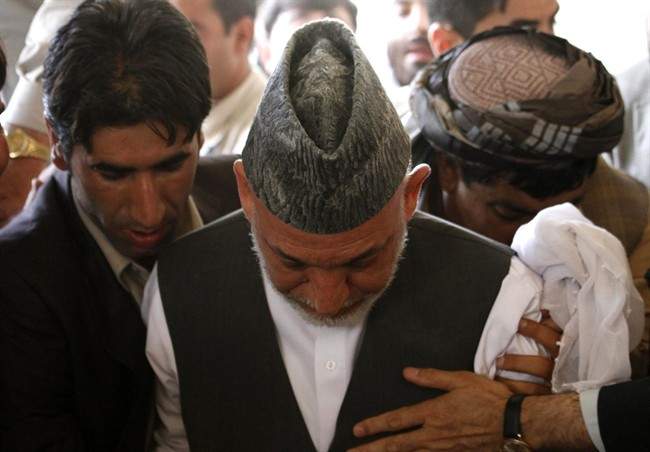
KANDAHAR, Afghanistan – A heartbroken Hamid Karzai stood weeping in his murdered half brother’s open grave Wednesday as one of southern Afghanistan’s mightiest power brokers, felled by the point-blank bullets of a confidante-turned-assassin, was laid to rest.

Beyond the confines of the sprawling government guest house where the Afghan president was grieving, however, few were shedding a tear for Ahmed Wali Karzai.
“My message to the Taliban, my brothers, is that they should stop killing their own people,” president Karzai told the gathered mourners.
“Anyone can kill, but real men are the ones who save lives.”
Beyond the walls of the compound known as Mandigak Palace, an eerie silence fell over a city gripped with the fear of retaliatory violence following Tuesday’s assassination, which was carried out by a close Karzai associate.
The streets of the provincial capital were empty and most shops closed in anticipation of a bloody backlash – a testament to the power Karzai, a political kingpin, wielded when he was alive.
Few in Kandahar city were untouched by his influence and business dealings, which is why he was so deeply respected and even feared, said Amatullah, a baker in the city’s commercial district.
Asked whether Ahmed Wali was loved, Amatullah’s gaze fell to the ground.
“No, I don’t think so,” he said. “No one was sorry, because of his character.”

Get breaking National news
Known by his initials AWK, Karzai practised a bare-knuckle style of politics viewed by many ordinary people as intended to benefit primarily himself and his brother, rather than Kandahar province itself.
While the more splashy allegations of facilitating drug running and being on the CIA payroll captivated westerners, it was Karzai’s bullying style and outright alienation of enemy tribes that offended Afghan sensibilities the most.
Dost Mohammed, a shopkeeper near Martyr’s Square, said he carried out an informal poll of customers coming through the door since news broke of the murder.
“Seventy-five per cent of people coming here, and you know I ask them; 75 per cent of them are saying things will be better now than before,” he said in an interview.
“The other 25 per cent who might be his tribe or (received) some benefits, are saying that things will be worse.”
More details of the killer emerged Wednesday, but police were still at a loss to explain why someone trusted for so long by the Karzai clan would turn on them.
Sardar Mohammed, who was himself gunned down in the moments following the shooting, was one of only a handful of people within AWK’s inner circle who were allowed to be armed inside the fortress-like compound, according to people who knew him.
- Company denies allegation nurse contract not being renewed over Poilievre photo
- How Edmonton intends to rollback blanket rezoning that allowed for more infill
- The engineering feat at the heart of Canada’s next big Arctic build
- NB Power extends winter disconnection moratorium for vulnerable customers


He was “the right hand man” and an “enforcer” who ran four security checkpoints with 16 guards under his direction.
“Most people I talk to, who come in here, think this was a family dispute,” Dost Mohammed said.
Provincial police chief Brig.-Gen. Abdul Raziq was not available Wednesday to comment on the investigation, but it was known that seven of the shooter’s bodyguards, arrested after the murder, were still being questioned.
The power vacuum created by the assassination was partly filled after the funeral when Shah Wali Karzai, another half brother and the eldest among the Karzai clan, was appointed as head of the Popolzai tribe.
Ahmed Wali’s body was buried in the family plot in Karz, a village about 30 kilometres outside of Kandahar city.
His extensive business interests remain in limbo.
The person who stands to benefit the most from his absence is a cousin with whom the president’s side of the family has had a long-running feud.
Hashmat Karzai, a first cousin, is the owner of a private security company that has ties to the Afghan government and made millions of dollars working with the U.S. military.
The dispute between the two clans goes back almost 30 years, but has occasionally created an ugly mess in public.
Hashmat was publicly accused of ordering the murder of another member of the family in December 2009. The father of the 18-year-old victim in that case was killed recently in a botched NATO raid, which was blamed on faulty intelligence.
Another one of the president’s brothers – Mahmoud Karzai – blamed the raid on a conspiracy and linked it to the feud with his cousin, although he was careful not to accuse Hashmat Karzai.


Comments
Want to discuss? Please read our Commenting Policy first.