




Just days after the Ford government tabled the 2026 budget, including a populist measure to cap the prices of resale tickets, the premier received a personal visit from one of Canada’s most powerful CEOs to discuss the law and its potential impact.

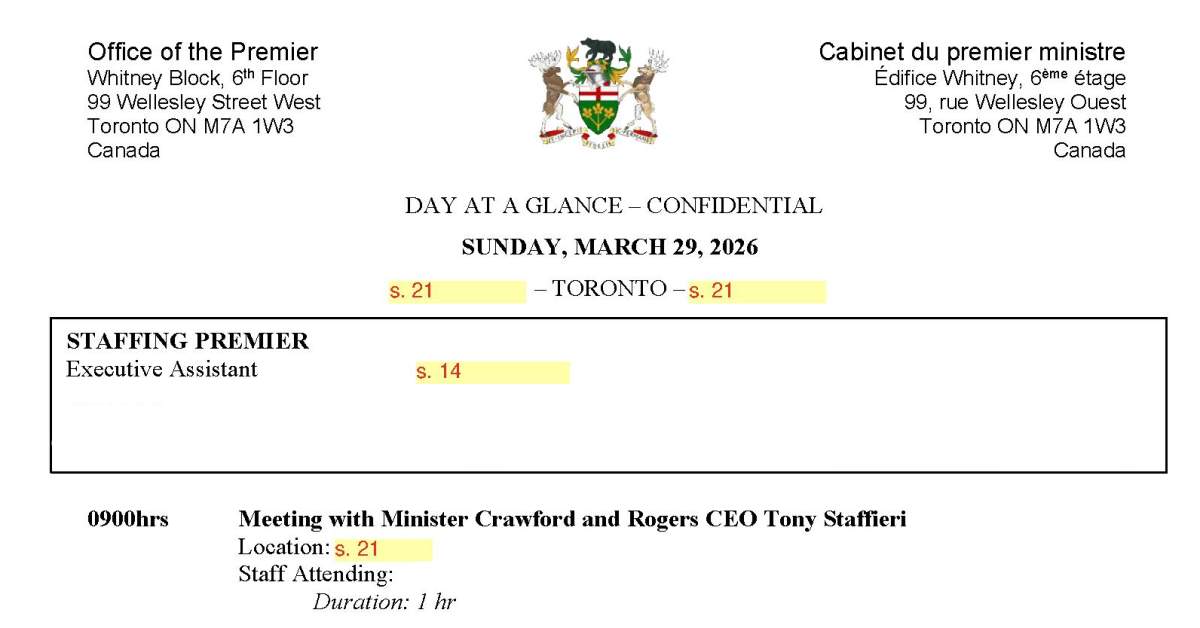
Premier Doug Ford’s itinerary, obtained by Global News through freedom of information laws, shows Rogers CEO Tony Staffieri met with Ford and Minister of Public and Business Service Delivery Steven Crawford on March 29.
Sources said the hour-long meeting, which took place on a Sunday at Ford’s Etobicoke home, was partly focused on the government’s new ticket legislation, which prevents sellers from listing tickets above face value.
As it tabled the legislation, the government promised that individuals and companies caught breaking the law could face massive fines.
“The rules are clear and so are the consequences: The days of scalpers ripping people off in Ontario are done,” Ford declared earlier this year.
But, according to sources, for the company that owns Ontario’s major sports teams, including the Toronto Maple Leafs, Toronto Raptors, Toronto FC and Toronto Blue Jays, the law appeared to come with unintended consequences.
Season ticket holders who bulk purchase seats at a discounted rate months before a season begins could have difficulty reselling their tickets for high-value games.
In effect, the law would penalize individuals who sell a portion of their tickets for a profit in order to subsidize the rest of their season ticket package.
According to Ontario’s Integrity Commissioner, Staffieri registered as a lobbyist on behalf of Rogers Communications for a range of issues that intersect with the provincial government.
Staffieri, the filing said, would be “communicating with the Government of Ontario about changes to the Ticket Sales Act.”
While it’s unclear when the Sunday morning meeting between Staffieri, Ford and Crawford was scheduled, sources with knowledge of the conversation said the Rogers CEO wanted to discuss the impact on season ticket holders.
Rogers Communications, which said it received $11.7 million in funding from the Ontario government in 2025, noted that “season ticket holders are among the most loyal fans,” who make a “significant commitment to support their teams year after year.”
“As with many topics that affect our customers, fans and communities, we regularly engage with government and other stakeholders,” the company said in a statement to Global News.

Get daily National news
The premier’s office said while he often meets with businesses and stakeholders “no changes came as a result of this meeting,”
Critics of the Ford government said the meeting is emblematic of the government’s priorities.
“The premier is willing to meet with the head of Rogers and not listen to the everyday fans,” said NDP MPP Tom Rakocevic.
“If people buy season tickets and they want to resell those tickets, let them sell them at face value. We don’t want to see tickets going up two, three, four times and essentially some fans making profits on the back of other fans.”
Law to undergo change
Months after the law was introduced, the bill is now set to undergo a regulatory overhaul as the province discovered the policy has been nearly impossible to enforce.
Multiple industry sources told Global News that Ford’s office has instructed Crawford to prepare regulations to fix the law, with options still to be determined.
That legislation, multiple industry sources suggested, was rushed through during the spring at the behest of the premier, who wanted a cap in place before Toronto hosted six matches for the 2026 FIFA World Cup.
The resale rules came into effect as soon as the budget received royal assent on April 24. The government made efforts to educate resale platforms. Letters were sent to 27 secondary sellers, including SeatGeek, StubHub, FIFA and VividSeat, to ensure they got in line.
However, despite the letters, the government determined that tickets on some sites continued to be sold well above face value. In early June, the provincial government named SeatGeek and StubHub on its Consumer Beware list as a punishment for selling tickets above face value.
- U.S. claims of Canadian political interference have ‘no merit,’ Carney says
- Ballots cast on election day in B.C. will be counted by hand, Elections BC says
- Advocates flag contributions, not costs, of newcomers in Alberta referendum aftermath
- Province-city relationship key point during Winnipeg mayoral debate


The government has not fined either company and has not been able to offer an explanation of whether it will under the existing rules.
A month after they were named on the list, the companies appear to have faced no consequences and have repeatedly claimed the rules the government has written are simply unenforceable.
“We have been seeking guidance on key details that are fundamental to compliance, such as what constitutes acceptable proof of a ticket’s original price,” StubHub wrote in a statement in June.
“We received partial answers to these questions today and are continuing to work with the Ministry toward full compliance.”
Difficult to enforce
The rules, one advocate for secondary sellers said, have been a nightmare to enforce.
“It’s been messy to say the least,” Brian Berry, of the advocacy group Ticket Policy Forum, told Global News.
“The law was finalized, and enforcement has been expected of companies before the rules of how to apply were really developed. It has been messy, there’s been some frustration.”
Now, it appears the government is accepting that the law it rushed through in the spring was at least partially flawed.
Industry sources told Global News the premier’s office had instructed Crawford’s office to draft regulations to work out how to define the face value of a ticket and how secondary markets will have to verify it.
The concern from resale sites is that they currently have no way to verify the original price of tickets because they can’t access the e-tickets or metadata from primary sellers.
People looking to resell tickets could use artificial intelligence or Photoshop to edit the price of their original ticket, for example, to resell it for more with no easy way to spot the change.
“(It) is a wrinkly policy that requires some ironing out,” Berry added.
“We warned that this is exactly what would happen: that there would be frustration, that enforcement would be difficult, that compliance would be difficult. And that’s exactly what’s playing out.”
He said he was reassured that it seemed the government was moving to make changes.
“Cooler minds will prevail,” he said. “Now the ministry, it appears, does want to sit down and reopen the rule, not necessarily to do away with it.”
Rakocevic called on the government to make any changes it’s contemplating, along with who’s pushing for it, public.
“Make this accountable, transparent, let the public know and make changes that benefit the majority of everyday fans, not just the super rich and the big corporate executives,” Rakocevic said.


Drob, the legislation is actually very harsh against Rogers.
“Please take this bribe so we can keep bending the consumer over”
Of course he did. Probably some messages on his personal phone taxpayers can’t access either. Perhaps someone from Rogers will make a donation to a family event.
LOL – “populist measure”. Right. Not a question of whether someone that is licensed with a ticket to attend an event is corrupting the market by acting as a third party enrichment scheme no doubt created to benefit organized crime rackets.
The news of the day. When does our safety Minister visit Ford and tell him the government will crack down on crime and stop bail and put criminals in Jail.
I miss the old days. Stand in line for 15-20 minutes to get tickets at face value, no fees.
OMG this reporter! Ford is criticized if he travels. And now he is criticized if an industry titan visits him.
Public needs to schedule to meet him on weekends from now on.
Someone at Global sure has a hard on for Dougie
Be intersting to see how long before he flip flops in order to protect his corporate supporters