


They are named Turner and Fitz — two male grizzly bear cubs that are just over a year old — and this week they made their public debut at the Calgary Zoo.

The bear cubs were orphaned in the wild last fall near Diamond Valley, about 70 kilometres south of Calgary, when their mother was killed in what the zoo called “a human-wildlife encounter.”
Too young to survive on their own, the cubs were brought to the Calgary Zoo.
“We are really good at caring for grizzlies. We’ve been looking after grizzlies at the Wilder to Calgary Zoo since 1938, so roughly 90 years or so,” said Jax Hogard, animal care supervisor at the Wilder Institute Calgary Zoo.
“They needed a quick home while we figured out where they would go next and it just so happened that we ended up having the space for them, so the decision was made for them to stay at the Wilder Institute Calgary Zoo and in the care of us here in wild Canada.”
While the bears are brothers, they do have their differences.
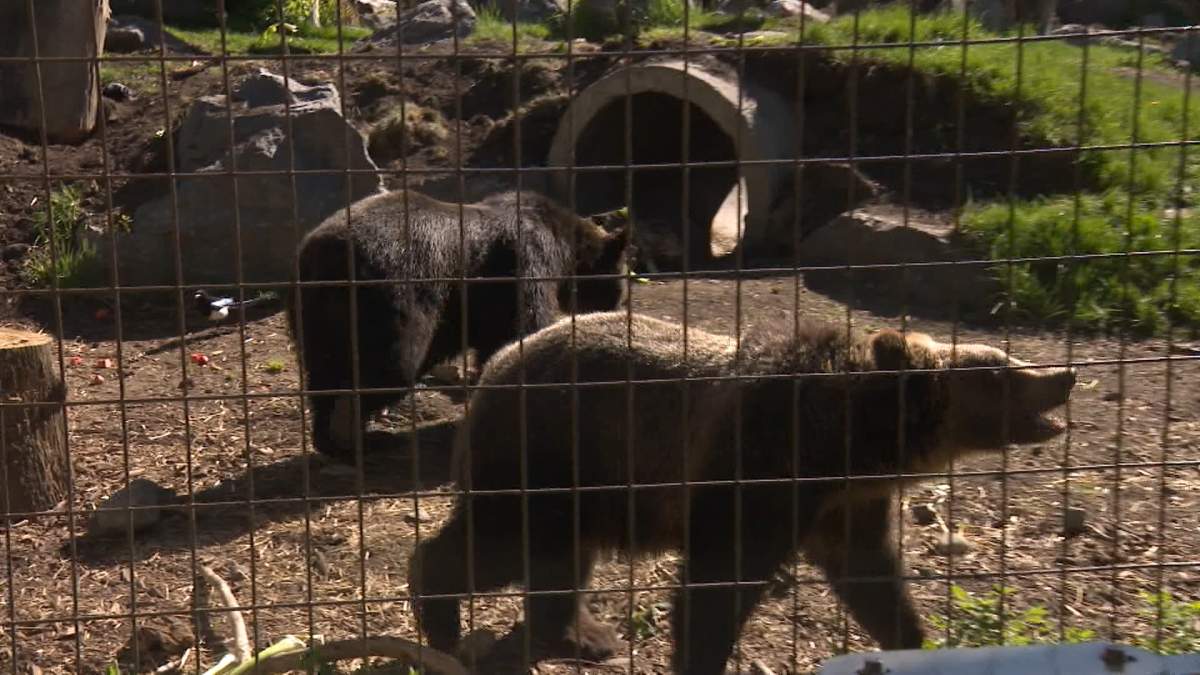
Turner has a darker coat and is the larger of the two, weighing about 116 kilograms (256 pounds), while Fitz is lighter in colour with a silver tinge and weighs about 110 kilograms (243 pounds).

Get breaking National news
Each of them eats about five kilograms (11 pounds) of food per day.
“So right on par with where they should be at just over a year old and doing phenomenally,” said Hogard.
“Their coats are beautiful — shiny, gorgeous. They’ve shed out their winter coat and have their beautiful spring coat coming in. They’re exactly what you expect young grizzly bears to look like. They’ve got that beautiful grizzled highlights in their hair and they’re perfect.”
This is the first week the bears have been allowed to explore their new outdoor habitat after spending the winter “behind the scenes” at the zoo.
“We’ve just been allowing them to do baby bear things all winter. We gave them the option to go to sleep if they wanted to. But they did stay up for the majority of the winter,” said Hogard.
“Whatever they wanted to do, it was completely their choice. We just wanted them to really gain confidence in their new home. We also wanted to make sure that their new home was safe and prepared for what baby grizzlies need, which is digging, running, climbing, playing. So there were a lot of habitat changes that were made and movement of the furniture in the habitat, rocks, logs. We wanted to make sure that everything was secure so when the boys were here, they were safe.”

Hogard said the zoo has two habitats that are both well-suited for bears.
The cubs are currently living in the smaller habitat, but as they grow, the zoo may decide to move them to the larger habitat.
“Just to give them small steps to larger spaces, just for enrichment and a change of scenery and size as they grow,” Hogard said.




Maybe they should be separated from Alberta and moved to a real Canadian Provence…