


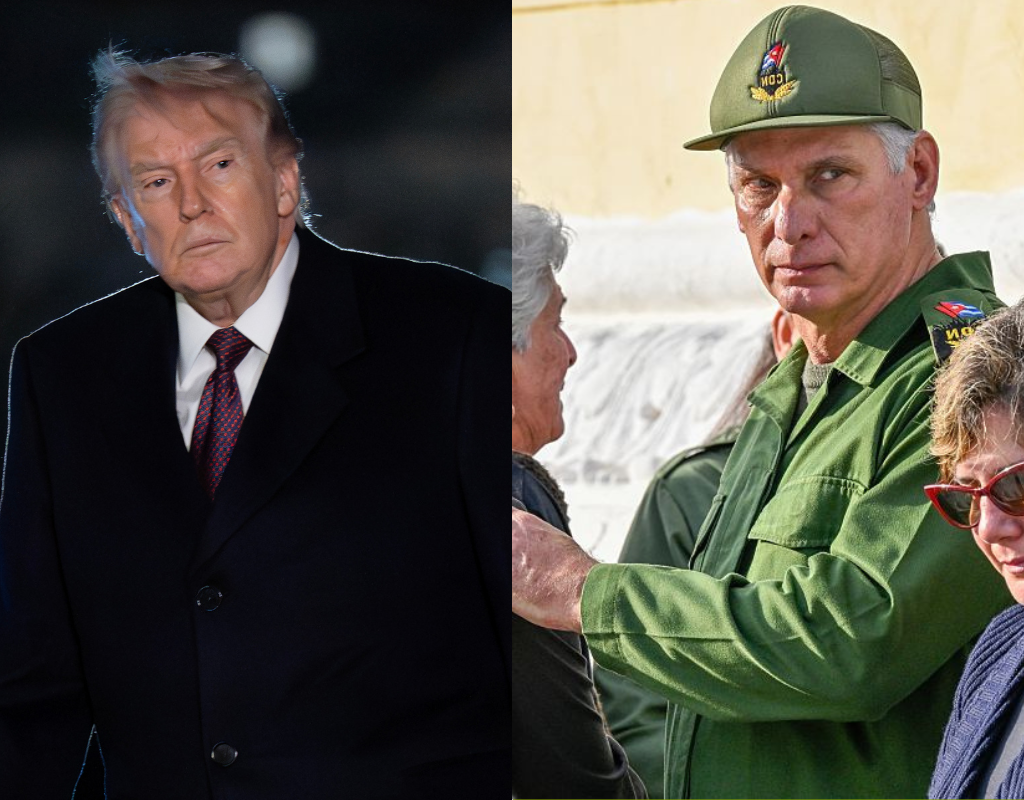
U.S. President Donald Trump said Sunday that he could soon strike a deal with Cuba or take other action, following protests in the island nation’s capital as its population faces rolling blackouts, fuel shortages and economic turmoil.

The president signalled that developments in the tumultuous relations between the U.S. and Cuba — defined by long-standing trade sanctions, diplomatic uncertainty, disagreements over security, migration and economic policy — could be on the horizon.
“Cuba also wants to make a deal, and I think we will pretty soon either make a deal or do whatever we have to do,” Trump told reporters on Air Force One.
“We’re talking to Cuba, but we’re going to do Iran before Cuba,” he added.


His comments came as discontent in Cuba boiled over into protests.
On Saturday night, locals in the city of Moron vandalized a Communist Party building, largely in response to blackouts and shortages of food, fuel and medicine, worsened by a U.S. blockade and disruptions to oil imports, which the island relies on to run power plants and transit networks.

Get daily National news
Five people were arrested, the BBC reported.
Fuel shortages have forced authorities to impose rolling electricity outages across the country and limit some public services.

In a post on X, Cuban President Miguel Díaz-Canel said that while it was understandable that conditions in Cuba are causing distress and that the “complaints” and “demands” of the people are “legitimate,” turning to violence would “threaten citizen tranquillity and the security of our institutions.”
“For vandalism and violence, there will be no impunity,” he concluded.


Díaz-Canel confirmed Friday that the country was in talks with the U.S.
“These talks have been aimed at finding solutions through dialogue to the bilateral differences we have between the two nations,” Díaz-Canel said in a video aired on state television, adding that he hoped the negotiations would move the adversaries “away from confrontation.”
In recent weeks, Trump has made a series of statements claiming Cuba was on the verge of collapse or eager to make a deal with the U.S.
Early last week, he said Cuba may be subject to a “friendly takeover,” then added, “it may not be a friendly takeover.”
He made similar comments in late February, telling reporters that Secretary of State Marco Rubio has been dealing with the issue at a “very high level.”
“The Cuban government is talking with us, and they’re in a big deal of trouble,” Trump said. “They have no money. They have no anything right now, but they’re talking with us, and maybe we’ll have a friendly takeover of Cuba.”
The first signs of policy shifts came on Monday when the country’s economic czar told NBC News that Cuban nationals living abroad, including in places like Miami, will be permitted to invest in the private sector and own businesses in Cuba.
Oscar Pérez-Oliva Fraga, Cuba’s deputy prime minister, said in an interview in Havana before announcing the news to the nation, that “Cuba is open to having a fluid commercial relationship with U.S. companies” and “also with Cubans residing in the United States and their descendants.”
Despite the renewed contact, significant differences remain between the two governments. U.S. officials have suggested that any easing of pressure would likely depend on political and economic concessions from Havana, while Cuban leaders insist that negotiations must respect the island’s independence.
— With files from Reuters


Yeah, Scott Flynn, that’s exactly what they want…
They have enough of communist regime and Canada is heading there fast.
Canada should extend an invite to Cuba to become a province within Canada – then give them the option of leaving once this is sorted…
“On Saturday night, locals in the city of Moron vandalized a Communist Party building”
My hometown
Jesus Christ has forgiven me and ped0 Trump for all of the sins we have committed against children. Amen
I love the taste of children
I love the taste of orange mans member
Ped0 Trump needs to be thrown in jail. Nevermind what’s going on in Cuba
Anonymous – Communism this TDS that. Shutup you fool
Communism never makes life for average people better it only rewards the elites. The average Cuban would have their lives immensely improved by a change in government to a democracy and one that is a protectorate of the USA. Logically it makes sense but of course those in Canada who support communism or who have TDS will not agree.
Me neid mapphia back on there.
The problems in Cuba are not worsened by the US, they are 100% caused by the US and Trump’s demands for a change in Cuba leadership.
Time US had a change in leadership.