


“Going into the fire season, we’re looking for a more normal start,” said Cory Davis, predictive services manager with Alberta wildfire, as he provided the media with a preview of the upcoming wildfire season and a tour of the agency’s provincial operations centre in Edmonton on Wednesday.

But Davis’ optimism comes with a caveat, as the forecast for the latter part of the fire season is drier than normal.
“What we are watching for is above normal temperatures for that early part of the fire season. When we look long-term and what trends could be coming, we are coming out of a La Niña season and into an El Niño trend, and what comes with El Niños is generally warmer, drier temperatures and weather,” said Davis.
Despite this week’s heavy snow and frigid temperatures across much of western Canada, in January, many parts of the Prairies saw record warm temperatures and a fraction of the normal snowfall, prompting fire bans to be put in place in many areas of Alberta, especially in the southern part of the province.
So while the recent snow is providing some badly needed moisture, a lot more is needed.
“Our critical time is when the snow first melts and the dry grass is exposed, and if we don’t have the precipitation and the moisture, those are conditions for wildfire spread,” said Davis. “So we’ll be watching the weather and the melt quite closely at that time of the spring.”
And hopefully avoid a repeat of recent years.
“We’ve had three of the biggest fire years that we’ve seen,” said Ben Jamieson, wildfire operations co-ordinator with Alberta Wildfire. “I’ve been doing this 20-plus years. We’ve had three back-to-back years that have been very difficult to manage. We’ve had resources from all over the world helping in all three of those years.”
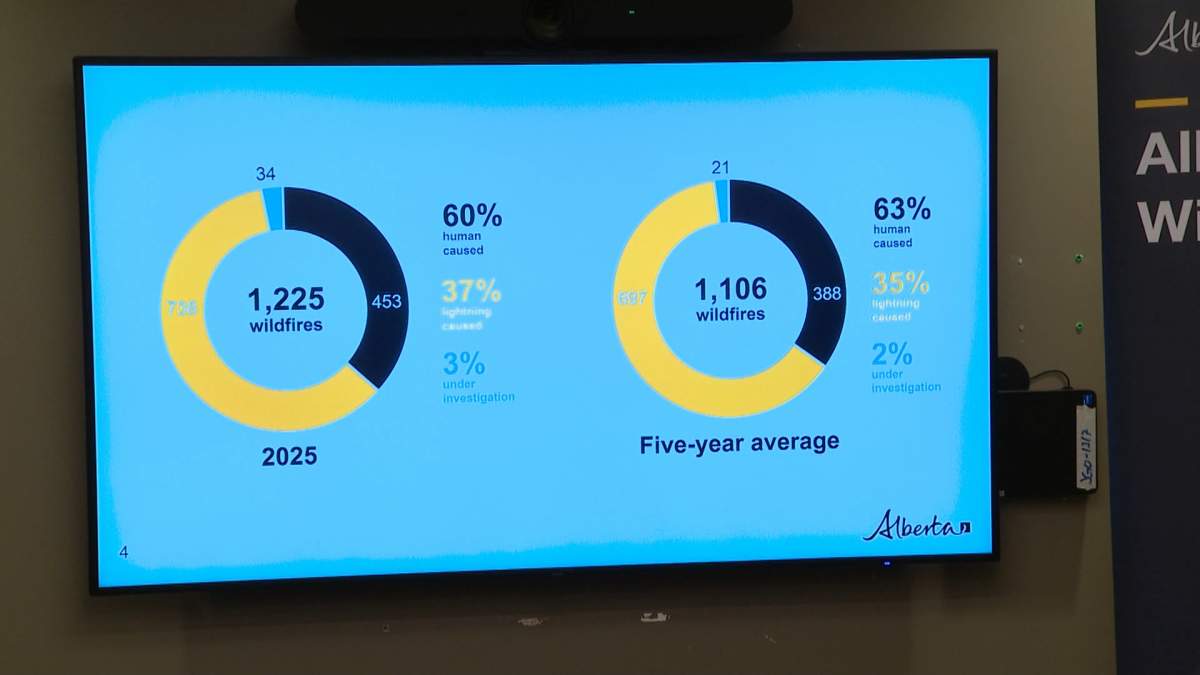
According to provincial wildfire officials, there were 1,225 wildfires in Alberta last year — that’s about 10 per cent higher than the five-year average, which includes the record-breaking 2023 season when more than 2.2 million hectares were burned — with about 60 per cent of them started by humans.
And although this year’s wildfire season doesn’t officially begin until March 1, already there have been more than two dozen new wildfires.
“We started the year with 17 carryover wildfires. A carryover wildfire is a fire that started in the previous year and is still burning on January 1st of this year,” said Christy Tucker, information manager with Alberta Wildfire. “And we have had 26 wildfires so far that started up in 2026. And they’ve burned 283 hectares.”
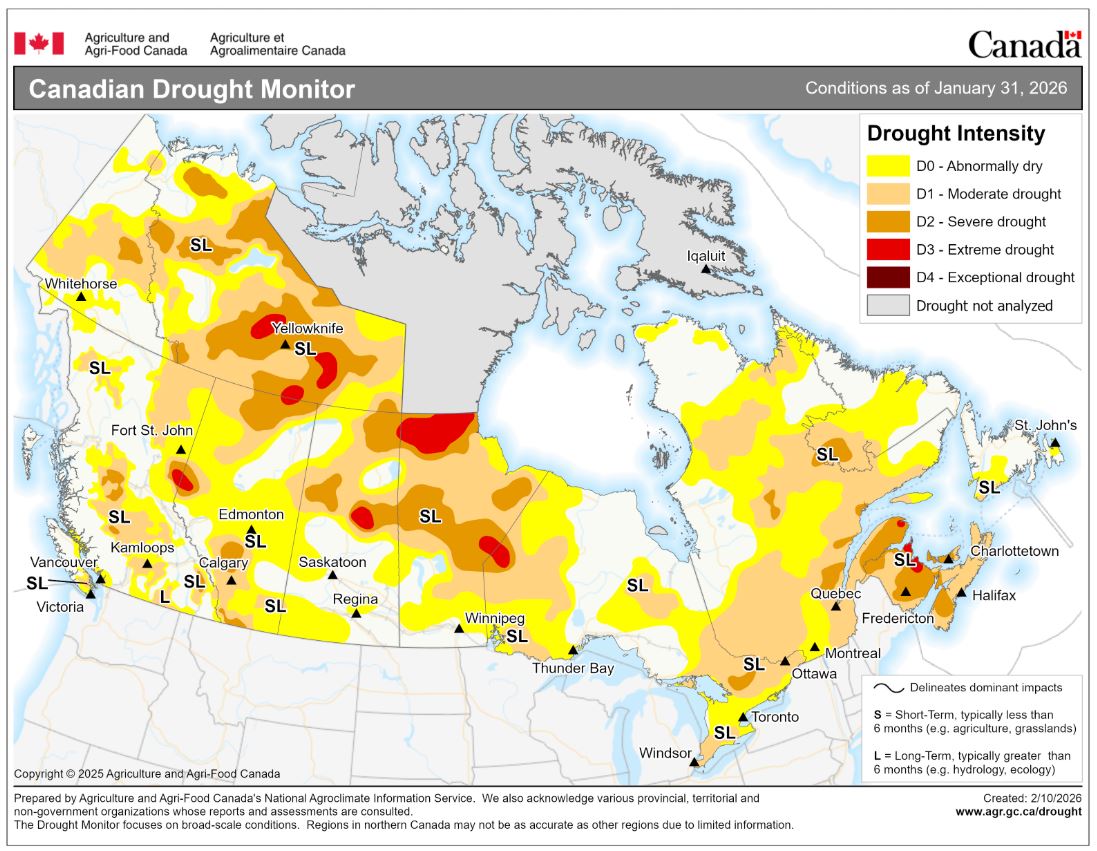
According to the federal government’s Canadian Drought Monitor, the latest map shows much of Alberta is experiencing drought conditions, ranging from “abnormally dry” to “extreme drought.”

Get breaking National news
Average temperatures across much of Alberta in January were 3 to 5 C above normal and more than 5 C in parts of the Peace Region.
Precipitation in many areas of the southern Prairies was also up to 60 per cent below normal.
“We’ve had a really dry winter, like exceptionally dry in some ways,” said Philip Roemmele, who owns a grain farm and a cattle feedlot near Claresholm, Alta., about 90 minutes south of Calgary.
“We’ve had seven plus years of somewhat off and on drought in southern Alberta. We had a very good July last year, which really was exceptional for us. It brought some really great rains. But yeah, we’re needing some moisture again,” said Roemmele.
“We really rely on those early spring rains, and then of course the most important rains are June and July, which the farmers rely on.”
His concerns about drought are echoed by John Smith, owner of Plateau Cattle Company, located near Nanton, Alta., about an hour south of Calgary, who said he’s seen about a decade of reduced precipitation, with some years being “flat out disasters.”
“In my memory, a January and February like we just had, I can’t remember one like that,” said Smith.
“You know, that being said, there’s a lot can happen. We’re always optimists in agriculture. I think our highest snowfall month is March, so from an eternally optimistic perspective, you know there’s time that hopefully something can turn around.”

While some parts of the Prairies have seen anywhere from 10 to 40 centimetres of snowfall in recent days, Peter Quinlan, meteorologist with Global News in Saskatoon, said it may not be enough to make up for what has been a very dry winter so far.
“In some parts of Western Canada, March and April can be some of the snowiest months of the year,” said Quinlan. (But) “I don’t think it will be enough to boost precipitation levels to where we need them, especially as we look ahead to the growing season. That’s because that January precipitation value for most areas on the Prairies was just so significantly below normal.”




Comments
Want to discuss? Please read our Commenting Policy first.