




It’s called Ranch by Design: a small family-owned company in Lacombe, Alta., selling western wear and tack supplies to customers in Canada and the United States.

Owner Beth Latwaitis estimates about 15 per cent of her customers are American and are attracted to buy from her because there aren’t many stores like hers that sell “show shirts” and other fancy clothing for riders to wear in the show ring.
They’re also able to save some money because of the favourable exchange rate between the Canadian and U.S. dollars.
But thanks to U.S. President Donald Trump’s tariffs, that may no longer the case.

“A lady purchased a show shirt, we call it, for $149.95 (CAD). She purchased it from California. I shipped it to California via Purolator. When Purolator delivered the shirt to her in California, they gave her a bill for $80 or $90 (US),” said Latwaitis.
That would increase the cost of the shirt to about twice the original purchase price. So the customer in California said no, refused to pay the tariff and arranged with Latwaitis to have the shirt shipped back to Canada.
“I said, absolutely, you can send it back. So she said, well, I’m just going to refuse it, so it just goes back. And I say, fine.”

Get daily National news
But then things went sideways.
“Next thing you know, I get an email saying that if I want the parcel back, I have to pay $147.85 to get the parcel back plus duties, fees, shipping to get it back,” said Latwaitis.
“In the meantime, the lady in California gets an email as well, saying if she doesn’t pay the fees, it’s into collections.”
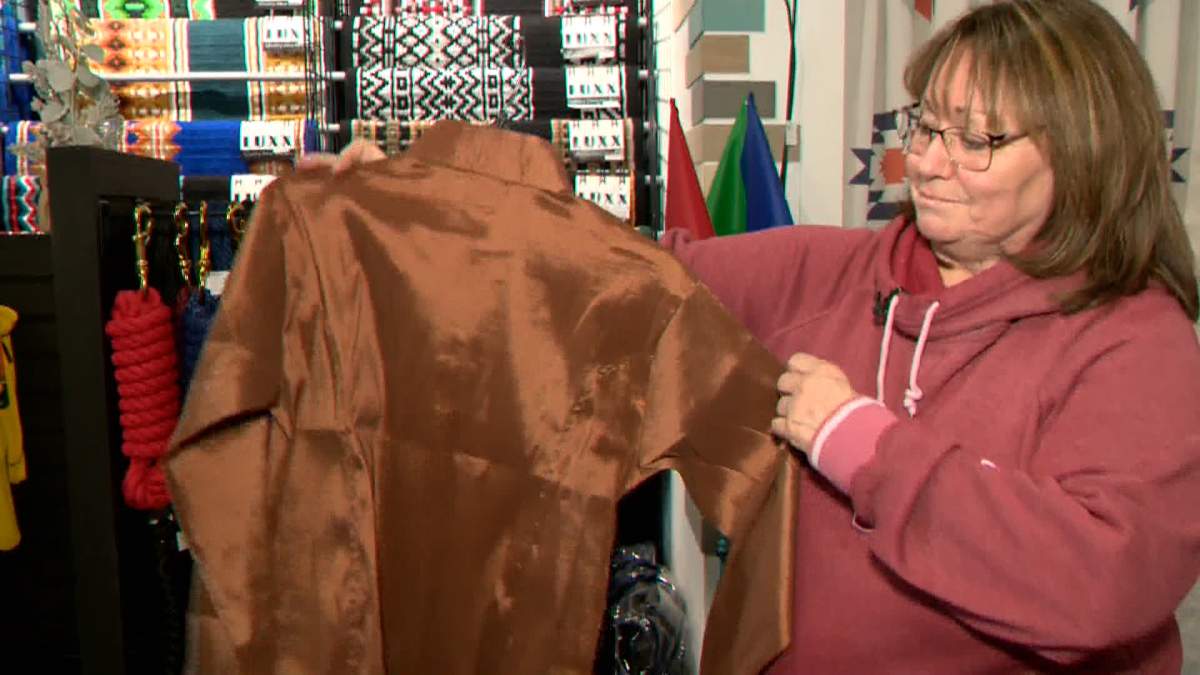
So Latwaitis and her customer are both are getting a big bill — and neither of them have the shirt.
According to Purolator, it is somewhere in Kansas City, Missouri.
The question about what tariffs apply is made even more complicated because the shirt was originally made in India and sold to a wholesaler in the U.S., who then sold it to Latwaitis in Canada, who in turn sold it to her American customer in California.

“This illustrates that when you get down to the nitty gritty, tariffs can be a very complicated logistical challenge for businesses trying to navigate the situation — especially small businesses,” said Trevor Tombe, a professor of economics at the University of Calgary. “Like who pays the tariff when you ship an item from Canada to the U.S.?
“Sometimes it’s difficult to know if you are subject to a tariff for a particular item. The situation is so uncertain with the United States.”
One solution, aid Tombe, might be for the small business to charge the tariff up front, but adding it on top of the original selling price risks alienating and losing customers.
“But we shouldn’t forget that the intent of the U.S. government is to discourage trade, and so what we’re seeing here is some of the effects on the ground of that policy choice,” said Tombe.
“The U.S. government wants to import less, and you know, paying the tariff is one thing, but the additional hassle and complexity involved is another way in which these policy changes discourage trade.”
Latwaitis has been making online sales to Americans for almost a decade, and this the first time she’s encountered this type of difficulty.
Trying to get in contact with someone at U.S. Customs who knows what’s going on, she says, “is like pulling hens teeth.”
“I don’t think anybody really knows, that’s the thing, I don’t think even they know,” Latwaitis added.
She and her American customer are still trying to come up with a solution — maybe each of them paying half of the tariff.
However it ends, Latwaitis admits it’s likely going to cost her more money.
“They told me that the fees will not go away and there’s nothing we can do about it.”




Comments
Want to discuss? Please read our Commenting Policy first.