

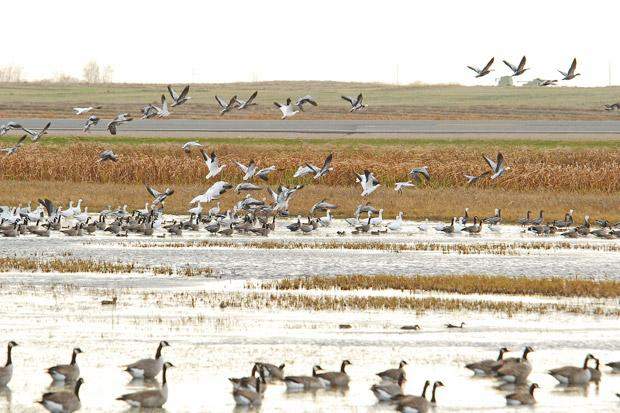
Canada Geese have become such a problem in areas of south Winnipeg that one group is planning to remove their eggs altogether this spring, in hopes that the gaggles of geese will leave the city in peace.
With the consent of land owners, and a federal permit from Environment Canada, members of the Urban Goose Working Group (UGWG) will be collecting eggs from Canada geese in an effort to improve traffic safety and reduce the number of geese along the southern portion of Kenaston Boulevard.
Jim Leafloor, water fowl biologist for Environment Canada, is just one of the members of the working group, which also includes people from the City of Winnipeg and Manitoba Conservation.
“Winnipeg has probably the largest concentration of geese as any urban centre in North America,” Leafloor said.
And that can pose big problems – especially along traffic congested Kenaston Boulevard. Now the UGWG will remove eggs from nests of Canada geese during the first week of May.
“We’re always concerned about human health and safety, but in the case of Kenaston Boulevard, it’s really an extraordinary situation where we have literally hundreds of Canada geese on the roadway during the summer months,” Leafloor said.
“They’re there for a least a couple of months, and the problem seems to be getting worse and worse with every year that goes by.”
Each year after the eggs hatch, adult geese and their broods gather along the Kenaston corridor, where they can easily access food and water.
The abundance of green space, food sources and open water coupled with few natural predators has resulted in increasing numbers of Canada geese. These geese then spend the summer months feeding along roadways and medians, creating dangerous obstacles for drivers.
Because this is a high-volume traffic area where vehicles travel at speeds of up to 80 kilometres per hour, having geese on the road can be very dangerous.
“And in the exact area that the geese congregate, there’s also a curve, so drivers can be caught unawares in that situation, and we think that the risks are real.”
Manitoba Public Insurance doesn’t track the number of geese-involved car accidents, but Leafloor said the evidence is on the road every summer.
“A number of us have used the roadway, we’ve been down that way, and it’s very common during the summer to see dead geese along the roadway, so we know that geese themselves have been involved in bird-vehicle collisions,” Leafloor said.
“And we don’t know how many times people might swerve or slam on the brakes, and how many times that might result in an accident. But with that many geese and that much traffic, it’s almost a certainty.”
While there are no firm numbers on geese that nest in that specific area, Leafloor estimates there are at least several hundred geese each summer. They are planning to count the numbers of pairs nesting in the area this year, as they collect eggs.
The egg removal will likely begin in early May, and the eggs will be disposed of over a one- to two-day period.
“There’s no real way that we can incubate them or maintain eggs in captivity for that number of birds,” Leafloor said.
They need to get permission from landowners along Kenaston Boulevard before they begin collection, but they’ve gotten permission from many already, and Leafloor expects many residents will give consent.



Comments
Want to discuss? Please read our Commenting Policy first.