

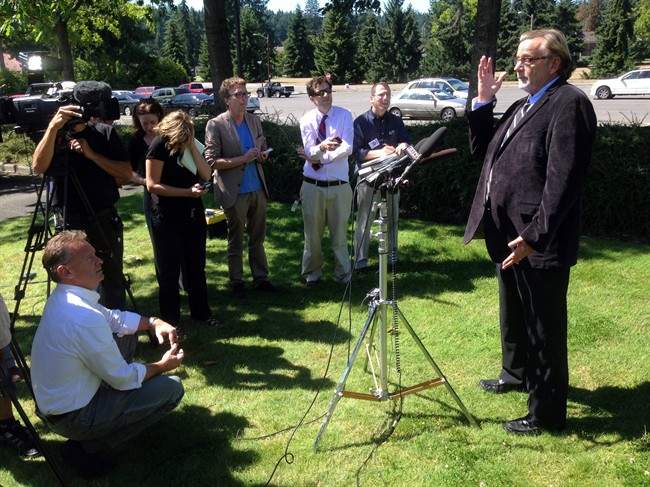
JOINT BASE LEWIS-MCCHORD, Wash. – The U.S. soldier who massacred 16 Afghan civilians during pre-dawn raids last year apologized for the first time for his “act of cowardice,” but could not explain the atrocities to a military jury considering whether he should one day have a shot at freedom.

Staff Sgt. Robert Bales said he would bring back the victims of his March 11, 2012, attack “in a heartbeat,” if possible.
“I’m truly, truly sorry to those people whose families got taken away,” he said in a mostly steady voice. “I can’t comprehend their loss. I think about it every time I look at my kids.”
Bales, 40, did not recount specifics of the horrors, but described the killings as an “act of cowardice, behind a mask of fear, bullshit and bravado.”
He said he hoped his words would be translated for the nine villagers who travelled from Afghanistan to testify against him – none of whom elected to be in court to hear his words.
The father of two from Washington state was serving his fourth combat deployment when he left his outpost at Camp Belambay, in Kandahar Province, in the middle of the night to attack two villages, exhibiting an unimaginable brutality as he slaughtered men, women and children screaming for his mercy.
The massacre prompted such angry protests that the U.S. temporarily halted combat operations, and it was three weeks before Army investigators could reach the crime scene.
Bales pleaded guilty in June, and the six-member jury is deciding whether his life sentence should include the chance of parole.

Get daily National news
If Bales is sentenced to life with the possibility of parole, he would be eligible in 20 years, but there’s no guarantee he would receive it. He will receive life with parole unless at least five of the six jurors say otherwise.
His attorneys previously made much of Bales’ repeated deployments and suggested that post-traumatic stress disorder and traumatic brain injury may have played a role in the killings. But they offered no testimony from psychiatrists or other doctors, saying they saw little point in making the case a battle of the experts.
Instead, they rested their defence after Bales finished speaking Thursday. Closing arguments were scheduled Friday morning.
Saying he was nervous to address the court, Bales sat at the witness stand and answered questions from one of his defence attorneys, Emma Scanlan, as his wife cried in the front row of the courtroom. Bales himself briefly became emotional, especially choking up as he apologized to his fellow soldiers.
“Nothing makes it right,” he added. “So many times before I’ve asked myself. I don’t know why. Sorry just isn’t good enough. I’m sorry.”
His statements were not made under oath, which prevented prosecutors from cross-examining him.
Bales described in detail the trouble he had readjusting to civilian life after his deployments to Iraq. He became angry all the time, he said, and he was mad at himself for that.
“Normal course of life became hard in that, you know, waiting in traffic, terrible,” he said. “Certain smells would just drive me nuts. Washing the dishes I’d just be mad about, for no reason.”
- ‘You’re allergic to the truth’: Defence accuses ‘Crypto King’ of lying at kidnapping trial
- B.C. lawsuit seeks millions in missing restaurant tips from fintech company
- Ex-banker who opened accounts, viewed PM’s data should get jail time: Crown
- Coroner’s inquest to be held into 2021 death of Campbell River First Nations man
-
![]() Ex-CRA employee sentenced after pleading guilty to fraud, breach of trust
-
![]() Toronto police make 21 arrests, lay 112 charges in probe into tow truck industry violence
-
![]() Philippine police file criminal complaints against Meghan Markle’s father
-
![]() Man who killed mom in Edmonton U-Haul hit-and-run sentenced to 14 years behind bars


He began drinking heavily, hiding bottles and sleeping pills from his wife. He fleetingly began to see a counsellor, but quit because he didn’t think it was working and he didn’t want others to find him weak.
His perpetual rage worsened as he deployed to Afghanistan in late 2011, taking steroids while there. He lashed out frequently at junior soldiers, he said, in ways he’s now embarrassed about.
Bales said he spent almost the entire day before the murders venting his anger by chopping and sawing a large tree that the soldiers had taken down near the base.
Bales’ lawyers tried to paint a sympathetic picture of the soldier to contrast his own admissions and the testimony of angry Afghan villagers about the horror he wrought.
Former pro football player Marc Edwards testified Thursday as a character witness, telling jurors he remembered Bales as a great leader from their high school days in Ohio.
The jurors on Thursday also heard from two soldiers who served with Bales in Iraq. One described how they sometimes had to collect the bodies of casualties, and how Bales helped carry civilians wounded and killed at the Battle of Zarqa in 2007.
The defence followed two days of testimony from nine Afghans, who spoke of their lives since the attacks.
Haji Mohammad Wazir lost 11 family members, including his mother, wife and six of his seven children. He told the six-member jury that the attacks destroyed what had been a happy life. He was in another village with his youngest son, now 5-year-old Habib Shah, during the attack.
“If someone loses one child, you can imagine how devastated their life would be,” said Wazir, who received $550,000 in condolence payments from the U.S. government, out of $980,000 paid in all. “If anybody speaks to me about the incident … I feel the same, like it’s happening right now.”


Comments
Comments closed.
Due to the sensitive and/or legal subject matter of some of the content on globalnews.ca, we reserve the ability to disable comments from time to time.
Please see our Commenting Policy for more.