

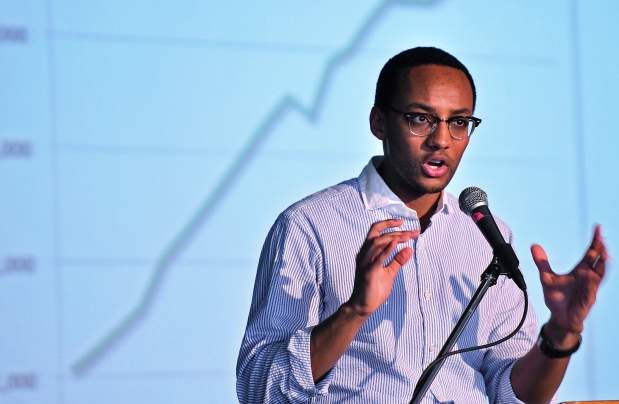
EDMONTON – University of Alberta students called for cuts to administration spending, retirement at 70 for professors and greater solidarity between professors and students to resist the 7.2-per-cent budget cuts imposed by the province this month.

Student council president Colten Yamagishi told the crowd of about 200 that freezing salaries for academic staff is one option discussed by Advanced Education Minister Thomas Lukaszuk.
That prompted one student to ask: “Is there any way to encourage retirement at age 70?” to avoid mass layoffs.
Yamagishi questioned whether older professors should continue to get annual salary increases for cost of living (two per cent) as well as merit increases.
“That’s a key issue,” he said.
Others questioned the high cost of university administration, which has risen by $500,000.
In 2009, students were hit with $300 increases in non-instructional fees and professors took unpaid furlough days.
A year later,” administrative staff got salary increases and our fees stayed high,” said Farid Iskander.
Yamagishi warned the crowd the U of A will propose “market modifiers” in an April 6 budget that will sharply increase tuition for medicine and other specialized faculties.
At MacEwan University, president David Atkinson noted a letter of expectation sent out by the province makes no specific mention that MacEwan will take on additional undergraduate teaching, one option that has been discussed in the last few weeks.

Get breaking National news
But that issue may be addressed when the province and university sit down to negotiate enrolment quotas “in approved programs,” as required by the letter of expectation, Atkinson said.
While there’s room for some increased enrolment on campus, already about 1,000 of the 11,500 students are not covered by government operating grants, he said.
The expectation letter also requires a 10-per-cent increase in transfer opportunities for students to move more easily between institutions. Atkinson noted that MacEwan has the province’s highest number of “in-transfer students” — those coming in from other institutions.
“So we already do a lot of transfers,” he said.
The MacEwan mandate letter differs from U of A’s only in the research section. MacEwan is required to enhance its applied research and commercialization while U of A is asked to pursue research “to advance the knowledge driven economy and create societal benefits.”
MacEwan is not considering following the lead of Calgary’s Mount Royal University, which cut its two-year transfer program for engineering to meet the 7.2-per-cent cut in the provincial budget.
“We are committed to keeping those programs here,” Atkinson said. “We pride ourselves in allowing students to segway from certificates into degrees.”
- Alberta government announces investment of more than $1 billion in student aid
- New Brunswick’s 12-year plans for school systems include adding pre-K
- With school violence on the rise, teachers say cuts will further strain classrooms
- Thousands of Calgary families facing a big jump in school bus fees next year
-
![]() Chilliwack boy badly hurt after being hit by e-scooter
Chilliwack boy badly hurt after being hit by e-scooter -
![]() Canada-wide science fair underway in Edmonton
Canada-wide science fair underway in Edmonton -
![]() Dozens of Calgary students join in on the weekly Bike Bus aimed at improving physical activity, safety and education
Dozens of Calgary students join in on the weekly Bike Bus aimed at improving physical activity, safety and education -
![]() BC’s education minister has seen text messages in the Victoria School Board trustees firing court case
BC’s education minister has seen text messages in the Victoria School Board trustees firing court case


MacEwan is also about to launch a new faculty of continuing education on a cost-recovery basis, he said. Those plans will go ahead despite the budget cut of $8 million on its $99.1 million operating grant.
Meanwhile, the province’s six independent universities, whose operating grants were not cut, are also reviewing their mandate letters.
Harry Fernhout, president of King’s University College, said there were no major surprises in the letter — though he’s looking closely at the emphasis on the colleges’ role in contributing to economic growth.
The letter requires King’s “to meet regional industrial needs” with its research.
“That shoe just doesn’t fit,” said Fernhout.
King’s does mostly basic science and not applied science, he said.
Universities serve more than the province’s economic needs, Fernhout said. A liberal arts college such as King’s produces “thought leaders and critical thinkers” for society.
“It’s about a broader social perspective,” he said.
The letters also have a new emphasis on “learner outcomes,” which means measuring skills such as writing and critical thinking as opposed to just measuring marks on a transcript.
It’s a new approach under discussion in Europe and in some other provinces in Canada.
“We’d like to be the guinea pig for the government to find what can be done with learner outcomes in the arts and sciences.”
The government operating grant was not cut for King’s and the five other independent colleges. The government funds 75 per cent of their operating grants but gives no capital funding.
King’s budget is $16 million, with $4.5 million coming from the government, Fernhout said.


Comments
Want to discuss? Please read our Commenting Policy first.