

The tattoo on Farhad Abdul Fatah’s right shoulder shows an AK-47 assault rifle over a burning Afghan flag.

AFGUN, it reads.
According to Toronto police, the tattoo is the mark of an Afghan street gang whose members have been implicated in stabbings, shootings, drugs, robberies, thefts and, most recently, automobile-insurance fraud.
Afghan For Life and its more violent-sounding offshoot, Afghan Fighting Generation, emerged partly in Toronto’s Thorncliffe Park neighbourhood, a hub of Canada’s fast-growing Afghan population. Police and immigration enforcement officers have now launched deportation proceedings against several alleged members, including Mr. Fatah, a 28-year-old Russian-speaking Afghan from Thorncliffe Park.
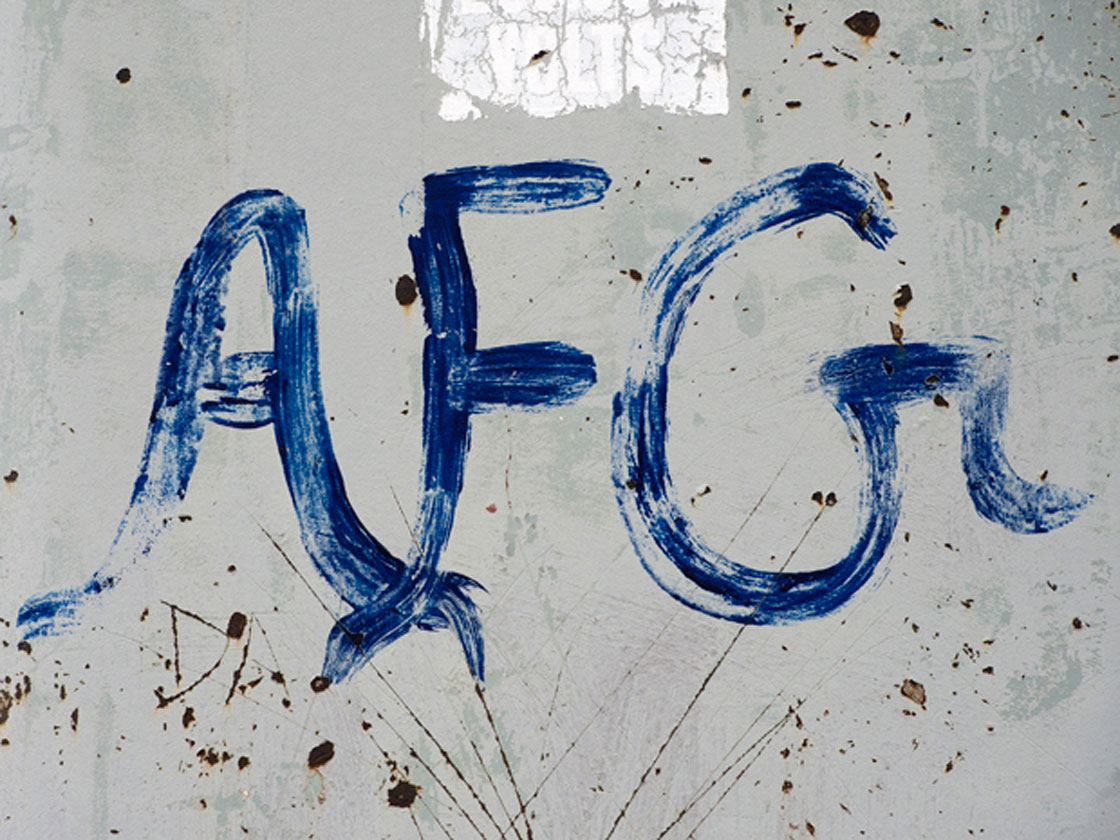
Since 2002, more than 23,000 Afghans have become permanent residents of Canada. Gang members began tagging Afghan neighbourhoods with Afghan For Life (AFL or A4L) and Afghan Fighting Generation (AFG) symbols a decade ago.
“The evidence shows that the AFL/AFG evolved within smaller neighborhoods of Toronto, where a number of Afghan youth lived or went to school,” according to the Immigration and Refugee Board. “The membership of the AFL/AFG is made up largely of persons of Afghan background.”
Members of AFL/AFG range in age from 16 to 24. While most are Afghan, at least one is Iranian. Police said 10 were known to have variations of the ‘AFGUN’ tattoo worn by Mr. Fatah. Over time, the gang armed itself with handguns, clashed with the rival Flemo Boys and shot a member of the Rascals.


“The activities of the members include simply ganging up on a fellow student, evolving to possession of multiple weapons,” the Refugee Board wrote last August when it dealt with Mr. Fatah’s deportation case.
Jehad Aliweiwi, executive director of the Thorncliffe Neighbourhood Office, a local social agency, said gangs were not a significant problem in the area, although he had seen AFL graffiti in the past. “When I used to walk a little bit around the park you will see ‘Afghan’ or ‘Afghan For Life.’ And young kids in our youth centre, we have a lot of Afghan kids,” he said.
But he said he was less worried about gangs than the high drop-out rate among Afghan boys. “That said, I think there is a lot of affinity with a group like the Afghan For Life for maybe social and belonging reasons, Afghan pride and all that,” he said. “I think it’s a new community that’s trying to find its place in here. It’s part of a struggle of integration.”
Since 2002, more than 23,000 Afghans have become permanent residents of Canada. Gang members began tagging Afghan neighbourhoods with Afghan For Life (AFL or A4L) and Afghan Fighting Generation (AFG) symbols a decade ago.

Get breaking National news
“The evidence shows that the AFL/AFG evolved within smaller neighborhoods of Toronto, where a number of Afghan youth lived or went to school,” according to the Immigration and Refugee Board. “The membership of the AFL/AFG is made up largely of persons of Afghan background.”
Members of AFL/AFG range in age from 16 to 24. While most are Afghan, at least one is Iranian. Police said 10 were known to have variations of the ‘AFGUN’ tattoo worn by Mr. Fatah. Over time, the gang armed itself with handguns, clashed with the rival Flemo Boys and shot a member of the Rascals.
“The activities of the members include simply ganging up on a fellow student, evolving to possession of multiple weapons,” the Refugee Board wrote last August when it dealt with Mr. Fatah’s deportation case.
Jehad Aliweiwi, executive director of the Thorncliffe Neighbourhood Office, a local social agency, said gangs were not a significant problem in the area, although he had seen AFL graffiti in the past. “When I used to walk a little bit around the park you will see ‘Afghan’ or ‘Afghan For Life.’ And young kids in our youth centre, we have a lot of Afghan kids,” he said.
But he said he was less worried about gangs than the high drop-out rate among Afghan boys. “That said, I think there is a lot of affinity with a group like the Afghan For Life for maybe social and belonging reasons, Afghan pride and all that,” he said. “I think it’s a new community that’s trying to find its place in here. It’s part of a struggle of integration.”
The Canada Border Services Agency brought Mr. Fatah’s case to the Refugee Board last year, arguing that as a foreign national and a member of a criminal organization, he should be deported. Mr. Fatah denied any gang affiliation and portrayed himself as a peaceful person with no interest in weapons or violence.
The IRB did not believe him.
“He has not been able to credibly explain his gang tattoos, his repeated associations with gang members, or his weapons possession convictions,” the board wrote in its ruling. A deportation order was issued on Aug. 2.


The crackdown on Afghan gangs is Canada’s latest attempt to use immigration laws to tackle street gangs. Despite being responsible for much of the gun violence in Canadian cities, gang members sometimes escape prosecution because victims won’t cooperate and witnesses fear retribution.
While that makes criminal convictions challenging, in recent years, police and immigration officials have teamed up to try a different approach: breaking up gangs by deporting key members to their home countries.
In Montreal, the tactic has been used against Haitian gangs. Honduran gangs have been targeted in Vancouver, while in Toronto immigration enforcement was partly responsible for ending the open warfare between Tamil gangs. Now Afghan gangs have been added to the list.
Since immigration officers went after Mr. Fatah and his colleagues, the AFL/AFG has become involved in automobile accident fraud — staging fake car crashes to collect insurance money, according to police.
But while the gang is still active, it has scaled back its violence, said Det. Const. Steve Kerr, a member of the Toronto Police Service’s Guns and Gang Task Force who testified at Mr. Fatah’s immigration hearing.
“A couple of years ago they were very active with regards to a lot of the violent crime that was happening in around Thorncliffe and that area … and Fatah was one of the well known guys that was trying to be the leader of that gang,” he said.
The deportation order against Mr. Fatah appears to have been a turning point. “Since that decision, things have quieted down. They’re still active but their violence has de-escalated. I guess you could say that they’re more into frauds.”
Mr. Fatah has been in custody since October, 2011. The government is currently deciding whether his deportation is justified when the danger he poses to Canadians is balanced against the risks he could face in Afghanistan, a country he last saw in 1991, when he was six years old. “He is still here,” his lawyer Rodney Woolf said. “He is in detention and the minister is seeking to remove him, that’s all I can tell you at the moment.”
At a detention hearing, he gave his occupation as “grass cutter” and said he needed to get back to work to help his father, who is 60 and on a disability pension. “Maybe you are just looking at his tattoo,” he said, speaking through a Russian interpreter, “that is why you think that he is a member of the gang.”
Comments