


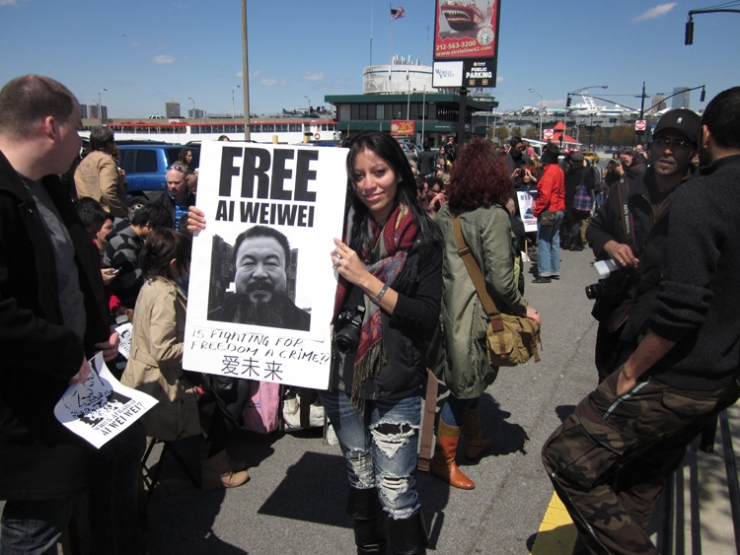
I was tired, jet lagged and nervous. I was about to meet Ai Weiwei, a Chinese artist and activist. I don’t often get to meet people who change the world, or are brave enough to try, so I wanted to make a good impression.

But even getting to his studio home is intimidating. When we drove up, a government car was parked outside, surveillance cameras covered the entrance and the smog was thick in the air.
While setting up for the interview, I was chatting with Ai Weiwei’s assistant, one eye peeled on the door, waiting for him to walk in. The door opens. But instead of a man in his fifties, a cat walks in.
“That’s the cat that can open doors,” Ai Weiwei’s assistant tells me. I laughed.

Get breaking National news
I was talking to the cameraman when Ai Weiwei walked in. His assistant introduced us and we shook hands. I had practiced saying Ni How on the flight over (“hello” in Mandarin), but I fumbled it up and said something I don’t remember. But I do remember his eyes- powerful, a little intimidating and kind of sweet.
I first heard about Ai Weiwei in 2010 when he had an exhibition at the Tate Modern in London, England. He had filled a room with a hundred million individually painted sunflower seeds, a comment on “made in China”. I had seen the pictures of him giving the finger to the White House, Eiffel Tower and Tiananmen Square (I am a fan of the middle finger in most instances).
I had heard about his disappearance in 2011 and saw Alison Klayman’s documentary ‘Ai Weiwei: Never Sorry” at the 2012 Hot Docs festival in Toronto. This was a guy who liked to mess with the system and was risking a lot to do so- part prankster, part activist.
It’s strange when you meet someone you know so much about. I thought I knew him but he had no idea who I was- this blonde, slightly awkward journalist from Canada who can’t say “Ni How” properly.
But he was very sweet, commenting on the cameras we were filming with and agreeing to do the interview in English. “It’s better for your audience, I think”, he said.
He speaks softly- though pointed. This is a man who has experienced a lot: labour camps, beatings, arrest and constant surveillance in a country with little personal freedom. And I was a girl from Edmonton asking him if he thought he was a brave person (He doesn’t) and if he thinks art can change the world (He does).
Sometimes my job is pretty cool.
-
![]() The Travel Lady: How travellers are being impacted by rising fuel prices and cruising in the Mediterranean
The Travel Lady: How travellers are being impacted by rising fuel prices and cruising in the Mediterranean -
![]() Future of Work: Inside TKS and the rise of student founders, scientists and innovators
Future of Work: Inside TKS and the rise of student founders, scientists and innovators -
![]() Money Matters with Aspire Wealth Partners
Money Matters with Aspire Wealth Partners -
![]() Carney gets his majority as Liberals pick up key wins in 3 byelections
Carney gets his majority as Liberals pick up key wins in 3 byelections




Comments
Want to discuss? Please read our Commenting Policy first.