


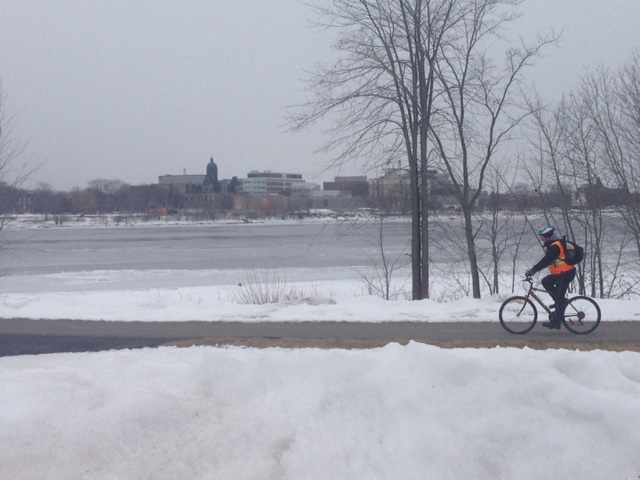
The City of Fredericton is looking at ways to improve and upgrade bike lanes and improve connectivity between the city’s trail system.

A public survey was conducted that received close to 500 responses in three months. A consulting firm recently presented a new Active Transportation Connection Plan to the city’s Transportation Committee. The report outlines gaps in the capital city and addresses areas the public would like to see trails improved.
City of Fredericton traffic engineer Jon Lewis said the new plan is an update to the Trails/Bikeways Master Plan from 2007. Lewis said the report outlines areas the city can work on over the next five to 10 years.
While there was “a lot of positive feedback,” Lewis said there are areas where the city can improve.
READ MORE: Fredericton working to improve bike lanes, years after target date
“There’s a number of gaps in our system in terms of our trail network and bike-lane network,” Lewis said.
The report outlines 50 projects that would enhance the city’s network of trails and bike lanes.
Eighty-three per cent of people who responded to the survey said they cycle at least once per week. According to the report, the “key challenges” identified by those who responded to the survey said there are currently a lack of bike lanes, lack of trail connectivity, dropping of bike lanes through intersections and challenging trail crossings. It also said the width of bike lanes and the need for increased education about road and trail sharing were concerns raised by respondents.
“Another part that we got a lot of feedback on was our trail crossings. So we’re going back and having a look at our trail crossings in terms of how we can make those safer,” Lewis said. “One of the tools we’ll be using going forward is looking at centre median treatments.”

Get breaking National news
Lewis said that would slow down traffic at trail crossings and provide “two-stage crossing” for trail users.
“There’s a couple big moves that certainly we’d like to look at in the near-term, one of the few biggest moves is probably some sort of bike infrastructure downtown. We’ve got a great trail network that gets people very close to to the downtown but doesn’t quite get people to their final destination,” Lewis said.
He said in the next couple years, the city will look at what options are available to put dedicated bike facilities on some downtown streets.
Radical Edge bike shop owner Mike Davis said the city is showing initiative and is pleased to see they’re interested in making changes.
“I think there’s a lot to be done. Where they start is always going to be the question,” Davis said.
He said improving crossings is a good idea, but said he would like the city to work on “linking up sections of the trail” that come to dead ends.
Davis said he’d like to see the city make the move to isolated bike lanes that would see one dedicated bike lane that is separated from cars, but said he realizes there’s limited space on downtown streets, and new lanes would likely impact driver traffic.
“I think some day, there has to be some real compromise and hard decisions made that a lot of people won’t immediately like, but I think in the long term will be really optically great for the City of Fredericton.”
- Edmonton Corn Maze opens as 2026 design celebrates AMA’s 100th anniversary
- Calgary’s iconic Stephen Avenue transformed in effort to attract more visitors
- An unforgettable night of football and fun at ladies’ night with the Calgary Stampeders
- Edmonton couple stuck in Caribbean amid WestJet strike aftermath


In regards to the safety of trail crossings, Davis said the onus to yield is on pedestrians and cyclists using the trails.
The four-lane Westmorland Street bridge is the most significant gap that exists, Davis said. He said it’s a “huge hiccup,” noting that the only safe transportation over the river right now is on the Bill Thorpe walking bridge.
“There’s no real safe way to come across the four-lane bridge. I think possibly cantilevering a lane off of it specifically for pedestrians and cyclists would be the least expensive yet expensive option,” Davis said.
Fredericton Trails Coalition president Art McFadden uses the trails himself and said people want to have more access to trails and more year-round use. He said that since the city paved them, they’re getting used more frequently.
“Bike traffic has certainly increased a lot,” McFadden said.
He agrees that figuring out how to fit more bike lanes downtown with existing infrastructure is important.
“Some streets are really narrow, some have parking on both sides and so on, so there’s been two or three different plans laid out. So which ones we’ll end up with on which streets remains to be seen through some traffic studies and so on, and a little bit of trial and error probably,” McFadden said.
He said he’s been a big advocate of putting cross walks at every trail crossing, but he said he recently learned that it goes against what the Motor Vehicle Act allows.
“In order to have legitimate cross walks at trail crossings other than at intersections, we’ve pretty well got to change the law, I guess”
He said trail crossings which cross roads will be removed to eliminate confusion because traffic has the right of way.
“What happens is you get traffic coming from two directions as one person stops and the other one doesn’t because one person knows the rules and says, ‘Well, I don’t have to stop for foot traffic,’ and the other one says, ‘I’m going to be nice and do it,’ — that’s where you get accidents,” McFadden said. “So we’re going to take the cross walks out for now, but we’re going to put signage on the roads saying “trail crossing” on each side of the street, and we’re also going to put markings on the pavement leading up to the street crossings.”




Comments
Want to discuss? Please read our Commenting Policy first.