

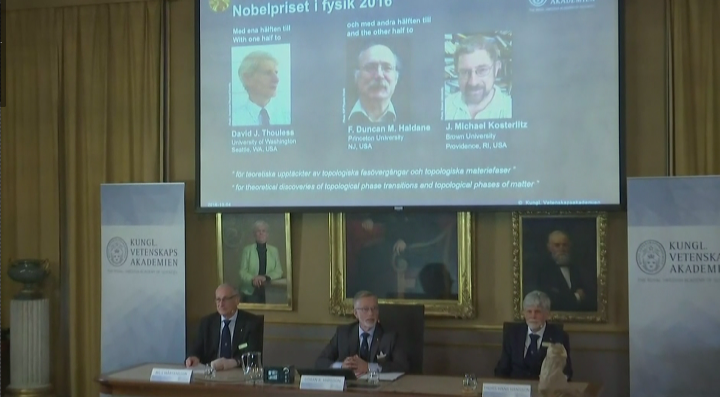
STOCKHOLM – British-born scientists David Thouless, Duncan Haldane and Michael Kosterlitz were awarded this year’s Nobel Prize in physics on Tuesday for work that “revealed the secrets of exotic matter,” the prize committee said.

The three “opened the door” to an unknown world where matter takes unusual states or phases, the Royal Swedish Academy of Sciences said.
They were for their “theoretical discoveries of topological phase transitions and topological phases of matter.”
READ MORE: Canadian scientist Arthur McDonald wins Nobel Prize for Physics

Get daily National news
Thouless, 82, is a professor emeritus at the University of Washington. Haldane, 65, is a physics professor at Princeton University in New Jersey. Kosterlitz, 73, is a physics professor at Brown University in Providence, Rhode Island.
Their research was conducted in the 1970s and ’80s. Nobel judges often award discoveries made decades ago, to make sure they withstand the test of time.
This year’s Nobel Prize announcements started Monday with the medicine award going to Japanese biologist Yoshinori Ohsumi for discoveries on autophagy, the process by which a cell breaks down and recycles content.
- Canadian Jeremy Hansen joins Artemis II crew, meets Trump at White House
- Alberta government launches annual campaign against invasive aquatic species
- Flooding fears prompt evacuation alert for residents near Fort McMurray
- Cenovus says oilfield extension off Newfoundland will hike emissions by 21 per cent


READ MORE: Japanese scientist Yoshinori Ohsumi wins Nobel Prize in medicine
The chemistry prize will be announced on Wednesday and the Nobel Peace Prize on Friday. The economics and literature awards will be announced next week.
Each prize has a purse of 8 million kronor (US$930,000). The winners also collect a medal and a diploma at the award ceremonies on Dec. 10, the anniversary of prize founder Alfred Nobel’s death in 1896.


Comments
Want to discuss? Please read our Commenting Policy first.