


Class size and composition have been major bargaining issues for the BC Teachers’ Federation (BCTF) and the government since the beginning of the teachers’ dispute.

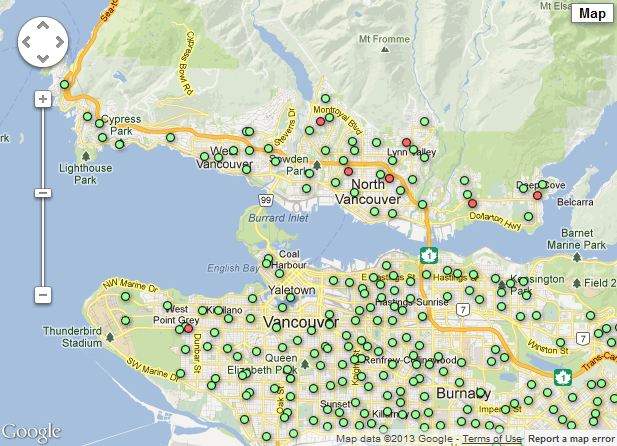
Using information added to the DataBC website by the Ministry of Education, Global News created a map of class sizes in B.C. This data covers class sizes in every public school in the province during the 2010-11 school year.
On the map, red dots indicate schools where more than 10 per cent of classes have 30 students or more. Clicking the dots will display average class sizes for each school by grade level.

Get daily National news
You can type in your postal code to see schools in your area. Or, zoom in and out to see other parts of B.C.
Looking at the map, it’s clear that the more crowded schools in the Lower Mainland tend to be outside of the City of Vancouver, in North Vancouver, Delta and Abbotsford. Kelowna and parts of Vancouver Island seem to also have issues with crowding.
B.C.’s most crowded school is Rick Hansen Secondary in Abbotsford, where 45 per cent of classes have more than 30 students.
By district, North Vancouver schools are the most crowded in the province, with 19 per cent of classes having more than 30 students. Abbotsford is in second place, with 12 per cent – well over the 6 per cent average for B.C. public schools.
According to the BCTF, for the 2010-11 year, there were 3,627 classes in public schools that exceeded 30 students per class for Grades 4-12, which are 338 more classes than the year before.


The provincial government has the same numbers.
In the past five years, the BCTF says the number of students needing an Individualized Education Program, IEP, decreased between 2005 and 2007, but since then has risen each year. In 2010-11, they say there are 12,240 classes exceeding the legislated limit of 3 IEP students, which is 18.9% of the 64,909 K-12 classes in B.C.’s public schools.
According to the government, there are 122 K-3 classes in the province with four or more students entitled to an IEP. They say that number rose to 12,118 classes within Grades 4-12.
When it comes to students in English as a second language, the government reports there are four or more in 2,695 K-3 classes in the province, but there are no students of this designation in 34,199 Grade 4-12 classes.
The BCTF says the number of classes in standard public schools in the province has decreased since 2007-8, and there are now 3,784 fewer classes in 2100-11 than in 2007-8.
The government reports that the average class size by school district is highest for Kindergarten and Grades 1-3 classes in the Central Coast.
For Grades 4-7, the highest average class size is in Central Okanagan and Langley.
In Grades 8-12, the government says the highest class size is in Nanaimo-Ladysmith.


Comments
Want to discuss? Please read our Commenting Policy first.