

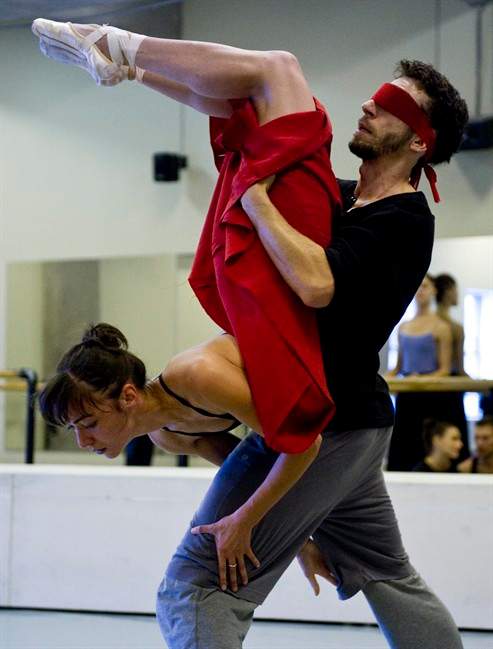
MONTREAL – Not even missing out on a historic evening at the Bolshoi can dampen choreographer Peter Quanz’s upbeat mood these days.

On Oct. 11, the legendary Moscow theatre is dedicating an entire program to some of Quanz’s work, making him the first Canadian choreographer to be feted in such a manner.
But the native of Baden, Ont., is far from crestfallen because two days later his “Rodin/Claudel” production begins a two-week run to kick off Les Grands Ballets Canadiens de Montreal’s 2011-12 season.
“It’s a complete dream to have a program of my work at the Bolshoi,” Quanz, 32, said in an interview Wednesday.
“And the first thing that went through my mind when I heard about (the Bolshoi tribute) is, ‘It’s the worst timing possible’ because it’s two days before my premiere here and this is such an important premiere and also a dream.
“It’s a Canadian premiere. This is my country. It’s a big ballet and it’s always been my dream to put on something like this.”

Get daily National news
“Rodin/Claudel,” Quanz’s first full-length ballet to be presented in North America, recounts the tempestuous relationship between French sculptors Auguste Rodin and Camille Claudel.
Rodin was 43 and Claudel just 19 when they met in Paris in 1883.
What followed was a love affair that lasted for years, although Rodin refused to leave Rose Beuret, with whom he had a son.
Claudel struggled financially and her mental health spiralled downward over the years.
Quanz, who attended the Royal Winnipeg Ballet School, said the stormy relationship was a natural for a ballet adaptation.
“It is a dramatic story that’s passionate,” explained the choreographer, who has collaborated with the American Ballet Theatre, Britain’s Royal Ballet and the National Ballet of Cuba.
“It’s a love affair, it’s a story of hatred, it’s a story of madness. It’s all involving art, and that art happens to be sculpture, about the body. It’s a perfect story for a ballet because it’s physical.”


Quanz was just nine years old when he realized what he wanted to do in life.
He said his parents would take him to the theatre in Stratford, 20 minutes away from the rural Mennonite community of Baden.
Quanz was fascinated by set changes.
“I told my teacher at school that I wanted to make that happen,” he said.
“I wanted to be the person who moved other people around on stage. She said ‘Peter, don’t you want to be the one on stage?’ And I said, ‘No, no no, I want to be the one with ideas.’ So she sent me to ballet school. And that was when I was nine.”
Was there any backlash to being a Billy Elliot (a movie he calls “extraordinary” and “very important”) prototype in small-town Ontario nearly 25 years ago?
“My parents were very careful to not be too open about me taking ballet classes,” he recalled. “I grew up in a Mennonite community and dancing is not part of our culture.
“It’s just not understood. And that’s fine. It’s a matter of education and a matter of exposure to the arts. And that’s happening over time.”




Comments
Want to discuss? Please read our Commenting Policy first.