

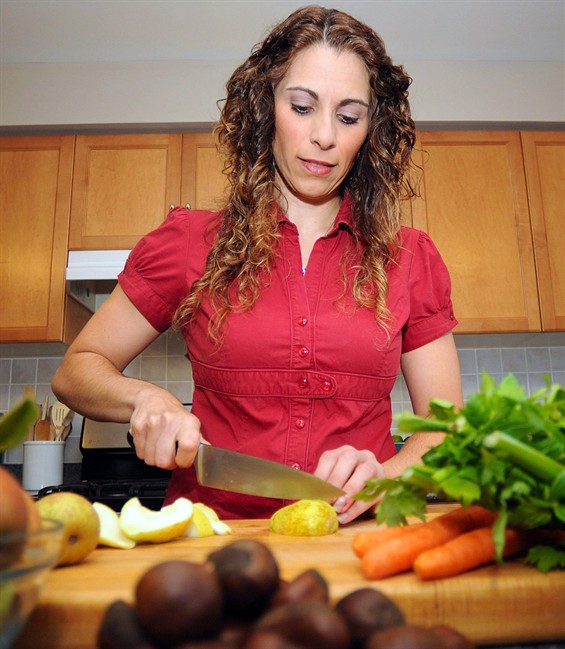
LONDON, Ont. – Turkey stuffing is one of those foods that commands great loyalty in some families, who make it holiday after holiday, year after year, sometimes generation after generation. You can try a new salad or change up dessert, but unless you want complaints, don’t mess with the stuffing.

“I think it’s a pretty strong tradition,” says Emily Richards of Guelph, Ont., home economist, cookbook author and former Food Network host. “For Thanksgiving dinners and any kind of holiday dinners, (most families) stick to the tried and true. The turkey is the centrepiece and the stuffing is as well. In my family, I make a mushroom stuffing and if that stuffing isn’t present, it’s not Thanksgiving.
“I love that because that’s what carries on tradition. That’s what food memories are built on.”
The history of stuffing is not well documented, but Richards believes it goes back to Roman times.
“In European countries it’s referred to as farce, as in forced meat, like when anything – nuts or seeds or bread – was used to stuff meat,” she says. At some point, the upper crust decided they didn’t like scooping stuffing from the inside of the bird and began cooking it in a separate dish.
This is the only difference between “stuffing” and “dressing.” The former is cooked inside the bird and the latter outside, although some families still use the terms interchangeably.
“I do both – stuff the bird and make a separate casserole,” Richards says. “You make everybody happy. The people who love the juices from the turkey and soft stuffing are happy and the people who like that nice crusty topping on the dressing are happy.”

Get breaking National news
Whatever was used to stuff the bird, “It was always the most inexpensive thing you could find,” she says. In her husband’s Scottish family, the traditional dressing was large-flake oatmeal, sauteed onions and salt and pepper cooked in some of the turkey drippings.
Jennifer Hunter’s family wouldn’t dream of cooking a turkey without traditional Irish dressing, made with potatoes. The recipe goes back at least as far as her great-great-grandmother and her Irish grandparents brought it to Ontario when they emigrated in the 1950s. Hunter, who now lives in Rochester, N.Y., says it’s as much about the tradition as the taste, “but I do love the taste.”
The potato dressing used to be cooked in the turkey, but they now make it in a separate casserole and although her grandmother still likes to have a potato with her meal, most of the family eats the dressing as a substitute for potatoes.
“It is also great as a leftover and spread on a turkey sandwich,” Hunter says.
Richards says there’s no practical purpose for stuffing other than the taste. In fact, stuffing complicates things because “the bird takes a little bit longer (to cook) when the cavity is full.” Also, the cooking temperature of an unstuffed bird doesn’t have to be as high, leading some people to believe they get a moister turkey when it is not stuffed.
“But if you’re cooking your turkey properly, you’ll always end up with a moist turkey, whether it’s stuffed or unstuffed.”
You should always use an instant-read thermometer to test the temperature of the cooked turkey, Richards says. If stuffed, the stuffing should be tested separately.
While any stuffing you use will absorb flavour through the turkey juices, the reverse is also true.
“It’s kind of like you’re poaching something,” Richards says. “It’s in there steaming, so some of the flavour will get distributed throughout the meat. Last year I did a pear stuffing and I found that the sweetness of the pear enhanced the turkey just a little bit.”
Cranberries and apples also often show up in stuffing.
With a combination apple-sausage stuffing, for example, “you get a little bit of sweet and salty. And I think it enhances the flavour because it’s packed in there. It has nowhere to go except into the meat.”
If the dressing is cooked outside the turkey, there is no special preparation required for the empty cavity, Richards says. But for the same, flavour-enhancing reasons, some cooks put onions or lemons or fresh whole herbs inside the cavity.
“I’ve stuffed a whole bunch of parsley in a turkey. The aroma in the oven was amazing and when the parsley was cooked, I mixed it in with the gravy just to add some fresh flavour. It worked really well.”
Richards’ newest cookbook is called “Get in the Kitchen and COOK!” “I’m publishing it online and I’m hoping to have it done by October.”
—
Susan Greer can be contacted at susan.greer(at)rogers.com.


Comments
Want to discuss? Please read our Commenting Policy first.