


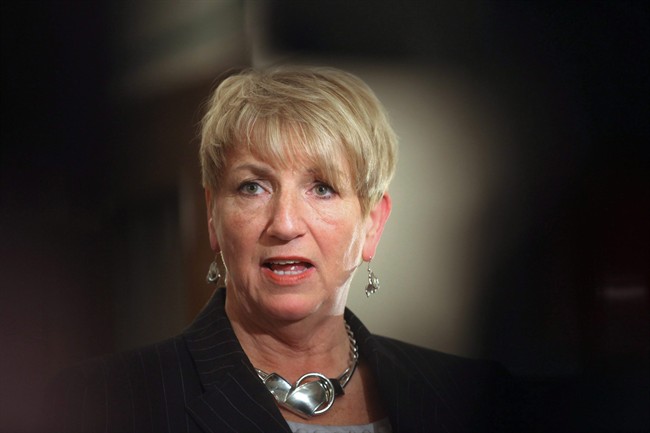
ST. JOHN’S, N.L. – Newfoundland and Labrador Premier Kathy Dunderdale says she isn’t worried by news that a loan guarantee for the Muskrat Falls hydroelectric project won’t be in Monday’s federal budget.

Federal support for the $6.2-billion venture doesn’t require budget approval through a vote in Parliament, she said in an interview Friday.
“The minister of finance has the authority, with cabinet approval, to enter into a loan guarantee with Newfoundland and Labrador.
“We just went through an election, the government is just back and functioning now. We’re very pleased with the progress of the loan guarantee, and both the federal government and our own negotiating team feel that all of this will be concluded by the end of the summer.”
The promised loan guarantee or equivalent funding could save the province hundreds of millions of dollars in interest costs.
Dunderdale refuted comments by Liberal MP Gerry Byrne, who has said the federal Conservative government needs parliamentary approval through a budget vote to offer a loan guarantee.
A senior government source told The Canadian Press that the Muskrat Falls loan guarantee won’t be in Monday’s federal budget, but fiscal support can be offered and then accounted for in future.
Friday’s speech from the throne also reiterated the federal government’s support for Muskrat Falls and other energy projects that make economic sense and reduce greenhouse gases.

Get breaking National news
Still, Byrne has asked the parliamentary budget officer for an official opinion on whether any loan guarantee needs voted approval.
“It would be better for it to have parliamentary oversight and authority granted to it in Monday’s budget because the deal would then be cemented forever and nobody can change it,” he said Friday.
It took mere weeks in December 2008 for Ottawa to negotiate multibillion-dollar loans and loan guarantees for the failing auto industry, Byrne said. Those measures were accounted for in the federal budget that followed a month later.
By comparison, Muskrat Falls talks have been going on for months, Byrne said.
Dunderdale is in a tricky political position, he suggested.
“As long as this gets drawn out in a protracted discussion … she’ll never be able to voice any concerns, any criticism about any federal-provincial issue,” Byrne said.
“If she does, there will be a quiet telephone call made by the Prime Minister’s Office … informing Premier Dunderdale that there are some ‘technical issues’ surrounding the loan guarantee, and it may be delayed for a little bit.”
The provincial Liberal opposition also asked Friday why Dunderdale hasn’t taken a higher profile in a dispute over halibut and turbot quotas that has seen irate fishermen occupy federal Fisheries offices on Newfoundland’s west coast.
- B.C. Conservatives plan to repeal no-fault insurance, leaked letter shows
- Ontario asks OPP to look into OSAP payments at private career colleges
- ‘Tipping recession’: Atlantic Canadian hospitality workers feeling the pinch
- Westwood Hills residents welcome work on new emergency exit, but want more routes
-
![]() Ottawa and Washington relationship ‘the worst in modern history’: Ex-US Ambassador to Canada
Ottawa and Washington relationship ‘the worst in modern history’: Ex-US Ambassador to Canada -
![]() U.S. Coast Guard suspends search for missing Ontario air ambulance crew, passengers
U.S. Coast Guard suspends search for missing Ontario air ambulance crew, passengers -
![]() BC Lions Gravy Bowl Game
BC Lions Gravy Bowl Game -
![]() Alicia Keys’ musical ‘Hell’s Kitchen’ hits Toronto with story about family, love and self-discovery
Alicia Keys’ musical ‘Hell’s Kitchen’ hits Toronto with story about family, love and self-discovery


Fisheries critic Marshall Dean asked in a news release whether the Muskrat Falls loan guarantee “has crippled the Dunderdale government from speaking out.”
Dunderdale said the hydroelectric megaproject is viable and will go ahead – with or without Ottawa’s help.
She took flak from political rivals for attending a Conservative rally in St. John’s, N.L., in March as Prime Minister Stephen Harper promised support for the plan to harness power from Labrador’s lower Churchill River.
Her critics accuse Harper of breaking his word to the province before, most notably on a promise to shield offshore oil profits from federal transfer fund clawbacks.
Dunderdale’s former boss, retired premier Danny Williams, famously nixed Tory hopes in the province in the 2008 federal election with his “Anything But Conservative” campaign.
But Dunderdale said Friday she has no regrets.
“I took a big risk supporting Stephen Harper, and it paid off. It paid off big-time for the people of Newfoundland and Labrador. We have a Conservative majority government that this province has to deal with for the next four years.”
An open line to Ottawa means provincial concerns on everything from the fishery to ferry services can be raised, Dunderdale said.
The province’s sole Conservative MP, Peter Penashue from Labrador, is also at the cabinet table in charge of intergovernmental affairs.
“At least we have a relationship now that is respectful, where we’re being heard and we can try to advance these files,” Dunderdale said. “That was the risk I took, and that’s the risk that has paid off for me.”


Comments
Want to discuss? Please read our Commenting Policy first.