






Calgarians and local businesses are set to pay more for water over the next four years after city council approved a slew of fee increases proposed by city administration Tuesday.

Those increases are set to amount to nearly 20 per cent for drinking water, 15.2 per cent for wastewater and 5.8 per cent for stormwater annually between 2027 and 2030.
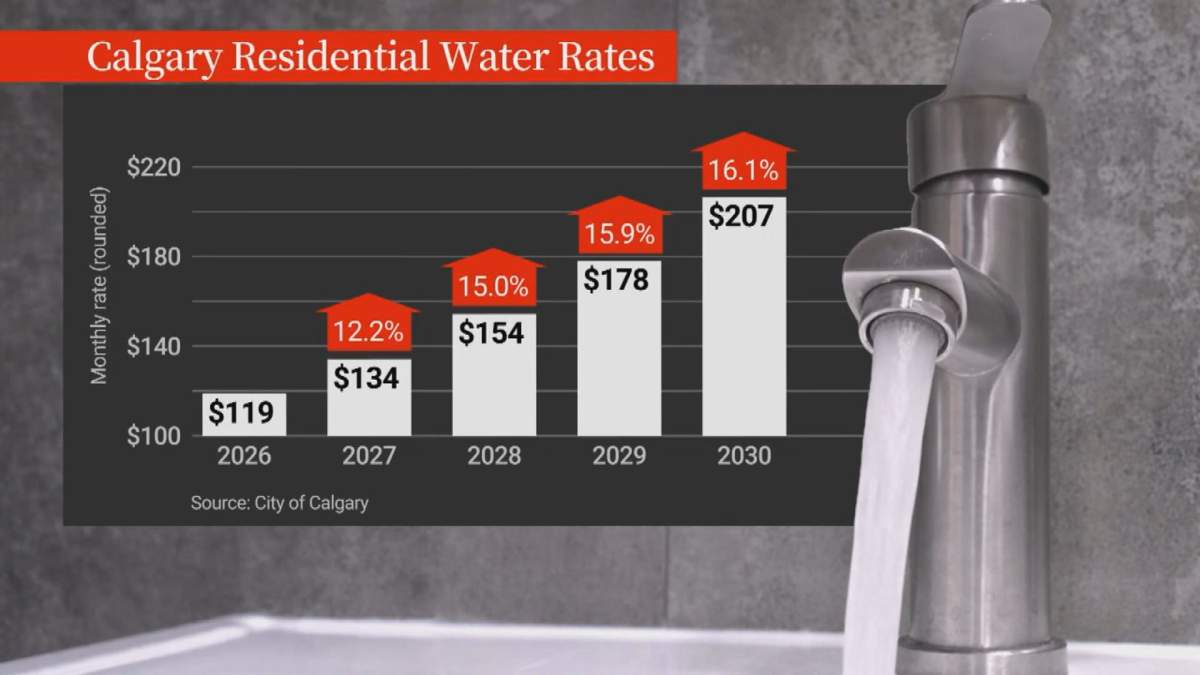
Water rates for the average household are set to increase from $119 monthly this year, to $134 per month in 2027, eventually increasing by $90 to $206 monthly by 2030.
Mayor Jeromy Farkas called the hikes an “accountability moment” after what he said was more than 10 years of underinvestment in the city’s water system.
“Us as a council, we’re taking charge, we’re committing to Calgarians that we are addressing this and we are not going to tolerate failure of the fundamental responsibility of a municipality, which is safe and clean drinking water,” Farkas told reporters.
The increases are set to help pay for a $6.5 billion capital invesment over the next four years to renew critical infrastructure, expand drinking water, wastewater and stormwater capacity, reduce water loss and improve emergency readiness.

Get daily National news
Challenges with the city’s water system have been highlighted by two catastrophic breaks along the Bearspaw feeder main, one of the city’s most critical water lines that carries more than 60 per cent of Calgary’s drinking water.
“This is not a one-off, this is a sign the entire system needs investment and needs work,” said Michael Thompson, chief operating officer of the city’s water utility.
According to Thompson, the city tried to keep water rates “low and affordable” over the last 10 years.
“I think what happened over that last decade was we focused on rates and not on the infrastructure as well,” he told council.
A report from administration warned of “major risks” within the city’s water system and delaying investment could leak to an increase service disruptions, emergency repairs and long-term costs.
“This isn’t all of what is needed, but it does scratch the surface,” Farkas said. “This is the bare minimum that we need to avoid the literal ‘crap-pocolypse’ of our stormwater, wastewater and water system failing again.”
City council voted 9-6 in favour of the new water rates, which will be included in the upcoming four-year budget deliberations in November. Councillors Landon Johnston, Rob Ward, Kim Tyers, Mike Jamieson, Jennifer Wyness and Dan McLean opposed.
McLean told reporters he hoped city administration would look at alternate funding mechanisms for water infrastructure, like municipal bonds, to help offset the impact on Calgarians’ water bills.
“I understand the need for this but I don’t think we’ve looked at every other option,” McLean told reporters. “This is too much on top of what we’re looking at for a proposed municipal property tax, so I just could not support it at this time.”
- New Alberta riding maps pass in legislature as NDP MLA kicked out of debate
- Liberals, Carney defend ‘brutal’ pace of committee work on major projects bill
- Saskatoon city council approves 5.26% property tax hike in 2027 budget
- U.S. wants to accommodate Canada on sectoral tariffs, Trump trade czar says
-
![]() Alberta uses sovereignty act to push back against federal hate law
-
![]() MacKinnon talks farmland expropriation for Alto high-speed rail project
-
![]() Carney shuts down Poilievre, says ‘did not’ discuss $2.3B Telesat deal with ‘buddy’ CEO as PM
-
![]() Nova Scotia’s new Liberal leader calling on PC government to pause AI data centre


City administration said any funding the city receives from other orders of government could reduce rates in the future.
Although Ward 10 Coun. Andre Chabot included an amendment to review the rates next year instead of halfway through the budget in 2028, there were no attempts from city council to reduce the hikes from administration.
“I was hoping that my fellow colleagues would see the cries from Calgarians, from small businesses, from large businesses… saying please slow this down,” Tyers told reporters. “During the budget, there’s definitely room for us to revisit this.”
Businesses are also facing an “egregious” rate hike, according to the Calgary Chamber of Commerce.
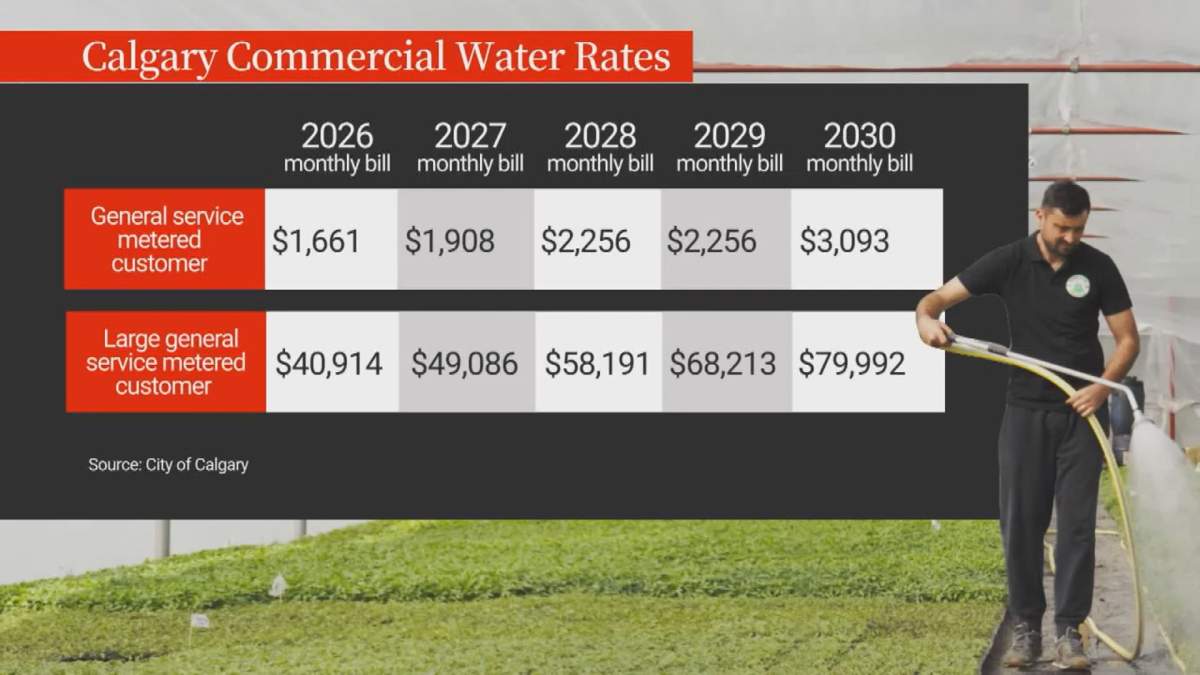
A medium sized business using 400 cubic metres of water monthly could see its bills increase from $1,661.33 per month this year to $3,093.19 monthly in 2030.
“It really renders our businesses very uncompetitive, it will squeeze their bottom lines significantly,” said Chamber of Commerce president Deborah Yedlin. “When you think about the fact that 95 per cent of Calgary’s businesses are small and medium sized enterprises, this is a huge concern.”
When pressed on the increases facing businesses, Farkas suggested using less water to reduce the costs.
“For us to give, say, a big break to our largest industrial users and redistribute that burden to the local residential class, that doesn’t make sense to me,” he said.


Go online and search city of Calgary jobs, it will blow your mind. You think water and sewage roads and snow removal… Right arts instructor, fitness instructor how about let’s get real and cut half of these jobs… We employ 10s of thousands of people literally…. Full 🛑 full benefits out the butt… Mandatory department cuts of 10% every year until the can pay for everything without asking for more more more
When your a politician making over $200k a year, increased fees doesnt hurt so much. But when youre a blue collar worker making $35k to $60k with a stagnant income, how can u afford these constant increases? There needs to be a balance when people cant afford basic necessities
Man, it can be brutal keeping ahead of auto corrects insane changes.
@-Ecobar 10:00 am. Actually Developers are paying for mose of the new onfrasture. It goes on the cost of the house. The City and their media friends keep forgetting that little fact.
And they will continue to build new infrastructure in the worst possible places to ensure early failure.
How do useless people get to run cities, provinces, the country?
City of Calgary council cleanup is needed!
How about charging the developers in all the new areas huge rates for all the infrastructures needed. You keep increasing everything for everyone pushing people out of owning homes. Do better.
Wow I find it amazing that people don’t seem to remember that Farcus was part of the council that he now says cost us so much in failing to fix the infrastructure in the past. Now he is mayor people think he is doing a good job fixing the problems that came from the very councils he was part of. The past 2 mayors are to easy to blame but yes they were bad but don’t give Farkus a free ride when he was part of the problem from the beginning.
The taxes we already pay are literally for infrastructure……it is not our fault as citizens the government chose to use it on anything else …90 of the b.s.the government does with our money is not what any normal person would approve….and certainly not a majority…..not of political parties but of just the people….time to sue the government……
1term Mayor!
There I just looked it up the City of Calgary has over 4.2 billion dollars in reserve bank accounts why are they raising taxes on our water when they have lots of money to cover infrastructure if they have that much money stashed away it says we have more money than any other City we have the highest Reserve bank account than any City in Canada
Another useless Council and mayor all they can do in this city is Ever Raised taxes why don’t they look at their City bank accounts this city has hundreds of millions of dollars stashed away which they never use they just keep taxing their citizens it’s time for major cuts in the budgets they don’t need to keep taxing their citizens no more they have enough money if they’ve had millions and millions of dollars in Surplus all these years they’ve been over taxing their citizens for years time to throw all the bums out again
I like our new mayor and he has to do things to fix what Nenshi and Gondek didnt do.
This is because of Nenshi and Gondek, as mentioned in the article, the focus of the previous administrations was “affordability” not infrastructure. Socialism always leads to broken systems and collapsing infrastructure, because Socialism is the ideology of failure.
$6.5 billion capital investment needs to be paid for, but as the water falls under city council it has to be paid within a budget/election cycle. As McLean said, Council should have looked at bonds that would have spread the payment over decades not a few years. Though what should really happen is that water should be taken over/absorbed by Enmax, taking infrastructure and other decisions away from City Hall.
You can thank nenshi and gondak for this totally there responsibility no way I want nenshi running our province