


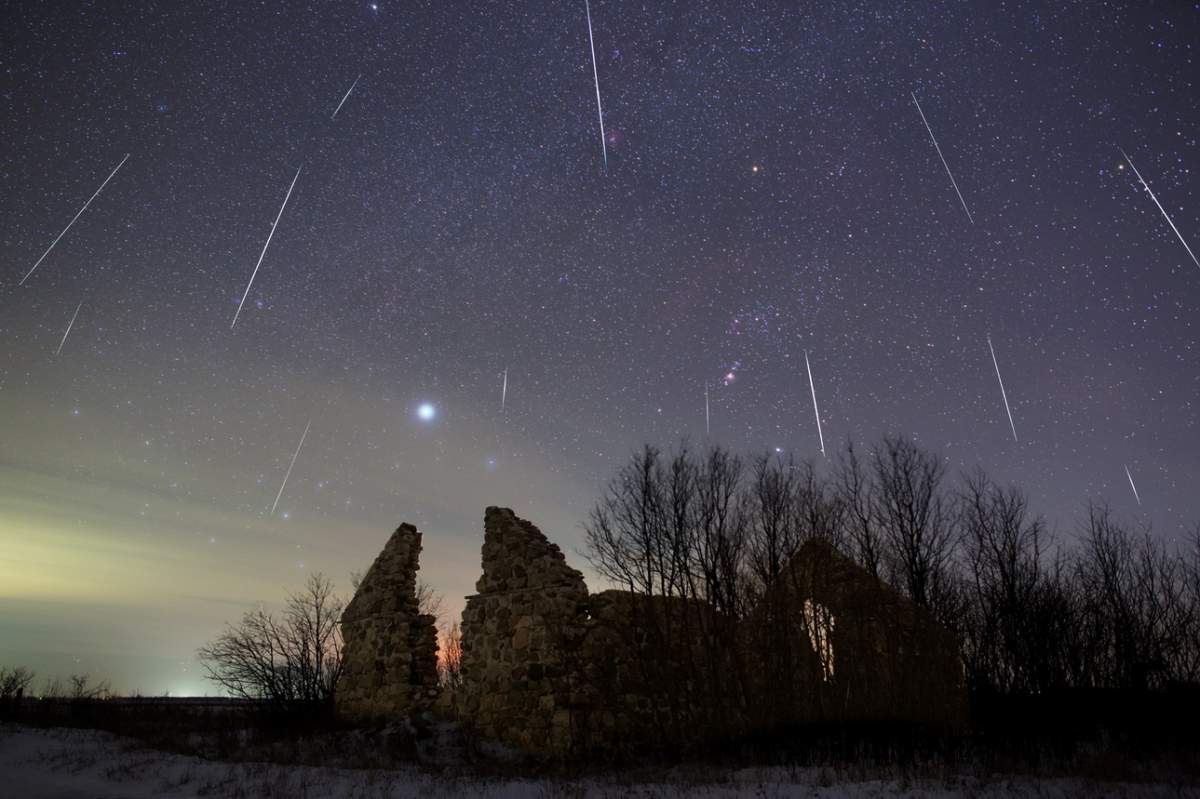
Canadians can prepare to witness the peak of a Perseid meteor shower and partial solar eclipse that is expected to light up skies across Canada next week.

Cited by the Canadian Space Agency (CSA) as “the best meteor shower of the year,” the peak viewing night is set to be Aug. 12 to 13.
“You have to be patient, but it’s a great spectacle if you’re lucky to be in a region where you can see it,” said Pierre Langlois, manager for the space astronomy and planetary science missions at the CSA.
What is a Perseid meteor shower?
A spokesperson with NASA said that a Perseid meteor shower is caused by “the Earth passing through debris left behind by Comet Swift-Tuttle as it moves in its orbit about the Sun.”
As a result, “these bits of debris enter Earth’s atmosphere at a very fast 59 kilometers per second, vaporizing about 80 to 90 kilometers altitude and leaving behind streaks of light we call meteors or shooting stars,” the spokesperson said to Global News in a written statement.
“It’s a bit like when we’re driving into snow, we see snowflakes coming towards us. That’s exactly what’s happening with these meteor showers,” Langlois said, also adding that Perseid meteor showers, which occur yearly, are “much easier to predict” visible shooting stars.
The Perseids can start to be seen from the Northern Hemisphere each year from late July to mid-August, the CSA says.
Partial solar eclipse to be visible next week
The showers align with a partial solar eclipse set to occur next week, giving Canadians another astronomical event to add to their summer schedules.

A partial solar eclipse happens when “the Moon passes between the Sun and Earth but the Sun, Moon, and Earth are not perfectly lined up. Only a part of the Sun will appear to be covered, giving it a crescent shape,” according to NASA.

Get daily National news
“During a total or annular solar eclipse, people outside the area covered by the Moon’s inner shadow see a partial solar eclipse.”
When and where is the best time to observe these events?


According to Langlois, “the further you are from big cities, the best chance you have” of viewing the Perseid meteor shower.
For the eclipse, Newfoundland and Labrador is anticipated to get the clearest view.
Langlois also noted that Spain and Iceland are anticipated to get the best view of the solar eclipse across the world.

When it comes to viewing the Perseid meteor shower, later in the night will be the best time to view the shower.
“As soon as the sun is set, you want the sky to be really dark, so I’d say around after 10 p.m. to 2 a.m., should be maximum just because of the sheer darkness,” he said.
NASA also advised to “find a place with a dark sky, lie on your back and look straight up to take in as much of the sky as possible,” since “Perseids can appear anywhere in the sky.”
“Give your eyes at least 30 minutes to adapt to the dark and try not to look at your cell phone, as the bright screen ruins night vision.”
No additional technology or eye coverings are needed to view the shower, although Langlois recommends using a camera with a long lens to take pictures.
“The best technology would be a heating blanket and a hot chocolate dispenser, if possible.”


No one is the Canada will see due to smoke
I agree, between Iceland and Spain will be the best place to view the eclipse; which is why we’re currently on a cruise destined for the Bay of Biscay.