


The death of 11-year-old Parker, a non-verbal autistic boy whose disappearance sparked an 11-day search involving hundreds of police officers, volunteers and community members, has left Albertans grieving and searching for ways to better protect vulnerable children.

In the wake of the tragedy, Autism Edmonton is encouraging the public to learn how to safely respond if they encounter a child who appears to be lost or in distress, stressing that a calm, informed approach can make a critical difference.
Executive director Cassandra Rasko acknowledged the heartbreak many families are feeling, particularly parents of autistic children who know how quickly a wandering incident can become dangerous.
“I think first off, acknowledge your feelings. They are valid,” Rasko said in an interview with Global News. “I think collectively we’re experiencing grief. A lot of love and support was poured into Calgary and this is definitely not the outcome we wanted.”
She said many of the organization’s members have shared stories of children wandering away in the past, leaving parents shaken by how close they came to tragedy.
“I know many parents, especially those with autistic kiddos, this is so close to home,” she said. “Really hug your loved ones, love your loved one and just embrace community right now.”
While the tragedy has prompted an outpouring of support, Rasko said it has also highlighted the importance of understanding how to help a neurodivergent child who may be lost.
Because autism is often described as an “invisible disability,” she said it may not be immediately apparent that a child is autistic.
If someone believes they have encountered a lost or distressed autistic or neurodivergent child, Rasko recommends calling authorities immediately while calmly observing the child from a safe distance.
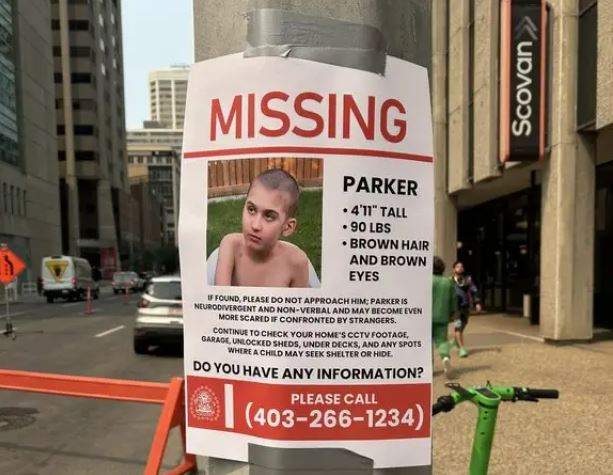
“You don’t want to yell. You don’t want to get into their personal space,” she said.
Instead, she suggests using a few simple words, introducing yourself and reassuring the child that you are there to help.

Get breaking National news
“Fewer words are better. You can say, ‘Hi, my name is Cassandra. I’m here to help,’ and keep it at that.”
If possible, she said, start by identifying a child’s special interest — it could be Disney, trains or another favourite topic — to help establish a connection while first responders are on the way.
Just as important, Rasko said there are things well-meaning bystanders should avoid doing. Yelling, touching the child, crowding their personal space and asking too many questions can become overwhelming and may cause the child to flee or hide.
“You don’t want sensory overload because then that could cause the opposite reaction of what you want,” she explained.
Rasko said increasing public understanding of autism can help ensure bystanders respond in ways that support rather than overwhelm a child in distress.


The tragedy has also led many Albertans to seek a better understanding of autism.
Rasko said organizations such as Autism Edmonton, Autism Calgary and Autism Society Alberta offer educational resources, webinars and community programs for families and the public.
She noted that autism has a prevalence rate of one in 44 across Canada, and that with diagnosis wait times often stretching two to three years, the true number may be even higher.
Rasko said the overwhelming community response during the search demonstrated how much people wanted to help.
“Once the community knew what to do, it was incredible, the support and care that was in Calgary,” she said.
Beyond education, Autism Edmonton provides front-line navigation services for families following a diagnosis, helps connect them with available supports and operates a low-sensory pantry program for those experiencing food insecurity.
Rasko also voiced support for a proposed alert system for vulnerable children, sometimes referred to as an Indigo Alert.
She said any future legislation should be shaped not only by advocates and first responders, but also by the families who live these experiences every day.
“Ensuring that the right people are at the table … but most importantly the families that this affects, so that their voices are heard.”
Rasko encouraged Albertans to continue learning about autism and to support organizations working with neurodivergent individuals, saying greater awareness can help communities respond more effectively when vulnerable children go missing.


This is a sad outcome, but I think it was nature just taking its course. Nobody is to blame, but there are people who will alway look to vilify someone.
@Barbara Munday, I was going to propose exactly the same, some sort of a wearable tracker.
Frankly, I have no idea how to handle autistic children, so I sympathize with the parents as well as the daycare this kid wandered out and away from. But there’s gotta be some foolproof solution, you can’t just rely on a member of the public to find the kid. Obviously, sometimes this ends in tragedy but, with a tracker, it could have been avoided.
Here’s the thing if you can’t parent your child don’t expect society to do it for you. Calgary police should charge the parents with negligence causing death. Problem solved.
We could start with the reason he went missing. The day care. These people should be subjected to his same perkl. Good thing im not in charge or they would be made to crawl until tired then just leave em there. Justice.
Yawn……This story is old news
If I were a parent of such a child or adult, I would have then wear a bracelet with a tracking feature so i would know where they were at all times….great idea I think.
But How We Can’t Even Protect Children That Are In There Own Homes (safe place) And It’s
Getting Worse 4 All Children From Parents Relatives Not Predators.. If A Kid With What Parker Has If Lost Or Terrified Will Sometimes Sit Crossed Legged And Fiddle With The Shoes And Or Laces Or There Head Gear If He’s Fiddling With It A Cartoon Character Asks Gently If There Okay Attention Span Is Very Important My Love And Condolences Go Out 2 Parkers Family And Everyone Who Is Feeling This Tragedy..
Such a tragedy. Condolences to the parents. RIP Parker.
The care home messed up. I doubt they followed any of the protocols or standards put in place. They need to be held accountable and we don’t have to re-engineer society instead. Blame needs to be laid and sanction handed out.
GPS trackers are readily available.
There must be some way to use this tragedy to bring more socialist governance down upon the peasants of Canada.
Also we need to find someone(s) to punish for this terrible event. A nice ‘juicy’ white male would be preferable.
A friend of mine put s GPS tracker on a pendant for his mother with dementia. If she managed to wander away they used their phone to go get her.
I don’t care for how Carney has made this political and using it for his own cynical advantage.
Nothing needs to be done. The kid ran away on his own. Decisions have consequences.
Cons are disgusting bunch for making this political. No surprised there.
We can all respect the grief, mourning, and unimaginable loss Parker’s family is experiencing. But at some point, we also need answers.
Parker was a vulnerable, non verbal autistic child. Typical supervision standards for autistic children require close, active monitoring, secure environments, individualized safety plans, and trained caregivers.
Why is there no information about the day home responsible for his care?
Were proper supervision protocols in place? Were autism specific safety measures followed? Was the caregiver trained and licensed to support a child with Parker’s needs?
These are not accusations — they are necessary questions.
Accountability and transparency matter, especially when a vulnerable child wanders from a care setting and loses his life.
The community deserves to know whether systemic failures occurred, and what steps will be taken to ensure this never happens again.
Where were Parker’s parents???
Didn’t they scream over to Parker’s day home and start looking?
Why didn’t they place a tracker on him???
The responsibility of vulnerable persons/children lie squarely on the caregivers and parents
They alone failed Parker,not the public
It’s heartbreaking that Parker was able to leave the day home unnoticed, and it raises serious questions about who was responsible for supervising him at that moment. A non verbal autistic child requires constant, direct supervision, especially in a home based daycare setting. The day home operator — whoever that was — had a duty to ensure doors were secured, transitions were monitored, and vulnerable children were never left unsupervised. Until investigators release more details, we don’t know exactly what went wrong, but it’s clear that the person responsible for Parker’s care failed to notice he had wandered off. That gap in supervision cost a child his life, and the public deserves answers about how it happened and who was accountable.
The Federal Liberals have culpability here as they have been shortchanging there fair share of health care costs to the Provinces
Ben. Sorry you don’t get to take the high road considering your posts on other threads. Total hypocrisy.
Suprised Carney regime didn’t offer MAID.
Some of the comments are deplorable. Using a child’s death to score political points or to mock is just totally wrong and unacceptable. The grieving family does not deserve this.
Canada always like to talk about misery. Seems to be a socialist thing. Carney can tweet hopes and prayers and score cheap political points.
Um why is the day home not being investigated????? A child under professional day care was able to escape???? What the hell
” ways to protect vulnerable children”
Air tags or ‘chips’ could be used on ‘special needs’ people.
It would probably save someone who is not mentally able to be independent.
So tired about hearing of this.
Protecting vulnerable people is the obligation of all.
Dave thinks that caring about vulnerable people is exploitation. Wow!
Hector comes out making his best effort to be the worst today to post a comment.
Total nothing burger story. Kid ran away and put himself in a heap of trouble on his own.
Low lifes exploiting the death of a child in order to further their own agenda