


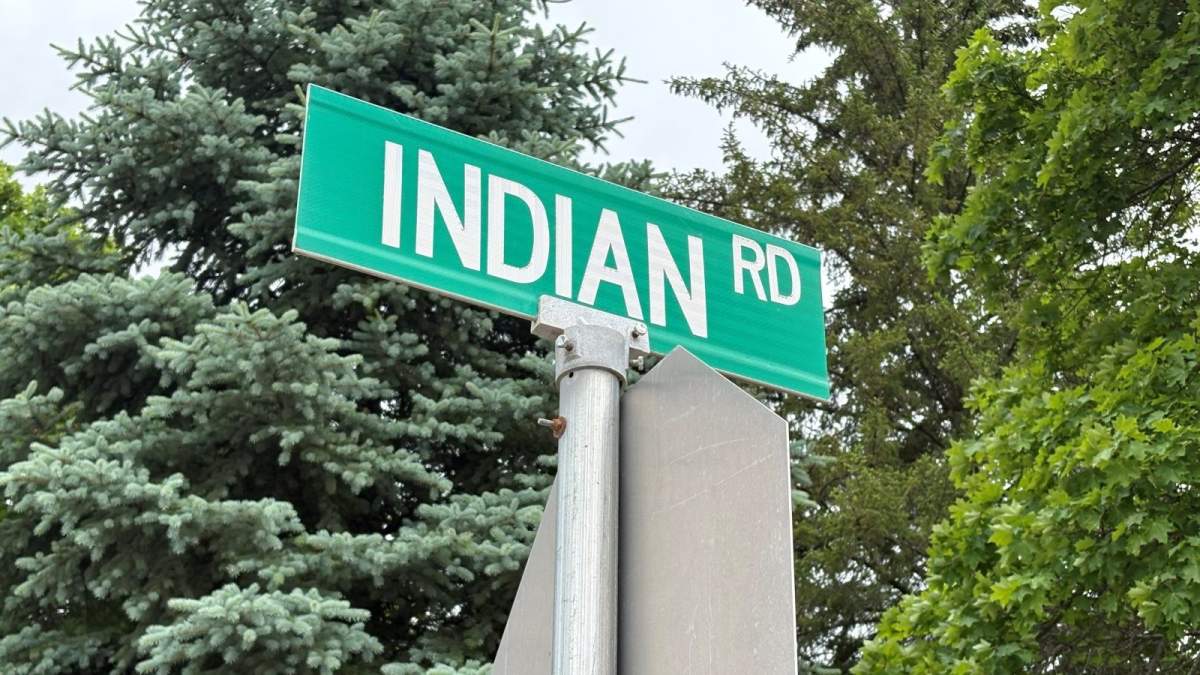
Kingston city council is getting set to vote on the renaming of a road with a controversial name, but many of those who live on the street say the change is unnecessary and not worth the time or money.

Out of 50 residents who responded to a survey on potential new names for Indian Road, 27 rejected all of the options.
“I, as are my family, are opposed to the proposition to change the name of Indian Road,” one person wrote in their survey comments that have been made public in a staff report to council.
Other residents shared concerns about the logistical process required to update official documents, personal connections to the street and questioned the need to change the name altogether.
“This entire process is a colossal waste of money and an embarrassment to democracy,” another resident wrote.
Other residents were more in favour of the idea.
“I am so happy that this is finally happening,” one wrote. “Many of the residents on this street are very unhappy with a street name that is perceived as an outdated and derogatory colonial reference to the Indigenous people of Canada. This is one of many steps we all must take towards true reconciliation.”
In June 2025, council directed city staff to initiate a name change process for Indian Road, Indian Park and Parkettes. Staff were directed to engage with residents affected by the name change, Indigenous service organizations and Indigenous Nations with a relationship to the land in question.

Get breaking National news
There are approximately 62 residential addresses on Indian Road. The city has said all will be compensated if a name change goes ahead.
Coun. Gregory Ridge, who brought forward the initial motion, told Global News that he empathizes with the residents of Indian Road and hears their frustrations.
“Council also has a responsibility to consider the broader context of why renaming the road has been proposed,” he added.
The issue is a complex one, according to Cody Groat, an assistant professor of history and Indigenous studies at Western University and a Kanyen’kehaka citizen.
“I think that it’s not always a given that, say, the term ‘Indian’ is understood as being derogatory,” he said. “But I think there’s definitely value in revisiting a term that is now outdated, I would say is perhaps a better term, and recognizing that there are ways to incorporate Indigenous language in a really positive way.”
Ridge said the name change is being considered because use of the word ‘Indian’ stands in violation of the city’s street names bylaw.
“While we cannot undo the harms of the past, I hope we can move forward thoughtfully, address this issue, and support residents through the transition,” he told Global News.
Groat said for a reconciliatory process to move forward, local Indigenous groups need to be the primary people consulted.
He alluded to an informal survey undertaken by another Kingston councillor who went door to door to ask residents about the name change, an act he said was “frustrating.”
- Saskatoon Tribal Council inks $269M federal contract for child and family services
- Ottawa considering ‘options’ as foreign home buyer ban nears end: minister
- Defence minister delivers pro-Canada message in Alberta, highlights $8B in funding
- Don’t target all students for possible OSAP misuse at a few schools, association says


“I would argue that their level of being impacted by living on the street is different than, say, the community members who are Indigenous, who are seeing this name and understanding it to be something that personally impacts them,” he said.
Groat said there has been an increasing move by all forms of government and organizations to reconsider place names since the final report of the Truth and Reconciliation Commission was published in 2015. One prominent name change being Toronto Metropolitan University (formerly Ryerson University).
But he said colonial names are not only harmful to Indigenous communities and noted that many place names could cause emotive reactions.
“When we look at names that need to be changed, I think there is value in having community members express their opinion and if it is a name that needs to be changed because there is that personal lived experience and it’s coming across as something that’s personally emotive and personally significant because of their cultural or racial background, I think those need to take priority.”
Kingston is currently considering four Ojibway names: Aki (earth/land/ground), Binesi (large bird), Nookomis (grandmother) and Odamino (to play). Groat noted that Kingston also has a large presence of Haudenosaunee people.
Groat said choosing to rename a street or a place in an Indigenous language is an excellent opportunity to bring forth traditional ways of knowing and people’s relationships to the earth.
“I think if people are arguing that the word Indian road was commemorative, was honorary before speaking to a relationship that existed speaking to Indigenous histories, well those histories can still be interpreted and reflected and celebrated by making this change in a positive way,” he said.
Toronto, Mississauga and Kitchener, along with many smaller Ontario communities, also have streets containing the word Indian. Kitchener city council has reviewed the name but has yet to change it.
The vote will take place at the next Kingston city council meeting on Tuesday.


Leave it as is……
With all the immigrants Trudeau let in they might like it.
I don’t understand being against the name change, call it Road #578 for all I care. “Waste of money”? Go ahead and enumerate the costs, Mister accountant. We’re all very interested.
Ass linking council. Must be an election year.
Vote them all oit
A waste of my taxpayers dollars! Vote Mayor Patterson out!
This “political correctness” thing is way out of hand now. It’s just a way for getting paid for doing nothing of any real value. The reference to ‘Indian’ was originally a nod to India, the country, not to putting people down, etc.
In fact, when I hear a reference to, say, “Indian summer”, that has an immediately comforting impact on my thought processes. What could possibly be wrong about that?
This has gotten to be way out of hand …
With all the serious issues this country is facing ,please stop this craziness.
Imagine the wokeness that has to be in place for this to even be a topic that matters. Stop wasting money.
Are Indians not still called Indians under the Indian act?
Call it” white man road”
Ever thought maybe they are proud of it? You people need lives. This cancel culture garbage is what is actually hurting these cultures. Grow up.
They are still called Indian reservations here in Alberta and what about Indian motorcycles?
Idiots wasting tax dollars