

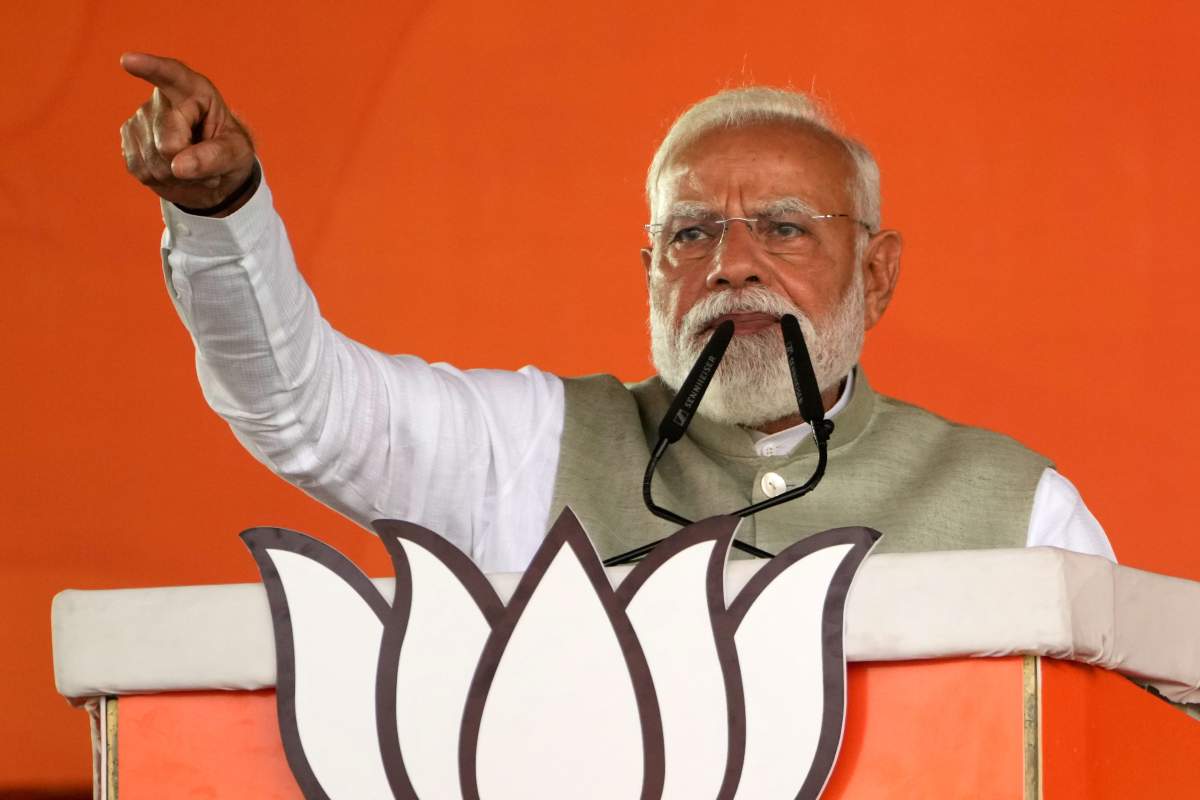
A bill to reserve a third of seats for women lawmakers failed to pass in the lower house of India’s Parliament on Friday, along with a separate, linked proposal to expand the national legislature by redrawing voting boundaries.

The measure was seen as one of the most significant changes to India’s political system since independence from British colonial rule in 1947, but fell short after two days of debate involving both government and opposition lawmakers.
It sought to mandate implementation of 33 per cent representation for women in Parliament and state legislatures, a move aimed at increasing female participation in a system where women remain underrepresented.
However, the quota was tied to a contentious plan to redraw voting boundaries across India, which became a major sticking point.

While there was broad cross-party support for increasing women’s representation, opposition parties warned that redrawing voting boundaries and expanding the size of Parliament could shift the political balance in favor of Prime Minister Narendra Modi ’s ruling Bharatiya Janata Party.
Both bills were introduced by Modi’s government during a three-day special session of Parliament that began Thursday and required approval by two-thirds of lawmakers.

Get breaking National news
The legislation tied to the women’s quota fell short of that threshold, and the government later withdrew the delimitation proposal.
The delimitation exercise, if passed, would have increased the number of seats in the lower house from 543 to about 850 by the time of the next parliamentary elections due in 2029.
Major opposition groups had resisted the bill, warning that basing constituencies on population data taken from the 2011 census could shift political power toward faster-growing northern states while reducing the representation, seat share, and influence of southern regions.


They also argued the changes could benefit Modi’s party, which enjoys strong support in the north.
The government rejected these concerns, saying the plan would include a uniform 50 per cent increase in seats across all states to preserve proportional representation nationwide.

However, critics noted that the draft legislation did not explicitly guarantee this.
Hours before the bills were set to be taken up for a vote, Modi said on X that the government had addressed all concerns and “misconceptions surrounding the legislation with facts and logic.”
But opposition leaders remained unconvinced. Rahul Gandhi of the Congress party described the move as “an attempt to change the electoral map of India.”


This is what happens when all the Canadian news network hire jihadists/anti-India propagandists – biased articles & anti India propaganda. Shame I’m Global TV….I am a Canadian, BTW, even though I was born on a.very small island half a world away!
This propagandist jihadi writer of this article sheikh saaliq and many more like him are reason, hardly anyone trusts golbeandnews. They will not stop until this news network is completely destroyed. Hahahaha
How the hell it was in his party’s favour id it was a bill for women reservation meant for all political parties and elections in India. Biased and false journalism and propagandist writer of this article sheikh saaliq. No wonder golbeandnews is fast losing its credibility.
The headline is an official press release or your reporter Sheikh Saaliq’s biased view? The issue is India’s majority politicians voted not to to allow 31% reservation for women in the legislative assembly. The re-mapping was a plea attached to the women’s reservation bill. This report mentions it one-sentence in the middle of this article.
But is quick to judge- that India’s ruling party leader bid it for political gains.
Majority of Inida’s population is in the north Indian states so whats wrong if there are more representatives from there?
This is the headline- the main news (and not what your reporter thinks about Modi’s tactics)-‘A bill to reserve a third of seats for women lawmakers failed to pass in the lower house of India’s Parliament on Friday.’
Shame on the lazy editor who cant even read an article before publishing it.