

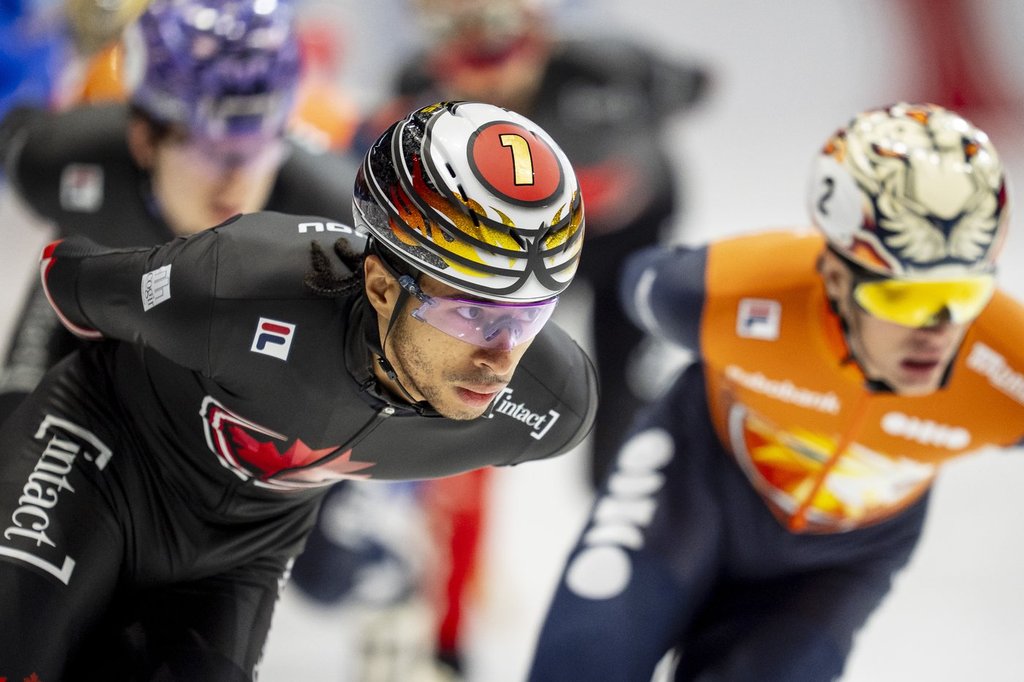
MILAN – William Dandjinou is the best short-track speedskater in the world — one who could become Canada’s star of the Milan Cortina Olympic Games.

And he’s fuelled by a dream of inspiring millions of new fans to cheer on his sport.
“It’s goosebumps, man,” Dandjinou said. “The opportunity that it represents for me to push my sport forward and actually showcase what short-track can be, that’s just amazing.”
Over the past two seasons, Dandjinou has taken the short-track World Tour by storm, winning back-to-back Crystal Globes as the overall leader. In his past 30 races, the 24-year-old from Montreal has reached the podium 19 times — climbing to the top step on 15 occasions.
It’s a run so impressive that even Canada’s most decorated short-track athlete believes Dandjinou is on a trajectory to become “the greatest.”
“He’s probably, in his young career on the world circuit, the best skater in Canada — ever,” Charles Hamelin said.
Hamelin retired in 2022 with six Olympic and 42 world championship medals, following in the footsteps of current national team coach Marc Gagnon — a five-time medallist at the Games.
But in Dandjinou, Hamelin sees something unprecedented in the sport.
Hamelin is impressed by Dandjinou’s speed — “the fastest skater in every sense” — add to that the young skater’s intelligence and winning mindset. Dandjinou is so strong, Hamelin said, that he strikes fear into his opponents, making them doubt themselves.
“He is the kind of skater that scares everyone else on the ice,” Hamelin said. “Makes people do mistakes … because they know that Will will either block them or outpunch them.”
Dandjinou will compete in the 500, 1,000 and 1,500-metre events, along with the men’s and mixed relays, with short-track competition running Tuesday through Feb. 20 at Milano Ice Skating Arena.
Hamelin won’t be surprised if Dandijinou goes five-for-five.
“I truly believe he can,” Hamelin said. “Sometimes you’re like, ‘Maybe two, one for sure.’ No, he can legit win five medals, and I would not be in shock. He’s that good.”
Yet despite being “that good,” many Canadians watching from home will be hearing Dandjinou’s name for the first time.

-
![]() Milano-Cortina Olympics: Team Canada to take on U.S. for men’s hockey gold medal
Milano-Cortina Olympics: Team Canada to take on U.S. for men’s hockey gold medal -
![]() Edmontonians flock to bars to cheer on Team Canada Men’s Hockey
Edmontonians flock to bars to cheer on Team Canada Men’s Hockey -
![]() ‘Everybody had a shot’: Canadian women’s speedskating team humble in gold medal win
‘Everybody had a shot’: Canadian women’s speedskating team humble in gold medal win -
![]() ‘You have to be confident’: Canada’s Grondin speaks silver medal win in Men’s Snowboard Cross
‘You have to be confident’: Canada’s Grondin speaks silver medal win in Men’s Snowboard Cross -
![]() Canadian skier Kingsbury ‘very happy’ with silver medal win in Olympic Men’s Moguls
Canadian skier Kingsbury ‘very happy’ with silver medal win in Olympic Men’s Moguls -
![]() Canada wins silver in short-track speedskating mixed team relay
Canada wins silver in short-track speedskating mixed team relay -
![]() Winter Olympics 2026: Canada’s Megan Oldham wins bronze in women’s freeski slopestyle
Winter Olympics 2026: Canada’s Megan Oldham wins bronze in women’s freeski slopestyle -
![]() Team USA Olympians, protesters speak out against ICE presence in Milan
Team USA Olympians, protesters speak out against ICE presence in Milan -
![]() What to expect from the Milano-Cortina Olympics
What to expect from the Milano-Cortina Olympics -
![]() Canadian Olympic snowboarder, medal hopeful Mark McMorris suffers ‘heavy crash’ in training
Canadian Olympic snowboarder, medal hopeful Mark McMorris suffers ‘heavy crash’ in training


It’s a frustrating reality for those competing in what’s seen as a niche sport, but he sees untapped potential — and is convinced that once people tune in on TV, they’ll be hooked.
“The speed, the unpredictable nature,” Dandjinou said of short track’s appeal. “When you put all the pieces of the puzzle together, I see a picture where our sport could be one of the most-watched in the world.”

Get daily National news
He likens short-track speedskaters to Formula One drivers.
“We’re addicted to speed,” Dandjinou said.
But unlike Max Verstappen and Lewis Hamilton, he generates his own velocity rather than relying on a multimillion-dollar engine.
“It’s the fastest sport that’s human propulsion,” said Dandjinou, who graduated from CEGEP in sciences and eventually plans to pursue law. “You have biking, but biking has a mechanism, so it’s the fastest sport that doesn’t require any mechanical devices, which is pretty cool, right?”
He imagines a future where short track adopts a semi-professional model, with leagues and outside-the-box events — similar to the NHL’s outdoor games — to draw more eyeballs. He even believes sports betting, something he’s admittedly unsure about, could thrive because of the sport’s inherent unpredictability.
“He would like for the sport to be bigger and for the athlete to be more recognized,” said coach Gagnon. “That is a big challenge … but it’s good that he wants to try because it means that he’s not thinking only about himself, but about the sport and all the athletes in it.”
Dandjinou is doing his part to stand out.
He’s a striking figure, wearing his hair in cornrows and standing six-foot-three, towering above his competition in a sport typically dominated by compact athletes.
His height poses its disadvantages — smaller skaters have an easier time weaving into impossibly tight gaps to pass opponents, and poor ice quality can deteriorate under his heavier frame — but Dandjinou compares it to being a lefty in tennis.
“People are not used to it,” he said. “You can use angles differently … I can use my track patterns to block people a lot easier if I’m able to use my long legs, and it gets really dangerous for others because I can keep up the speed longer.”
He also isn’t shy about revealing his personality, celebrating wins with a patented bird-flapping move he’s turned into a brand, complete with a logo and merchandise.
“I have some cool ideas that I’m going to try to implement during the Games that I feel like are going to get people excited about my events, but also the sport,” he said. “Stay tuned!”


Dandjinou’s popularity has spiked in other countries, particularly China, where he can communicate with fans because he speaks Mandarin.
His mother, Mirabelle Kelly, discovered tributes from the Chinese skating community on Little Red Book, a social media platform, where fans call him “Brother Bird” for his signature celebration.
“Someone called him Dapeng, which is like a mystical bird in Chinese mythology,” Kelly said. “I found it beautiful that a fan in China would see that in him and use that symbolism.”
Still, Dandjinou arrives in Italy as an Olympic rookie after watching the Beijing Games from home four years ago, devastated to fall one spot short of cracking Canada’s roster.
The disappointment pushed him to the brink of quitting. Instead, he came back determined to become the best.
“That was also a good lesson on many levels,” Gagnon said. “When you think you’re somewhere, maybe you haven’t reached that level yet, and you need to keep working.
“Will has learned that. He’s never sitting on his laurels … If you talk to him about his success and the fact that he’s the strongest skater in the world, he will probably not even admit that.”
Dandjinou has come so far since his mother and father — two microbiologists who met at university in Sherbrooke, Que. — dragged him around the rink on double-bladed skates when he was just one year old.
His father, Alain Dandjinou, wasn’t familiar with winter sports when he immigrated from the Ivory Coast, but he wanted his son to take part in the activities during Canada’s coldest season.
Dandjinou began playing hockey at age three in Montreal’s La Petite-Patrie neighbourhood before picking up short-track speedskating a couple of years later at a club in the nearby Saint-Michel borough.
Around the same time, he remembers finding a role model in African-American long-track star Shani Davis and drawing inspiration from U.S. short-track legend Apolo Ohno while watching the 2006 Turin Olympics.
Twenty years later, he leads Canada — historically a short-track powerhouse — into the Milan Games.
Gagnon said the current group is the best he’s seen in 30 years. Beyond Dandjinou, the team boasts multi-Olympic medallists Kim Boutin and Steven Dubois, and women’s Crystal Globe winner Courtney Sarault.
With the contenders in all nine events, Gagnon set an objective of breaking the country’s record of six medals at a single Games.
Dandjinou knows the pressure is high — and he won’t shy away from them with the world watching.
“The fact that four years ago I didn’t even qualify for the Games and now I’m in a position where I can have the weight of the world on my shoulders is pretty cool, actually,” he said. “I’ve been working, I say four years, but basically my whole life for moments like these.
“I just hope I can showcase how much short track is cool in those moments.”
— With files from Donna Spencer.
This report by The Canadian Press was first published Feb. 9, 2026.


Comments
Want to discuss? Please read our Commenting Policy first.