

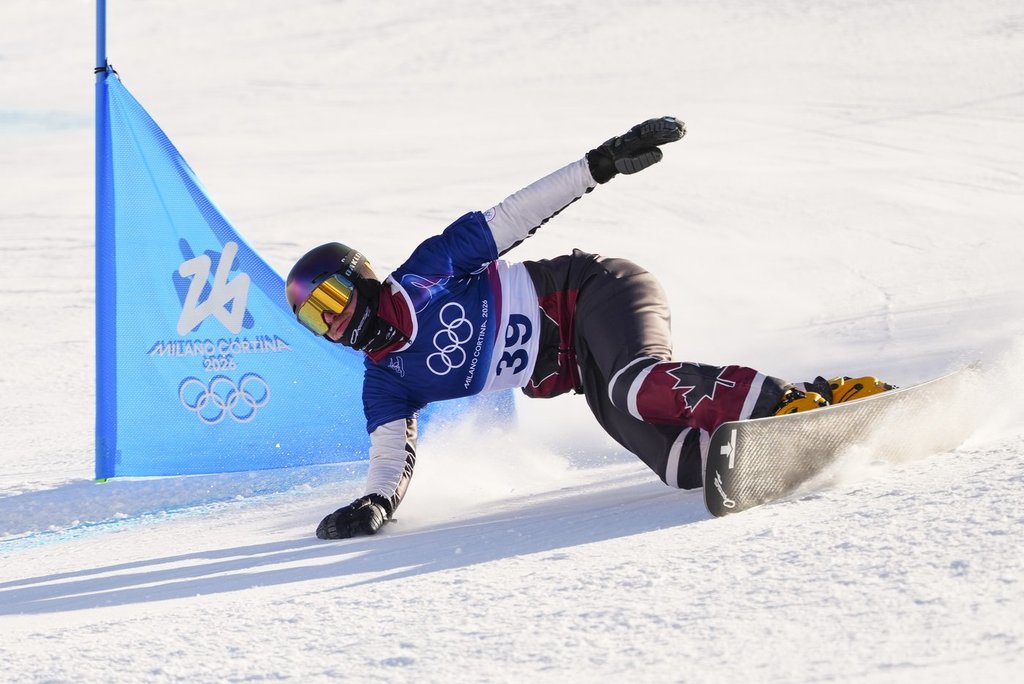
LIVIGNO – There was heartbreak Sunday for Canadian snowboarder Arnaud Gaudet, who missed out on the parallel giant slalom semifinal by three-hundredths of a second to Bulgarian Tervel Zamfirov at the Milan Cortina Olympics.

So little time. So much pain.
“Losing by this little, it hurts for sure,” said the 25-year-old from Montcalm, Que., the raw emotion still evident. “I guess I’m still happy with my riding today. It’s coming.”
Had time been in his favour, Gaudet would have been one race away from a shot at a medal.
Austria’s Benjamin Karl went on to defend his Olympic title, defeating South Korean Sangkyum Kim in the big final on a picture-perfect sunny day at the Livigno Snow Park. Karl celebrated by doffing his shirt and flexing before falling bare-chested, into the snow.
The 40-year-old Austrian, competing in his fifth Olympics, also has a silver in PGS from the 2010 games in Vancouver and a bronze in parallel slalom from 2014 in Sochi.
Zamfirov took bronze, edging 2022 silver medallist Tim Mastnak of Slovenia in a photo finish.
Czechia’s Zuzana Maderova was the surprise winner on the women’s side, dispatching Austria’s Sabine Payer in convincing fashion. The 22-year-old Maderova, who has yet to record a World Cup victory, won by 0.83 seconds.
Payer had upset two-time defending champion Ester Ledecka of Czechia by 0.06 seconds in the quarterfinal.
Italy’s Lucia Dalmasso collected the bronze.

-
![]() Milano-Cortina Olympics: Team Canada to take on U.S. for men’s hockey gold medal
Milano-Cortina Olympics: Team Canada to take on U.S. for men’s hockey gold medal -
![]() Edmontonians flock to bars to cheer on Team Canada Men’s Hockey
Edmontonians flock to bars to cheer on Team Canada Men’s Hockey -
![]() ‘Everybody had a shot’: Canadian women’s speedskating team humble in gold medal win
‘Everybody had a shot’: Canadian women’s speedskating team humble in gold medal win -
![]() ‘You have to be confident’: Canada’s Grondin speaks silver medal win in Men’s Snowboard Cross
‘You have to be confident’: Canada’s Grondin speaks silver medal win in Men’s Snowboard Cross -
![]() Canadian skier Kingsbury ‘very happy’ with silver medal win in Olympic Men’s Moguls
Canadian skier Kingsbury ‘very happy’ with silver medal win in Olympic Men’s Moguls -
![]() Canada wins silver in short-track speedskating mixed team relay
Canada wins silver in short-track speedskating mixed team relay -
![]() Winter Olympics 2026: Canada’s Megan Oldham wins bronze in women’s freeski slopestyle
Winter Olympics 2026: Canada’s Megan Oldham wins bronze in women’s freeski slopestyle -
![]() Team USA Olympians, protesters speak out against ICE presence in Milan
Team USA Olympians, protesters speak out against ICE presence in Milan -
![]() What to expect from the Milano-Cortina Olympics
What to expect from the Milano-Cortina Olympics -
![]() Canadian Olympic snowboarder, medal hopeful Mark McMorris suffers ‘heavy crash’ in training
Canadian Olympic snowboarder, medal hopeful Mark McMorris suffers ‘heavy crash’ in training


Ledecka is the only woman to earn gold in two different sports at the same games, having won the alpine super-G in 2018 in addition to her snowboard title. In Italy. she had to choose between the PGS and the alpine downhill, which were contested the same day.
Ledecka, who is scheduled to race in Thursday’s super-G, focused on her skis rather than her snowboard this season, winning the lone snowboard event she entered prior to the games.

Get daily National news
The 30-year-old had her own cheering section in the crowd, with signs reading “2 Sports, 1 Queen” and “Ester the Bester.”
Parallel giant slalom sees two snowboarders ride down two parallel tracks at the same time. The 635-metre Livigno course featured a vertical drop of 170 metres with 32 gates and 30 turns.
With runs lasting under 50 seconds and a rapid-fire elimination format, the competition goes fast.
There is next-to-no time between races with Olympic organizers ratcheting up the tension with an ever-speeding heartbeat playing on the PA system before each start. Music blared as the riders raced down the hill, slicing around gates at an impossible angle like a MotoGP racer on a board.
During the qualifiers, each competitor rides down the two tracks (blue and red) once. Their times are combined and the 16 best advance to the elimination rounds where the riders go head to head with the top-ranked competitor facing the 16th and so on.
The discipline is competing for its life at these Olympics, given it is under review by the International Olympic Committee ahead of the 2030 games in France. Snowboarders have responded with a social media campaign with the hashtag #keepPGSolympic.


It has been part of the Olympic program since 1998 when snowboarding was first added. Canadian Jasey-Jay Anderson won PGS gold in Vancouver in 2010.
Gaudet, who works as a lumberjack and on a maple farm in the summer in Quebec, put aside his emotions to make a passionate defence of the sport.
“This is where snowboarding started,” he said. “It started with ski boots and carving. They should keep PGS, they should add parallel slalom … I don’t see why you would get rid of events, of sports. Because that would pretty much kill the sport. Because everything is based around the Olympics.
“They would never think of removing giant slalom in skiing,” he added. “So I don’t see why people would even think of removing it in snowboarding.”
PGS is arguably the least physically demanding snowboard discipline, however, and the Olympic field was filled with veteran riders including 52-year-old Austrian Claudia Riegler, a six-time Olympian who made her debut at the 2022 games.
Ledecka ousted Riegler in the first round of elimination races, the 1/8 final. Kim, meanwhile, dispatched 45-year-old Italian Roland Fischnaller a seven-time Olympian, in the quarterfinals.
Gaudet arrived in good form, having finished second in Bansko, Bulgaria, for his first career PGS World Cup podium. He also competes in the parallel slalom and team parallel slalom, which are not on the Olympic program.
“I know I’m one of the top guys and I can fight for podiums every race,” he said.
Canadians Aurelie Moisan and Kaylie Buck were eliminated in the 1/8 finals.
Moisan, 21-year-old from Baie-D’Urfe, lost to Poland’s Aleksandra Krtol-Walas, a bronze medallist at the 2025 world championships, while Buck, a 25-year-old from Oakville, Ont., was beaten by former world champion Tsubaki Miki of Japan.
Toronto’s Ben Heldman, a 24-year-old from Toronto, did not advance to the knockout rounds, finishing 26th in the elimination round.
—
This report by The Canadian Press was first published Feb. 8, 2026.


Comments
Want to discuss? Please read our Commenting Policy first.